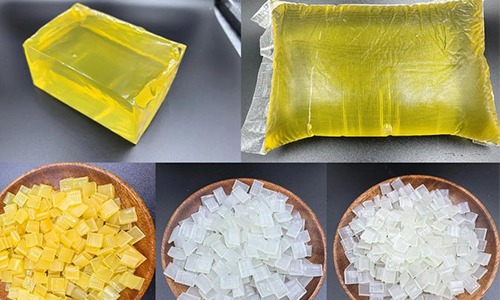
High-temperature Hot Melt Adhesives are primarily based on polyamide resin, hence they are also known as polyamide hot melt adhesives.
Polyamide resin is a linear thermoplastic resin with numerous repeating amide groups on its molecular main chain. Compared with other thermoplastic resins, it has a distinctive feature: both melting and solidification occur within a narrow temperature range when heated and cooled. This characteristic enables polyamide hot melt adhesives to cure rapidly upon slight cooling after being heated, melted and applied during construction; it also allows them to maintain good bonding performance even at temperatures close to their softening point.
High-temperature hot melt adhesives are mainly produced by the direct copolymerization of polyamide resin from dibasic acids and diamines, followed by modification, pulverization and other processes. The production does not involve nitrilation, hydrogenation, neutralization or other procedures, which simplifies the production process and equipment requirements for high-temperature hot melt adhesives. The production of high-temperature hot melt adhesive sticks features easy control of raw material costs, convenient and precise process control, thus ensuring stable product quality. High-temperature hot melt adhesives offer excellent bonding performance, high softening points, convenient storage and easy popularization and application.
Low-Temperature Hot Melt Adhesives
Before the emergence of low-temperature hot melt adhesives, a chemical called "gangbao" (shoe stiffener) served similar purposes, used in the production of mattresses, sanitary napkins, diapers and other products. However, with industrial development, improved living standards and enhanced public awareness, people now pursue eco-friendly and durable products, while manufacturers also prioritize production efficiency. This has driven the development of hot melt adhesive products and the emergence of low-temperature hot melt adhesives.
Differences Between Low-Temperature Hot Melt Adhesives and Gangbao
Low-temperature hot melt adhesives deliver excellent shaping after cooling, offer waterproofing and extremely short curing times, boosting production efficiency. In contrast, gangbao may deform over time after shaping. For high-quality products, premium hot melt adhesives generally feature fast and strong bonding, aging resistance, heat and cold resistance, and good permeability. They also exhibit good compatibility with other additives, allowing the development of tailored hot melt adhesive products for different substrate materials, resulting in a wide range of applications across various industries.
Ultra-Low-Temperature Hot Melt Adhesive Films
Ultra-low-temperature hot melt adhesive films are characterized by easy molding, non-deformability after molding, exceptional elasticity, low operating temperatures and usability without additional equipment. Their adhesiveness remains unchanged after repeated use, and they do not stick to hands when heated and softened. As 100% eco-friendly products, ultra-low-temperature hot melt adhesive films are suitable for toe puffs and heel counters in high-end leather shoes, riding boots, women's shoes, sports shoes and other footwear.

 HOT LINE: 086-13967771389