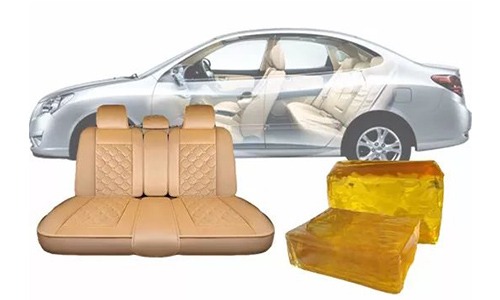
Driven by the growing emphasis on environmental protection and consumer demands for improved in-vehicle air quality, coupled with the fast-curing properties of Hot Melt Adhesives (HMAs), these eco-friendly adhesives have been widely adopted for bonding various automotive components during manufacturing, including headliners, door panels, carpets, wire harnesses, tire protection layers, labels, filters, headlights, and dashboard assemblies.
Bonding of PVC Headliners and Insulation Layers
Solvent-based adhesives were predominantly used for this application in the past, requiring large dosages. These adhesives are formulated by dissolving neoprene, nitrile butadiene rubber (NBR), and styrene-butadiene rubber (SBR) with tackifying resins in organic solvents. The bonding process necessitates ventilation to evaporate solvents, creating a harsh working environment and posing health risks to operators. In recent years, this traditional process has been replaced by HMA-based solutions such as hot melt adhesive films, powdered hot melt adhesives, and direct spray application of pressure-sensitive hot melt adhesives. These alternatives have significantly improved workplace conditions and comply with VOC (Volatile Organic Compound) regulations and in-vehicle air quality standards.
Lamination of Thermal and Acoustic Insulation Layers for Headliners and Other Body Parts
Hot melt adhesives, particularly synthetic rubber-based pressure-sensitive hot melt adhesives, are now extensively used for laminating thermal and acoustic insulation layers in automotive headliners and other body components. This type of HMA offers excellent low-temperature resistance, low odor, low VOC emissions, fast curing, and eco-friendly, non-toxic properties with no volatile substances. While it requires specialized hot melt adhesive spraying and application equipment, it enables precise, quantitative coating, meets production process requirements, and is compatible with automated manufacturing lines.
Bonding of Automotive Interior Trim Parts
Most automotive interior trim parts are made of non-metallic materials such as PVC, ABS films, sheets, panels, foam plastic boards, carpets, and wood-grain decorative panels. For low-stress interior trim components, hot melt adhesives are now the primary bonding solution. They are also used for bonding and positioning plastic sheet edging on door frames and decorative lining panels.
Welding and Sealing of Automotive Body Panels
Sealing of automotive body panels occurs in the later stages of vehicle assembly, demanding high construction quality. Especially for exterior body parts, adhesive seams are required to be as narrow and smooth as possible to ensure the vehicle's aesthetic appearance. Hot melt adhesives—typically polyolefin-based or PUR (polyurethane reactive) hot melt adhesives—have largely replaced two-component rubber adhesives for this application.
Applications in Automotive Wire Harnesses
Automotive electrical control circuits are organized into various wire harnesses, which are bundled and secured using harness tapes. Tapes for this application must exhibit flame retardancy, high bond strength, excellent aging resistance, and the ability to withstand a wide range of temperatures (both high and low). They must also prevent edge lifting after bundling and feature an unwinding force that aligns with automotive production process requirements. Hot melt adhesive-based tapes are the preferred choice for meeting these criteria.
Foamable Pressure-Sensitive Hot Melt Adhesives for Waterproof PP Films and Foam Boards in Car Door Panels
Every car door panel incorporates a waterproof PP (polypropylene) film or foam board to prevent water from entering the vehicle interior and causing component rust during rain or car washing. Traditionally, automotive assembly plants used butyl rubber-based sealing strips to bond these PP films/foam boards to the car body. In recent years, pressure-sensitive hot melt adhesives have been widely adopted in this field. SBC (styrene block copolymer)-based pressure-sensitive hot melt adhesives offer higher elasticity than butyl rubber-based sealing strips, allowing for easy and clean removal from the vehicle body surface during after-sales repair work while still achieving reliable waterproofing.
Bonding of Car Door Panels and Rubber Sealing Strips
A significant portion of this bonding work is performed via robotic automation using hot melt adhesives. The key performance requirements for this application include maintaining bond strength at extreme temperatures (-40°C and 108°C) and ensuring stable adhesive strength 24 hours after bonding. While specific standards vary among manufacturers, all are designed to simulate the real-world operating conditions of automobiles.
Automotive Tire Protection Adhesives
The automotive beauty industry offers a tire coating service using a specialized "anti-burst adhesive". Demonstrations are often conducted on-site: tires coated with this adhesive are mounted on vehicles and driven over a nail-studded board, with no tire blowouts or air leaks observed. This anti-burst adhesive is a type of hot melt adhesive formulated for tire protection.
Hot Melt Adhesives for Automotive Filters
Modern automobiles vary greatly in size, brand, and powertrain type (gasoline, diesel, liquefied petroleum gas, electric, etc.), and the filters used correspondently differ. A typical vehicle requires four types of filters: an engine air filter, cabin air filter, fuel filter, and oil filter. Filters are consumable parts and are typically replaced every 5,000 kilometers of vehicle operation. Multiple bonding points are required during filter manufacturing, and hot melt adhesives are used for the majority of these bonding processes. The type of HMA varies by filter application: PA (polyamide)-based hot melt adhesives are commonly used for oil and fuel filters, while air filters often utilize EVA, PA, or PO (polyolefin)-based hot melt adhesives.

 HOT LINE: 086-13967771389