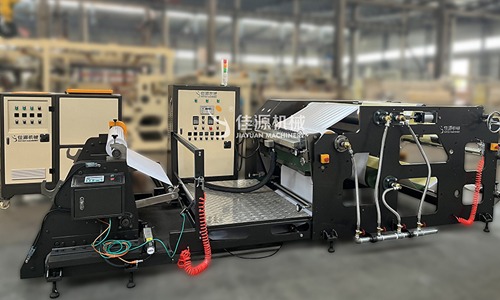
Q1: Which industries is it suitable for?
A: It is widely used in packaging (carton sealing, gift boxes), hygiene products (diapers, sanitary napkins), automotive interiors, furniture edge banding, labels and tapes, filter materials, medical protective clothing, and other industries.
Q2: What types of Hot Melt Adhesives can be coated?
A: Compatible with mainstream hot melts including EVA (Ethylene-Vinyl Acetate), PO (Polyolefin), PUR (Reactive Polyurethane), and APAO (Amorphous Polyolefin). Equipment parameters must be matched according to the melting point and viscosity of the adhesive.
Q3: Is the coating width and thickness customizable?
A: Yes. Coating width can be adjusted via adjustable doctor blades or die heads (e.g., 10 mm ~ 1000 mm). Thickness is controlled by precision metering pumps, blade gap adjustment, or roller pressure, with a typical range of 0.01 mm ~ 2 mm.
Q4: What is the operating speed?
A: Standard models feature a line speed of 5–150 m/min; high-speed models can exceed 300 m/min. Actual speed depends on adhesive viscosity, coating thickness, and substrate properties.
Q5: What is the temperature control range?
A: Standard temperature control ranges from ambient temperature to 200 °C. High-temperature models can reach 230 °C (suitable for PUR adhesives). Control accuracy is typically ±1–2 °C to ensure stable adhesive fluidity.
Q6: How is coating accuracy and uniformity guaranteed?
A: Ensured by the following technologies:
High-precision gear pump: output error ≤ ±1%;
Constant temperature system: eliminates viscosity fluctuations;
Distribution roller / doctor blade: ensures uniform coating;
Closed-loop tension control: prevents substrate wrinkling.
Q7: Is operation complicated? How many operators are required?
A: Modern models are equipped with a touch-screen PLC control system supporting parameter presetting and one‑key start/stop.
Regular production requires only 1 operator. Complex processes such as adhesive change or die replacement require 2 operators.
Q8: How to clean the equipment? What is the cleaning frequency?
A: Daily shutdown: Flush the glue tank and pipelines with special purging adhesive or hot melt cleaner;
Weekly / when changing adhesive: Disassemble nozzles and filters for soaking and cleaning;
Severe carbonization: Requires professional high-temperature decomposition cleaning.
Note: Avoid highly corrosive solvents!
Q9: How to prevent hot melt adhesive carbonization?
A: Key measures:
Precise temperature control: Avoid local overheating (equipped with multi-point temperature sensors);
Nitrogen protection system: Inject nitrogen into the glue tank to isolate oxygen;
Reduce adhesive residence time: Empty the tank if shutdown exceeds 30 minutes;
Regular cleaning: Remove carbon deposits and residues.
Q10: What to do if no adhesive is dispensed after startup?
A: Troubleshoot in the following order:
Temperature check: Ensure the tank, pipelines, and nozzle reach the set temperature;
Blockage check: Inspect filters and nozzles for clogging (clean with a needle);
Pump/valve inspection: Verify metering pump operation and solenoid valve opening;
Adhesive level: Refill to the safe working level.
Q11: How to extend the service life of the equipment?
A:Regular maintenance: Inspect heaters, sensors, and pump seals monthly;
Standardized operation: Avoid overloading; clean thoroughly before shutdown;
Use genuine consumables: Replace original filters and seals;
Environment control: Maintain a dry, low-dust working environment.
Q12: How to select the right model?
A: Based on the following factors:
Coating process: Dot coating, spray coating, roll coating, or knife coating?
Production requirements: Speed, accuracy, thickness range;
Adhesive type: EVA/PO/PUR require different temperature control systems;
Integration requirements: Whether to connect with production lines (communication protocols such as RS485)?
Q13: Can the machine be compatible with different types of hot melt adhesives?
A: Yes, provided that:
The equipment's temperature range covers the adhesive's melting point (e.g., PUR requires over 200 °C);
The adhesive path is thoroughly cleaned to avoid cross-contamination;
Corresponding components are replaced: high-viscosity adhesives require high-flow gear pumps.
Q14: Does it support multi‑purpose use on one machine?
A: Selected models support multi‑function switching via quick‑change die heads:
Same production run: Only adhesives with similar melting point and viscosity are allowed;
Different substrates: Must match the tension system (e.g., film vs. non-woven fabric).
Q15: How long does preheating take?
A: Approximately 20–40 minutes for cold start (depending on equipment power and ambient temperature). Insulated models or standby mode can shorten preheating to under 10 minutes.
Q16: How to precisely control coating thickness?
A: Using:
Servo-driven metering pump: adhesive volume accuracy ±0.5%;
Fine-adjustable blade gap: resolution 0.01 mm;
Online thickness detector (optional): real-time feedback and adjustment.
Q17: Does it support intermittent (breakpoint) coating?
A: Yes. Through PLC programming to control glue valve on/off, synchronized with conveyor positioning signals, achieving accurate breakpoint length (minimum interval down to 1 mm).
Q18: How to prevent nozzle clogging?
A: Mandatory cleaning after shutdown: Flush with purging adhesive/cleaner until no residue remains;
Nozzle insulation: Independent temperature control to prevent low-temperature solidification;
Dustproof protective cap: Cover the nozzle when not in use;
Use anti-drip nozzles.
Q19: Can it run continuously for a long time? How to prevent overheating?
A: Supports 24/7 continuous operation; industrial‑grade design life ≥ 50,000 hours.
Overheating protection:
Air/water cooling system for key components;
Automatic shutdown on abnormal temperature;
Zoned temperature control in the glue tank to reduce heat buildup.
Q20: Can it be integrated with a production line?
A: Yes. Support includes:
Physical docking: Custom frame to match line height and width;
Communication integration: Standard RS232/RS485, Ethernet, Modbus protocol supported;
Signal synchronization: Receives PLC start/stop and speed signals for synchronized control.
Q21: Is energy consumption high? Is there an energy-saving mode?
A: Power range: Small machines ~3–5 kW, large lines 10–20 kW.
Energy-saving features:
Insulation layers reduce heat loss (over 30% energy saving);
Automatic temperature reduction in standby mode;
Variable-frequency drive for pumps and fans.
Q22: Does it comply with environmental standards? Does it support eco-friendly adhesives?
A: Equipment standards: Complies with CE / RoHS electrical safety and environmental requirements;
Eco-adhesive compatible: Supports solvent-free hot melts, bio-based degradable adhesives (e.g., certain PO types);
VOC control: Closed glue tank + optional exhaust recovery system.

 HOT LINE: 086-13967771389