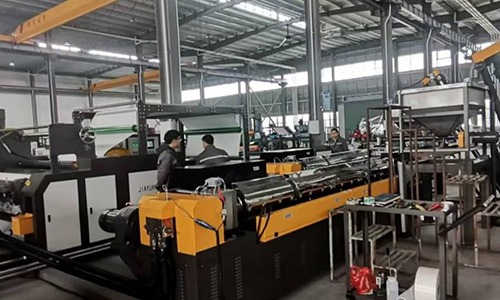
Within the industrial sealing sector, butyl sealant strips are widely adopted across construction, automotive, new energy and other key industries, valued for outstanding airtight performance, weather resistance and reliable adhesion.
Final product quality depends not only on raw material formulations and process development, but heavily on the capability of production machinery. As the core production unit, the butyl sealant strip coating machine oversees the full production sequence: extrusion, melting, coating, forming and rewinding. Its structural design and process precision directly govern the uniformity, long-term performance and output capacity of finished butyl strips.
Custom-built to match the unique properties of butyl rubber, dedicated butyl processing equipment operates on a clear workflow. Solid butyl compound is heated until molten, then pushed through an extrusion system under controlled pressure and evenly applied onto base materials. The coated material is cooled, set into shape, and finally wound into finished rolls.
Every stage demands balanced control over melt accuracy, extrusion stability, coating uniformity and continuous operation. Minor flaws in any process step will compromise the overall performance of the sealant strip.
A trusted specialist in coating machinery, Ruian Jiayuan Machinery Co., Ltd. has long-standing industry experience and in-depth understanding of butyl rubber's melting behavior, extrusion characteristics and coating requirements. Our tailor-built butyl sealant strip production lines are engineered to suit every stage of butyl processing, delivering steady, consistent quality for mass manufacturing.
The entire production line is built around five core functional units: melting, extrusion, coating, cooling and rewinding, all operating in seamless coordination.
The heating and melting unit transforms solid butyl rubber into a workable fluid state. Butyl compound is highly temperature-sensitive: prone to aging at excessive heat, low in fluidity at lower temperatures, and requiring steady viscosity once melted. Precise temperature regulation is therefore essential.
Effective heating ensures thorough melting and ideal fluidity, while preventing thermal degradation and material aging. Even heat distribution eliminates local overheating and incomplete melting. Jiayuan Machinery optimizes heating layouts and temperature control modules to maintain butyl rubber at its optimal working condition, creating stable conditions for extrusion and coating.
Positioned right after the melting section, the extrusion system delivers consistent, pressurized flow of molten butyl rubber, acting as a stable material supply for uniform coating.
Extrusion pressure must be finely calibrated. Too much pressure causes overflow and over-coating, while insufficient pressure leads to unstable output and uneven application. Adjustable pressure settings allow operators to adapt to varying rubber viscosity and product sizes, ensuring continuous output with no material blockage or overflow.
We have refined screw designs and pressure regulation components to boost extrusion stability, perfectly matching material supply with coating speed for accurate, consistent results.
The coating system defines final strip dimensions and surface finish, with high-precision die heads working alongside pressure and speed controls. Coating dies accurately regulate coating thickness and width, delivering smooth, even coverage free from gaps, overflow or uneven edges.
Dies are fully adjustable to accommodate custom sizes, with highly polished surfaces to reduce material buildup and ensure uniform results across production batches. Our die head design is engineered around butyl rubber's flow properties, maximizing the sealing and bonding advantages of finished strips.
The conveying system runs through the entire line, maintaining steady, wrinkle-free transport of base materials. Conveyor speed must be fully synchronized with extrusion and coating speed. Misalignment or unstable movement will cause uneven coating and positioning errors, lowering overall yield rates.
Our conveying solution offers stable speed control and precise material positioning, suitable for films, textiles, metal sheets and various roll-fed substrates — a key marker of professional industrial equipment design.
The cooling and forming section solidifies freshly coated butyl rubber into a stable, fixed profile. Controlled cooling is critical: rapid cooling creates internal stress and cracking, while slow cooling slows production and causes surface defects such as sagging.
Adjustable, balanced cooling systems adapt to different product specifications, ensuring stable forming and reliable long-term performance. We have redesigned cooling structures specifically for butyl rubber, minimizing common issues like deformation and surface imperfections.
Rewinding directly impacts finished roll quality, storage, transport and end usability. Non-stop dual-station rewinding is a key upgrade for uninterrupted mass production.
Traditional single-station winding requires full shutdown during roll changes, resulting in downtime, material waste and inconsistent product quality. Dual-station automatic switching enables continuous operation, with fast cutting and transfer between rolls — no stoppages required.
Precision tension control prevents over-stretching or loose rolling, maintaining neat, compact finished rolls. Our optimized switching response and tension management ensure smooth cooperation with all other production units, unlocking true high-volume continuous production.
It is critical that all individual systems work in synchronized harmony. Temperature, extrusion pressure, coating thickness, line speed, cooling rate and rewinding tension must all be fine-tuned according to material traits and product standards.
The integrated control system features an intuitive interface for real-time monitoring and precise parameter adjustment, alongside fault detection and safety protection functions. This ensures stable, safe operation and simplifies daily maintenance and upkeep.
Manufacturers today require flexible production solutions, covering both standard mass production and custom-engineered specialty strips with unique performance features. Versatile, adaptable equipment is essential to meet evolving market demands.
Our butyl processing lines allow easy adjustment of process parameters and coating sizes, balancing operational simplicity with long-term reliability. Whether for standard runs or custom orders, Jiayuan Machinery delivers durable, high-performance equipment tailored to real production needs.
As global quality standards for industrial sealing materials continue to rise, manufacturers are shifting toward larger-scale, more efficient production models. Equipment innovation focuses on better precision, synchronized processing and intelligent upgrades, all aimed at improving output, stability and finished quality.
Backed by decades of technical expertise and practical manufacturing experience, Ruian Jiayuan Machinery continuously refines butyl production equipment, helping manufacturers produce premium butyl sealant strips at higher efficiency and lower operational cost.
In summary, professional butyl sealant strip production equipment is the foundation of reliable, high-quality sealing material manufacturing. Mechanical design, process accuracy and functional configuration directly determine product performance and production capacity.
Superior processing equipment relies on proven engineering and in-depth material expertise. With comprehensive know-how in butyl manufacturing technology and robust custom engineering capabilities, Ruian Jiayuan Machinery supplies high-performance, fully optimized butyl coating lines.

 HOT LINE: 086-13967771389