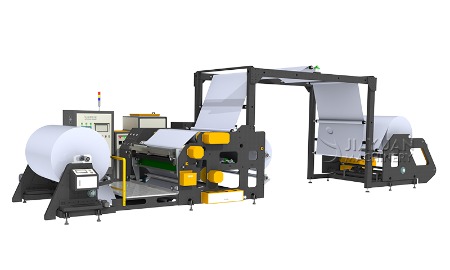
Complete resource covering working principle, coating methods (slot die, roll, spray, gravure), technical specs, industrial applications, and selection for tape, label, hygiene, packaging & automotive industries.
An adhesive coating machine is a precision industrial system designed to apply a uniform layer of adhesive (liquid, hot‑melt, or pressure‑sensitive) onto a flexible substrate such as film, paper, foil, nonwoven, or fabric. These machines are central to the production of tapes, labels, laminates, medical dressings, and many other bonded products. Depending on the adhesive chemistry, coating can be done via solvent‑borne, water‑borne, or 100% solids (hot melt) processes.
Key advantages: high speed (up to 600 m/min for some methods), excellent coat weight uniformity, low waste, and the ability to handle a wide range of viscosities (from 50 to over 100,000 cps) with the appropriate coating head.
The operating sequence typically follows these core stages:
| Parameter | Typical Range |
| Coating Width | 200 mm – 4000 mm |
| Line Speed | 0 – 600 m/min (depending on method) |
| Coating Accuracy (slot die) | ±1.0% of target |
| Max Operating Temp. | Up to 250°C (hot melt) |
| Adhesive Viscosity Range | 50 – 150,000 cps |
| Substrate Types | paper, film, foil, nonwoven, fabric, release liner |
Tapes & Labels
PSA tapes (packaging, double‑sided, masking), label stock, transfer tapes.
Hygiene Products
Diaper construction, sanitary napkin bonding, elastic attachment.
Packaging
Carton sealing, flexible packaging lamination, case erecting.
Automotive
Noise‑dampening pads, interior trim lamination, under‑hood insulation.
Medical
Wound dressings, surgical tapes, transdermal patches.
Electronics
Insulating tapes, EMI shielding, die‑cutting adhesives.
1. Adhesive Type & Chemistry
Solvent‑based, water‑based, or hot melt? This determines drying/curing requirements and material compatibility.
2. Required Coat Weight & Accuracy
Slot die offers best uniformity (±1‑2%) for thin coats (5‑50 gsm); roll coaters are suitable for heavier coats (50+ gsm) and moderate tolerance.
3. Substrate Characteristics
Film thickness, flexibility, porosity, and heat sensitivity influence coating head selection and tension control.
4. Production Speed & Volume
High‑speed lines demand advanced pump systems, fast‑response dryers, and automatic splicing.
5. Available Space & Utilities
Solvent coaters need exhaust and recovery; hot melt coaters require high‑power electrical and cooling water.
6. Budget & ROI
Balance initial investment against operating costs, waste reduction, and product quality.
Adhesive coating vs. laminating?
Coating applies adhesive to one substrate; laminating bonds two substrates using that adhesive.
What are the common coating defects?
Streaks, air bubbles, edge beads, and uneven thickness. They often stem from poor die gap, temperature variations, or pump pulsation.
How do you choose between slot die and roll coating?
Slot die gives high accuracy and low waste, ideal for thin layers. Roll coating is simpler and cheaper for thicker, less critical coats.
Can the same machine run both hot melt and solvent adhesives?
Not typically – they require different heating/drying systems and material‑wetted parts. Some hybrid designs exist but are costly.