Achieving Streak-Free Coating: Root Causes, Elimination Strategies, and Process Optimization
Streak-free coating is a fundamental quality requirement for virtually all coated products, from adhesive tapes and labels to battery electrodes and optical films. A streak is defined as a linear thickness variation or surface discontinuity that runs in the machine direction. Streaks can be continuous (running the entire length of the roll) or intermittent (appearing and disappearing). They are visually distracting and often compromise functional properties such as adhesion, barrier performance, or optical clarity. The economic impact is significant: a single streak on a wide web can render an entire master roll unsaleable, leading to 100% scrap for that section. Therefore, eliminating streaks is a top priority for coating engineers. The root causes of streaks fall into four categories: mechanical (die lip scratches, shim defects, roll surface damage), fluid-related (agglomerates, gels, bubbles), process-related (flow maldistribution, pressure fluctuations), and environmental (dust, fibers). A systematic approach to diagnosis and correction is essential for achieving consistent streak-free production.
Mechanical causes are the most frequent source of continuous streaks. In slot-die coating, a scratch or nick on the die lip creates a localized gap variation that produces a thicker or thinner coating line. Even a defect as small as 10 µm can generate a visible streak. The solution is regular inspection of the die lip using a high-intensity light and a magnifying loupe, followed by careful polishing with fine abrasive stones or diamond lapping film. For gravure coating, a damaged doctor blade or a blocked cell can produce streaks; blade replacement and cylinder cleaning are required. In roll coating, a scratch on the applicator roll transfers a pattern to the coating; the roll must be polished or re-ground. Another mechanical cause is shim wrinkles or burrs in slot-die; the shim must be perfectly flat and replaced if any imperfection is found. The die bolts must be torqued evenly to avoid distortion; uneven torque causes non-uniform gap and streaks. Regular preventive maintenance—including die disassembly, cleaning, and inspection—is the most effective way to prevent mechanical streaks. Many high-volume lines use a "die cleanliness" checklist that requires inspection after each shift.
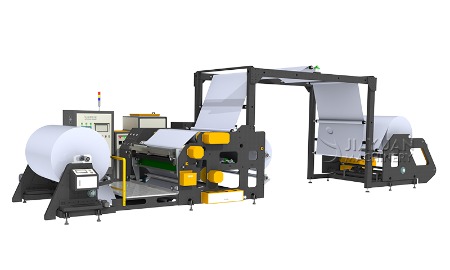
Adhesive coating machine
Fluid-related streaks are often caused by agglomerates, gels, or undissolved particles that lodge in the die slot or on the roll surface. These particles act as obstructions, creating a shadow or a void that appears as a streak. The primary defense is multi-stage filtration: a coarse filter (e.g., 100 mesh) in the recirculation loop and a fine filter (e.g., 10-20 micron) just before the die. For high-viscosity fluids, screen changers with continuous filtration are used. Regular filter changes and monitoring of differential pressure are essential. Degassing is also critical; bubbles that reach the die can cause intermittent streaks when they burst. Vacuum degassers or ultrasonic degassing units are recommended. Additionally, the fluid's temperature must be stable; viscosity variations can cause flow maldistribution, leading to streaks. Using a static mixer in the supply line can homogenize the fluid and prevent concentration gradients. The fluid's shelf life should be respected; aged fluids may form gels that cause streaks. For water-based systems, biocides must be added to prevent microbial growth that can create slimy agglomerates. Regular sampling and lab testing of the fluid's particle content are good practices.
Process-related streaks arise from flow instabilities such as pump pulsation or pressure fluctuations. A gear pump with insufficient pulse dampening can produce periodic streaks that align with the pump's tooth frequency. Installing a properly sized pulse dampener (bladder or accumulator) and tuning it to the pump's pressure can eliminate these streaks. For high-precision lines, a servo-driven pump with high-resolution encoder feedback is used to minimize pulsation. The die's internal manifold design is also critical; if the manifold does not provide uniform flow distribution, localized high-velocity areas can cause streaks. Computational fluid dynamics (CFD) can be used to optimize the manifold geometry. The die-to-web gap and angle must be precisely set; a misaligned die can cause one-sided streaking. Using a laser alignment tool ensures accurate setup. The web speed must be stable; tension fluctuations change the hydrodynamic pressure, which can cause streaks. Therefore, the tension control system must be well-tuned. In some cases, the streak is caused by static electricity attracting dust; anti-static bars and ionizing blowers are installed near the coating head. Environmental cleanliness is also important; the coating room should be kept under positive pressure with HEPA-filtered air to minimize airborne particles.
Troubleshooting streaks systematically involves: (1) Determine if the streak is continuous or intermittent; (2) Measure the streak's width and location relative to the web edge; (3) Inspect the die lip at the corresponding position; (4) Check the filter for particles; (5) Verify the pump pressure and pulsation; (6) Review the die gap and alignment; (7) Inspect the substrate for pre-existing defects; (8) Run a trial with a different batch of fluid to eliminate formulation issues; (9) Use a high-speed camera to visualize the bead dynamics; (10) Implement corrective action and verify. This methodology, combined with a detailed defect log, can significantly reduce streak-related waste. Ultimately, streak-free coating requires a holistic approach that integrates precision mechanics, rigorous filtration, stable process control, and proactive maintenance. By addressing each potential source systematically, coating lines can achieve the high quality demanded by today's markets.