Adhesive Applicator: Process Control, Fluid Delivery, and Advanced Nozzle Technologies
The performance of any adhesive applicator is inseparable from the fluid delivery system that supplies the adhesive from the storage tank to the applicator head. A typical delivery circuit includes a tank (often jacketed for temperature control), a stirrer or agitator to maintain homogeneity, a positive-displacement pump (gear, piston, or peristaltic), a filter or strainer, a pulse dampener, a pressure sensor, and a recirculation loop. The pump is the prime mover; it must deliver the adhesive at a steady, pulse-free flow rate that matches the consumption rate of the applicator. Gear pumps are preferred for most adhesives because they provide a linear relationship between motor speed and flow, with low pulsation. However, for shear-sensitive emulsions, peristaltic or progressive cavity pumps are used to minimize degradation. The pump speed is controlled by a variable-frequency drive (VFD) with encoder feedback, and the flow rate is often monitored by a mass flow meter or a Coriolis meter. The filter (typically 10-100 micron) removes agglomerates, gels, and contaminants that could block the die slot or cause streaks. The pulse dampener—a bladder or accumulator—smooths out any remaining pressure ripples from the pump, ensuring a constant supply to the applicator. The pressure sensor at the die inlet monitors the back pressure; a gradual pressure increase indicates filter clogging, while a sudden drop suggests a leak or pump failure. A recirculation line allows the adhesive to flow back to the tank when the applicator is idle, preventing settling and maintaining temperature uniformity.
Temperature control is critical for adhesives whose viscosity changes significantly with temperature. For hot-melt adhesives, the tank, hoses, and die must all be heated to a precise setpoint (typically 120-200°C) using electrical cartridge heaters or oil circulation. Multi-zone temperature controllers maintain the adhesive within ±1°C, as a 5°C variation can change viscosity by 20%, directly affecting coat weight. For water-based and solvent-based adhesives, the tank may be cooled to prevent evaporation or heated to reduce viscosity. Thermal sensors (thermocouples or RTDs) are placed at multiple points in the circuit to provide feedback to the PID controllers. The hoses between the tank and applicator must be insulated and heated (for hot-melt) or thermally traced to prevent cold spots. In some systems, a heat exchanger is used for rapid temperature adjustment when switching products. Proper temperature control not only stabilizes coat weight but also prevents premature crosslinking, skinning, and char formation. It also reduces the stress on the pump by maintaining consistent viscosity. Therefore, the fluid delivery system is not merely a plumbing arrangement but a key component of process control, deserving careful design and regular maintenance.
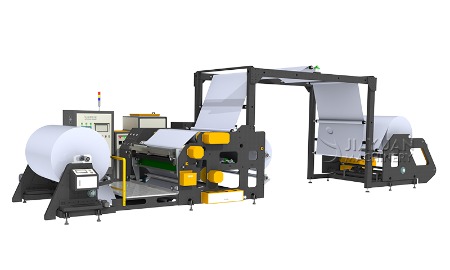
Adhesive coating machine
Advanced nozzle and die technologies are pushing the boundaries of adhesive application. Heated slot-dies incorporate internal heaters and temperature sensors to ensure the die body is isothermal, preventing cold spots that could cause viscosity gradients. Some slot-dies have "active shims" with embedded heaters to adjust the gap profile locally, enabling automatic profile control. In spray applicators, "airless" and "air-assisted" nozzles have been refined with computational fluid dynamics to produce narrower droplet size distributions and more defined spray patterns, reducing overspray. "Rotary atomizers" using high-speed spinning cups produce very fine mists with high transfer efficiency for complex 3D parts. For patterned adhesive application, "micro-pattern" applicators such as gravure with variable cell depth or inkjet-like printheads can deposit adhesive in dots, lines, or grids with resolutions down to 50 microns. These are used in electronic assembly, medical device bonding, and RFID tag manufacturing. Another emerging technology is "electrostatic-assisted" spray, where the adhesive droplets are charged and attracted to the grounded substrate, achieving transfer efficiency above 95% and uniform coverage on edges. For extreme precision, "piezoelectric" micro-dispensers use a piezoelectric crystal to eject picoliter droplets of adhesive, enabling very small bond areas in microelectronics.
Process control strategies for
adhesive applicators have evolved from simple open-loop settings to sophisticated closed-loop systems. In a closed-loop system, an inline thickness gauge (e.g., near-infrared, beta, or optical) measures the applied coat weight and sends a signal to the controller. The controller adjusts the pump speed or the die gap to correct any deviation. This feedback loop can operate at frequencies up to 100 Hz, enabling real-time correction of coating weight variations caused by changes in fluid viscosity, web speed, or ambient temperature. Advanced controllers use model predictive control (MPC) that anticipates the effect of a speed change and pre-adjusts the pump speed accordingly, minimizing transient coat weight spikes. For multi-layer coating, two or more applicators are cascaded with individual control loops, and a master controller coordinates them to achieve the target layer thickness ratios. The control system also monitors the pressure drop across the filter and triggers an alarm when cleaning is due. All control parameters, including pump speed, temperatures, and pressure, are stored as recipes for each product, ensuring repeatability. The integration of Industry 4.0 enables remote access to the control system, allowing engineers to monitor line performance, diagnose issues, and even adjust settings from off-site locations, reducing response time and improving overall line availability.
Cleaning and changeover procedures are integral to the applicator system. For slot-dies, cleaning involves removing the die, disassembling it, flushing the internal channels with solvent, and ultrasonically cleaning the shim and lip. To reduce downtime, many plants use a "quick-change" die that can be removed and replaced with a pre-cleaned die within minutes. For spray nozzles, the nozzle tip must be removed and soaked in solvent; some systems have "auto-purge" that blasts solvent through the nozzle between cycles. For roll coaters, cleaning the rolls and pans is labor-intensive but critical; using disposable pan liners can simplify the process. Proper cleaning prevents cross-contamination between different adhesive chemistries and avoids dried residue that can cause streaks. The design of the applicator should facilitate easy access to all wetted parts. By investing in robust fluid delivery, precise temperature control, advanced nozzle technologies, and smart process control, manufacturers can achieve exceptional adhesive application quality, reduce waste, and enhance productivity. This holistic approach ensures that the adhesive applicator system meets the stringent demands of modern converting and assembly operations.