Adhesive Applicator Systems: Types, Mechanisms, and Selection for Optimal Bonding
Adhesive applicators are specialized devices designed to handle the wide diversity of adhesive formulations—from low-viscosity water-based emulsions to high-viscosity hot-melt thermoplastics and reactive solvent-based systems. The applicator is the heart of any adhesive coating or bonding line, and its performance directly determines the bond quality, material consumption, and production efficiency. The primary function is to meter the adhesive at a precise flow rate and apply it onto the target substrate with controlled thickness, width, and pattern. The applicator must also accommodate the adhesive's rheological behavior, which can be Newtonian, shear-thinning, or thixotropic, and its temperature sensitivity. Additionally, the applicator system includes the fluid supply, filtration, degassing (if needed), and temperature control units. The choice of applicator type is influenced by the required coat weight (ranging from 0.5 gsm for silicone release to 200 gsm for structural tapes), the desired uniformity (tolerances from ±1% to ±10%), the line speed (up to 600 m/min), and the substrate's mechanical and thermal properties. A mismatch between applicator and adhesive can lead to defects such as streaks, pinholes, uneven thickness, and poor wetting, all of which compromise the final product's performance.
Roll applicators are the oldest and most widespread type, using a series of rotating cylinders to pick up adhesive from a reservoir and transfer it to the substrate. The most common configurations are the two-roll, three-roll, and reverse roll designs. In a two-roll system, the adhesive is metered by the gap between the rolls, which is manually adjusted. This is suitable for simple, low-cost applications like packaging adhesives where accuracy is not critical. The three-roll coater adds a doctor roll to scrape excess adhesive from the applicator roll, improving coat weight control. Reverse roll applicators, where the applicator roll rotates counter to the substrate direction, provide superior uniformity and are used for high-quality PSA tapes and laminating adhesives. Roll applicators handle viscosities from 50 to 50,000 cP and coat weights from 5 to 150 gsm, with uniformity around ±3-5%. They are robust, easy to clean, and can run at high speeds. However, they are open systems, which may cause solvent evaporation and viscosity drift; they also require careful roll alignment and maintenance. Gravure applicators use an engraved cylinder to transfer precise micro-quantities of adhesive; they excel at low coat weights (1-15 gsm) with excellent repeatability, making them the standard for release coatings and thin PSA layers. The engraved cell volume determines the maximum coat weight, and the doctor blade ensures a clean wipe. Gravure applicators are limited to low-to-medium viscosity fluids and are sensitive to cell wear.
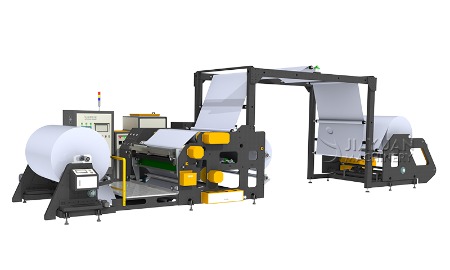
Adhesive coating machine
Slot-die applicators have emerged as the high-precision choice for demanding adhesive applications. They are pre-metered, meaning the adhesive flow is determined solely by the pump rate and line speed, independent of fluid properties. This yields outstanding uniformity, typically ±1%, and allows coat weights from 0.5 to 200 gsm. Slot-dies handle a vast viscosity range (1 to over 100,000 cP) and are compatible with solvent-based, water-based, and hot-melt adhesives. They are closed systems, minimizing solvent emission and contamination. The die gap and shim define the slot opening, and the internal manifold ensures cross-web uniformity. Slot-die applicators require precise pump calibration and careful cleaning to prevent dried adhesive buildup. They are more expensive and have longer changeover times, but their material efficiency (up to 99% transfer) and precision justify the investment for high-value products like optical adhesives and battery binders. Spray applicators are used for non-continuous or patterned adhesive deposition, especially on 3D substrates. They use atomizing air or hydraulic pressure to create droplets that are sprayed onto the surface. Spray is ideal for low-viscosity adhesives and applications requiring thin, conformal coatings on irregular shapes, but transfer efficiency is lower (30-70%), and overspray is a concern. Hot-melt applicators include heated slot-dies, roll coaters, and spiral spray systems, where the adhesive is melted just before application and solidifies upon cooling. They require thermal management and are used for high-speed, solvent-free bonding in packaging, nonwovens, and tapes.
Selecting the right
adhesive applicator involves a multi-criteria decision matrix. First, define the adhesive's viscosity at application temperature—low (<500 cP) favors gravure or spray; medium (500-5000 cP) suits roll or slot-die; high (>5000 cP) requires slot-die or hot-melt roll coaters. Second, the required coat weight and tolerance: for tight tolerances (<±2%), slot-die is the only choice; for moderate tolerances, roll or gravure are acceptable. Third, the line speed: gravure and roll coaters can exceed 400 m/min; slot-dies are capable but may require vacuum assist at very high speeds. Fourth, the substrate: thin, delicate films need kiss or slot-die with minimal tension; rigid boards can use heavier roll coaters. Fifth, environmental constraints: solvent-based adhesives need closed systems (slot-die) with fume extraction; water-based can use open pans but need corrosion resistance; hot-melt needs thermal insulation. Sixth, production flexibility: if frequent product changes are needed, quick-clean slot-dies or cartridge-based spray heads are preferred. Seventh, capital and operating costs: roll coaters are cheapest; slot-dies have higher upfront cost but lower waste; spray has moderate cost but high overspray loss. A cost-per-square-meter analysis, including adhesive waste, cleaning solvent, and energy, often reveals the most economical choice in the long term. Running trials with sample adhesives on candidate applicators is strongly advised; it provides real-world data on coating windows, defect occurrence, and ease of operation. Ultimately, the optimal adhesive applicator aligns technical performance with business objectives, ensuring consistent product quality and competitive production economics.