Adhesive Coater Maintenance and Cleaning Protocols for Extended Service Life
Adhesive coaters operate under demanding conditions: high speeds, elevated temperatures, and sticky, often aggressive fluids. Without a rigorous maintenance and cleaning regimen, performance degrades rapidly, leading to coat weight drift, surface defects, and premature component failure. A structured preventive maintenance program is the backbone of reliable operation. This program should include daily, weekly, monthly, and annual tasks, with clear checklists and documented records. Daily tasks typically involve visual inspection of rolls for wear or scoring, checking oil levels in gearboxes, verifying that all safety interlocks function, and cleaning the adhesive pan and doctor blade area. The web path should be wiped with lint-free cloths to remove loose debris. Operators should also review pressure and temperature readings from the control panel; any deviation from normal ranges should be investigated immediately. These quick actions prevent small issues from escalating into major breakdowns.
Weekly maintenance goes deeper: lubricating bearings, inspecting belts and chains for tension and wear, and checking the alignment of the coating head relative to the backup roll. For slot-die coaters, the die lip should be inspected for dried residue, using a feeler gauge to verify uniform gap. Shims should be removed, cleaned, and measured for distortion; distorted shims cause non-uniform flow. Gravure coaters require cleaning of the engraved cylinder with specialized brushes and solvents to remove plugged cells; a magnifying glass or microscope helps detect cell damage. Also, the doctor blade should be replaced or rotated to maintain a sharp edge. All cleaning solvents must be compatible with the adhesive type—for example, water-based adhesives require water or mild detergents, while solvent-based adhesives need specific organic solvents. Safety protocols, including explosion-proof ventilation and PPE, must be strictly followed during cleaning with volatile solvents.
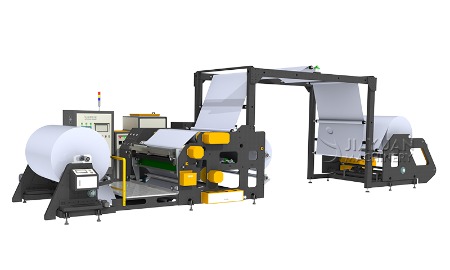
Adhesive coating machine
Monthly maintenance includes checking the pump seals and diaphragms for leakage, calibrating pressure and temperature sensors, and inspecting the oven's heating elements, fans, and thermocouples. Air filters in the oven and cooling system must be replaced to maintain airflow and prevent overheating. The solvent recovery system, if present, should have its condenser coils cleaned and activated carbon beds regenerated. The tension control system—load cells, dancer potentiometers, and amplifiers—should be calibrated using known weights to ensure accuracy. Electrical cabinets must be vacuumed to remove dust that could cause shorts, and terminal connections tightened. Maintenance logs should record all actions, measurements, and observations, creating a historical database that aids in predictive diagnostics. For instance, gradual increase in pump motor current may signal bearing wear or viscosity change.
Annual maintenance typically involves major overhauls: replacing all seals and gaskets in the pump and piping, re-grinding or replacing worn rolls, and recertifying safety devices like emergency stops and fire suppression systems. The entire coating head should be disassembled for ultrasonic cleaning of internal channels, especially for slot dies where dried adhesive can accumulate in the manifold. After reassembly, a thorough alignment check using laser tools ensures that all parallel and perpendicular tolerances are met. The oven's burners or heating coils should be serviced, and the exhaust stack cleaned to maintain proper draft. Additionally, software and PLC firmware should be updated to the latest versions provided by the manufacturer. These annual overhauls are best scheduled during planned plant shutdowns, minimizing disruption to production. Many service contracts offer these comprehensive inspections by trained engineers who can also provide training to local maintenance teams.
Cleaning procedures deserve special attention because improper cleaning can damage sensitive surfaces. For roll coaters, the rolls must be cleaned with non-abrasive pads and approved solvents, rotating slowly to ensure full coverage. Chrome-plated or rubber-covered rolls require different cleaning agents—solvents that attack rubber should be avoided. For slot dies, the die halves should be separated carefully, and the flow channels flushed with solvent under low pressure; never use metal tools to scrape dried adhesive, as they scratch the lip. Instead, use plastic spatulas or ultrasonic baths. Drying after cleaning is crucial to prevent rust or solvent residue; use clean, oil-free compressed air to blow out passages. Documentation of cleaning frequency and methods is part of Good Manufacturing Practice (GMP) and helps in audit trails. Some coaters feature automated cleaning cycles that circulate solvent through the system, reducing manual labor. However, manual verification is still recommended. By adhering to these maintenance and cleaning protocols,
adhesive coater owners can extend equipment life, reduce unplanned downtime, and maintain consistent product quality over years of operation.