Adhesive Coating Machine Operation: Troubleshooting Common Defects and Quality Assurance
Operating an adhesive coating machine demands not only mechanical knowledge but also a systematic approach to diagnosing and resolving defects that arise during production. Common defects include coat weight variation, streaks, pinholes, edge bead, contamination, and delamination. Coat weight variation can be transverse (across the web) or machine-direction (along the web). Transverse variation often results from uneven die lip gaps, worn gravure cylinders, or non-uniform roll nip pressure. Machine-direction variation is typically caused by pump pulsation, viscosity changes, or fluctuating web speed. To diagnose, operators use online beta or optical gauges that provide continuous thickness profiles. Corrective actions include adjusting die bolts, changing pump speed, or stabilizing temperature. In slot-die systems, shim thickness and manifold design must be checked periodically.
Streaks are linear defects that appear as continuous or intermittent lines in the coating direction. They often originate from dried adhesive residue on the die lip, scratches on the roll surface, or foreign particles lodged in the slot. Preventive measures include regular cleaning cycles using appropriate solvents and non-abrasive wipers, inspection of roll surfaces with high-intensity lighting, and installing fine filtration (down to 5-10 microns) in the supply line. For intermittent streaks, the issue may be due to pump cavitation or air entrainment in the adhesive. Degassing units or vacuum deaerators can be added to remove trapped air. Operator logs that record the time and location of streaks help correlate defects with specific events like splices or roll changes.
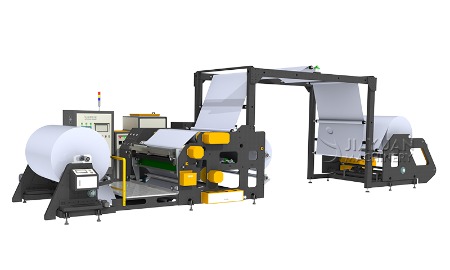
Adhesive coating machine
Pinholes and bubbles are minute voids in the coating that compromise barrier properties and adhesion. They occur when dissolved gases or volatile components escape during drying, or when air is trapped during application. Reducing pinholes requires careful control of coating viscosity and surface tension; sometimes adding de-foaming agents helps. The substrate surface energy must be adequate to promote wetting; corona or plasma treatment is often applied upstream. Drying ramp rates should be gradual to allow solvent to diffuse out without boiling. In addition, the coating head should be operated with a slight positive pressure to prevent air ingestion. Regular calibration of vacuum assist (for slot-die) and inspection of the liquid bead stability are routine practices to minimize pinhole formation.
Edge bead is the thickening of coating at the substrate edges, which can cause problems in slitting, winding, or converting. This is common in slot-die and roll coating due to surface tension effects. To mitigate edge bead, operators can use edge masking tapes, air knives to trim excess, or shims with tapered ends. Some slot dies feature adjustable deckles that physically block flow at the edges. Another solution is to run a slightly wider substrate and trim off the edges after coating. However, this increases waste, so precise edge control is preferred. Closed-loop edge thickness sensors can feed back to actuators that modify the lip gap locally. Regular maintenance of die edges and replacement of worn masking strips are necessary.
Contamination includes dirt, lint, oil, or silicone particles that embed in the adhesive layer, leading to poor adhesion or cosmetic rejects. Sources are ambient air, incoming substrate, or the adhesive itself. Implementing cleanroom practices, using HEPA filters on air intakes, and maintaining positive pressure in the coating room reduce airborne particles. Substrate cleaning stations with brushes or ionizing bars remove loose debris before coating. For the adhesive, multi-stage filtration and periodic tank cleaning are mandatory. Operators should wear gloves and use lint-free wipes when handling dies. Quality assurance also includes peel adhesion tests, shear strength tests, and accelerated aging studies to confirm that the coating meets specifications. Statistical process control (SPC) charts on coat weight and defects help track trends and trigger preventive actions. By systematically addressing these defects,
adhesive coating machine operators can achieve high yield, reduce scrap, and deliver reliable products to customers.