Adhesive Lamination: Principles, Process Control, and Bond Strength Optimization
Adhesive lamination is a widely used process in packaging, label manufacturing, tape production, and medical device assembly. The process involves applying a liquid or hot-melt adhesive onto a first substrate (the carrier), then bringing a second substrate (the face stock) into contact under pressure to form a permanent bond. The adhesive can be applied by roll coating, slot-die, gravure, or spray. After application, the adhesive may be dried (for solvent/water-based) or cooled (for hot-melt) before lamination, or it may be laminated wet (for certain systems). The lamination is performed in a nip—the gap between two rolls where the substrates meet. The nip pressure forces the adhesive to flow and wet the second substrate, displacing air and creating molecular contact. The bond strength depends on the adhesive's chemistry, the coat weight, the nip conditions, and the surface energies of the substrates. Proper surface treatment (corona, flame, plasma) of the substrates is often required to improve wetting and adhesion. The lamination process can be done in-line with the coating machine or off-line on a dedicated laminator. In-line lamination offers efficiency and reduces handling, but requires precise synchronization of the two webs. Off-line lamination allows more flexibility in substrate pairing and is used for complex multi-layer structures.
The nip is the heart of the lamination process. The nip pressure, usually expressed in Newtons per millimeter (N/mm), must be high enough to ensure intimate contact between the adhesive and the second substrate. The pressure is applied by pneumatic or hydraulic cylinders on the nip roll. The nip pressure profile across the width must be uniform; any non-uniformity causes uneven bonding and wrinkles. The nip roll is typically rubber-covered (Shore A hardness 60-90) to conform to the substrates and distribute the pressure evenly. The hardness of the roll affects the nip width: a softer roll gives a wider nip, which may be beneficial for thick substrates. The nip temperature is also critical; for hot-melt adhesives, the nip rolls may be heated to keep the adhesive molten during lamination. For solvent-based systems, the nip is usually at room temperature. The nip speed must match the line speed; any speed mismatch causes tension variations and web breakage. The substrates must be aligned precisely with an edge guide to prevent offset lamination. The tension of both webs must be controlled independently to avoid stretching or wrinkling. The lamination nip is often followed by a cooling section (for hot-melt) or a curing section (for reactive adhesives) to set the bond.
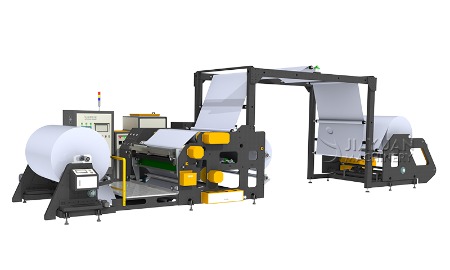
Adhesive coating machine
Bond strength optimization involves balancing adhesive coat weight, nip pressure, and substrate properties. The adhesive coat weight must be sufficient to fill the surface irregularities of both substrates; a too-thin coat leads to weak bonds (adhesive starvation), while a too-thick coat causes ooze and slow curing. The optimal coat weight is determined by the substrate roughness and the adhesive's rheology. For smooth films, a coat weight of 5-15 gsm is typical; for rough paper, 20-40 gsm may be needed. The nip pressure affects the adhesive's flow into the substrate pores; higher pressure increases contact area and bond strength, but excessive pressure can squeeze out the adhesive or deform the substrate. The temperature affects the adhesive's viscosity; higher temperature lowers viscosity, improving wetting, but may cause thermal degradation. The bond strength is often tested by peel tests (90° or 180°) and shear tests. The peel strength should be higher than the required application force. The peel mode can be adhesive failure (at the interface) or cohesive failure (within the adhesive layer); cohesive failure is usually preferred because it indicates that the adhesive is stronger than the bond. To achieve cohesive failure, the adhesive must be fully cured and the substrate surface must be properly treated. A common optimization approach is design of experiments (DOE) varying pressure, temperature, and coat weight, and measuring the peel strength. The results guide the selection of the operating point that maximizes bond strength while minimizing defects.
Defects in
adhesive lamination include bubbles, wrinkles, delamination, adhesive ooze, and poor adhesion. Bubbles are trapped air pockets that appear as transparent spots; they are caused by insufficient nip pressure, high web speed (not allowing air to escape), or rough substrates. Solutions: increase nip pressure, use a grooved nip roll to allow air to escape, or reduce speed. Wrinkles are folds in the laminated web due to uneven tension or misalignment; they are prevented by proper tension control and edge guiding. Delamination is the separation of the layers after lamination; it is caused by low bond strength, which may result from insufficient coat weight, poor surface treatment, or incomplete curing. Improving the surface treatment (corona level), increasing coat weight, or extending the curing time solves this. Adhesive ooze is the squeezing of adhesive out of the edges; it is caused by excessive nip pressure or too high coat weight. Reducing pressure or coat weight, and using edge dams, prevents ooze. Poor adhesion (peeling easily) is often due to low surface energy of the substrate; plasma or primer treatment is the solution. The lamination line should have an inline inspection system (e.g., a camera) to detect bubbles and wrinkles immediately after the nip, allowing real-time correction. Regular maintenance of the nip rolls—cleaning, checking parallelism, and verifying hardness—is essential for consistent quality. In summary, adhesive lamination is a versatile process that requires careful control of multiple parameters. By understanding the interactions between adhesive, substrates, nip conditions, and surface treatments, manufacturers can achieve strong, reliable bonds that meet the demanding requirements of modern packaging and tape applications.