Adhesive Lamination: Substrate Selection, Surface Treatment, and Bond Durability
In adhesive lamination, the substrates are not passive participants; their surface chemistry and morphology play a decisive role in bond formation and durability. The surface energy of the substrate must be higher than the surface tension of the adhesive to achieve good wetting. Low-energy plastics like polyethylene (PE), polypropylene (PP), and polytetrafluoroethylene (PTFE) have surface energies of 30-35 mN/m, while most adhesives have surface tensions of 30-40 mN/m. If the adhesive's surface tension exceeds the substrate's surface energy, the adhesive will bead up and not wet the surface, resulting in poor adhesion. Therefore, low-energy substrates must be surface-treated to raise their surface energy to at least 40-45 mN/m. Surface treatment also introduces polar functional groups (e.g., carbonyl, hydroxyl) that can form chemical bonds with the adhesive. The choice of substrate also affects the lamination's flexibility, optical clarity, barrier properties, and cost. For packaging films, a common lamination is PET/aluminum foil/PE, where each layer provides specific properties (barrier, strength, sealability). For tapes, the substrate is often PET or PP, and the adhesive is a PSA. For medical applications, the substrate must be biocompatible and breathable. The substrate thickness and stiffness influence the lamination process; thicker substrates require higher nip pressure to conform. The substrate's dimensional stability under heat and humidity is also important; if the substrates shrink or expand differently, the laminated structure may curl or delaminate. Therefore, the substrates must be selected with matched thermal expansion coefficients or with a controlled differential.
Surface treatment methods are tailored to the substrate material. Corona treatment is the most common for films; it uses a high-frequency electrical discharge to oxidize the surface. The treatment level is measured by the dyne level (in mN/m) using dyne test pens. A dyne level of 38 mN/m is the minimum for good adhesion; 42-44 mN/m is preferred. The treatment effect decays over time, especially in humid conditions, so the lamination should be done soon after treatment. Plasma treatment is more effective for achieving high surface energy and is used for difficult materials like PTFE and silicones; it also cleans the surface of organic contaminants. Flame treatment is used for thicker substrates like paper and board; it oxidizes the surface but is less uniform. Primers are chemical coatings applied as a thin layer to promote adhesion; they are used when corona or plasma is insufficient. For example, a polyurethane primer on PET film improves adhesion to acrylic adhesives. The primer is applied by roll coating or gravure, and it must be dried before lamination. The selection of the treatment method depends on the substrate, the required bond strength, and the production speed. In-line corona treaters are common on lamination lines; the treatment level is continuously monitored by a dyne test or an optical sensor. If the treatment level drops, the power is increased automatically.
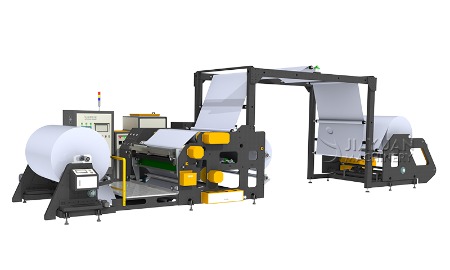
Adhesive coating machine
Bond durability is tested by exposing the laminated samples to accelerated aging conditions: heat (e.g., 60°C for days), humidity (e.g., 90% RH), and thermal cycling. The peel strength is measured before and after exposure. A good bond should retain at least 80% of its initial strength after aging. If the bond strength drops significantly, it indicates hydrolysis of the adhesive, plasticizer migration, or interfacial degradation. For outdoor applications, UV exposure is also tested. The adhesive formulation must include antioxidants and UV stabilizers to resist degradation. The substrate's additives—slip agents, antistatic agents, and antioxidants—can migrate to the surface and interfere with adhesion; they should be minimized or chosen to be compatible with the adhesive. The lamination process itself can affect durability: if the adhesive is not fully cured, it may continue to react and cause embrittlement or outgassing. Therefore, curing conditions must be verified. The bond durability is also affected by the storage conditions of the laminated rolls; they should be stored in a cool, dry place to prevent aging. In summary, durable
adhesive lamination requires a holistic approach that considers substrate selection, surface treatment, adhesive chemistry, process control, and environmental testing. By optimizing each factor, manufacturers can produce laminated structures that withstand the rigors of their intended use, ensuring customer satisfaction and product reliability.
Practical guidelines for adhesive lamination: (1) Measure the surface energy of both substrates before lamination; (2) Use the appropriate surface treatment to raise the dyne level to the required value; (3) Choose an adhesive that is compatible with the substrates and the end-use conditions; (4) Set the nip pressure and temperature based on the substrate thickness and adhesive type; (5) Monitor the coat weight to ensure sufficient adhesive for wetting; (6) Inspect the laminated product for bubbles, wrinkles, and delamination; (7) Conduct peel tests and aging tests to verify bond quality; (8) Adjust the process parameters based on the test results; (9) Document all settings and test results for each product; (10) Train operators to recognize defects and take corrective action. Following these guidelines will result in consistent, high-quality laminations that meet the performance and durability requirements of diverse applications, from food packaging to industrial tapes.