Automotive Adhesive Coating: Applications, Adhesive Types, and Coating Processes for Vehicle Assembly
Automotive adhesive coating plays a crucial role in modern vehicle assembly, replacing mechanical fasteners and improving structural integrity, weight reduction, and acoustic comfort. Adhesives are used for bonding body panels, attaching windshields, sealing seams, damping vibrations, and protecting the underbody from stone chips. The adhesive must withstand harsh environments: temperature extremes (-40°C to 150°C), exposure to water, salt, oil, and UV radiation, and high mechanical loads. Common adhesive types include: epoxies (high structural strength), polyurethanes (flexible and impact-resistant), acrylics (fast curing), and silicones (high temperature and sealant applications). The coating process applies these adhesives as beads, films, or sprays. For structural bonding, a uniform adhesive layer is critical to ensure load transfer; coat weights are typically 50-200 gsm for film applications. For seam sealing, a bead of sealant is applied to prevent water ingress. For anti-chip coatings, a thick layer is sprayed on the underbody to protect against stones. The coating equipment is often integrated into the assembly line, with robotic applicators for precision. The line speed is slower than packaging lines (5-20 m/min) due to the precision and the large parts. The adhesives are often one-part (heat-cured) or two-part (mixed on the fly). The coating machine must handle high-viscosity pastes (up to 1,000,000 cP) and must be compatible with the adhesive's chemistry. Clean-in-place systems are essential to prevent cross-contamination.
The coating methods for automotive adhesives are chosen based on the application and the adhesive's rheology. For structural bonding, slot-die coating is used to apply a precise film onto a panel; the adhesive is then laminated with another panel. The slot-die gap is set to 0.1-0.5 mm, and the coat weight is controlled by the pump speed. For seam sealing, an extrusion bead is applied using a nozzle; the bead width and height are controlled by the nozzle diameter and the flow rate. For underbody anti-chip coatings, spray coating is used; the adhesive (often a water-based or solvent-based epoxy) is atomized by air or hydraulic pressure. The spray pattern and coat weight are controlled by the spray gun's air and fluid settings. For NVH damping, a layer of viscoelastic adhesive is applied to panels to absorb vibrations; this is often done by roll coating a tape or by spraying. The application must be uniform to achieve consistent damping. All these processes require the adhesive to be pumped from bulk containers (drums, totes) through filters and heaters to the application point. The pumping system must be capable of high pressure (up to 200 bar) for high-viscosity adhesives. The adhesive's temperature must be controlled to maintain viscosity; many adhesives are applied at elevated temperatures (30-80°C) to reduce viscosity. The coating head is often mounted on a robotic arm that follows the contour of the panel. The robot's path and speed must be programmed to achieve the desired coat weight and pattern. The machine's control system coordinates the robot, the pump, and any curing equipment (e.g., UV or IR lamps). The coating line must have safety features to handle the solvents and isocyanates used in some adhesives.
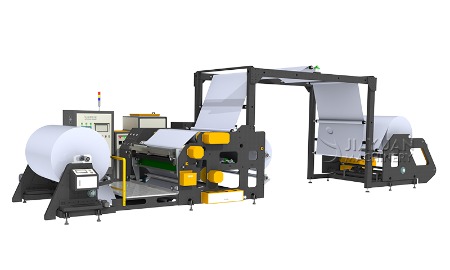
Adhesive coating machine
Quality control for
automotive adhesive coating is rigorous. The coat weight is measured by weighing panels before and after coating or by using an online gauge. For beads, the bead width and height are measured by a laser profilometer; variations beyond tolerance trigger an adjustment. The bond strength is tested by destructive tests (pull-off, lap shear) on sample coupons that are coated and cured alongside the production parts. The adhesive's cure degree is monitored by DSC or by measuring the hardness. The coating must have excellent adhesion to the substrate; surface preparation (cleaning, plasma, or primer) is essential. The substrate's surface energy must be checked with a dyne pen. The coating must also pass corrosion tests (salt spray) and environmental tests (temperature cycling, humidity). The adhesive's resistance to chemicals (gasoline, oil, brake fluid) is tested. The quality data is logged and used for SPC. If a coating defect is found (e.g., pinholes, bubbles, thickness variation), the cause is investigated: it may be due to a clogged filter, an air bubble in the adhesive, or a misaligned slot-die. The corrective action is implemented and verified. The automotive industry's quality standards are very high (e.g., IATF 16949), so the coating process must be validated and monitored continuously. In summary, automotive adhesive coating is a high-precision, high-performance process that demands robust equipment, strict process control, and comprehensive quality assurance to ensure the safety and durability of the vehicle.