Automotive Adhesive Coating: Process Optimization, Defect Prevention, and Sustainability
Optimization of automotive adhesive coating involves balancing the adhesive's rheology, application method, and substrate conditions. The adhesive's viscosity is the most critical parameter; it must be within the specified range for the coating method. Temperature control is key: for hot-applied adhesives, the temperature must be stable within ±1°C to maintain viscosity. The pump speed must be precisely controlled; for robotic applications, the pump must respond quickly to speed changes. The slot-die gap or the spray nozzle size must be selected based on the required coat weight. For structural bonding, the coat weight is determined by the joint design; a DOE can be used to find the optimal coat weight that provides maximum bond strength. The substrate's temperature and cleanliness affect adhesion; the coating should be applied soon after surface treatment. The curing process must be optimized: for heat-cured adhesives, the temperature ramp rate and holding time must be sufficient to achieve full cure without degrading the adhesive or the substrate. For UV-curable adhesives, the UV dose must be uniform. The optimization should consider the line speed; higher speeds may require higher cure temperatures or more intense UV lamps. The machine's control system should have a recipe management system that stores optimized settings for each product. Operators should be trained to adjust parameters based on real-time feedback from sensors. The optimization process should be documented and reviewed periodically. In summary, process optimization is a continuous effort that improves quality, reduces waste, and increases productivity.
Defect prevention in automotive adhesive coating focuses on porosity, voids, poor adhesion, and contamination. Porosity (air bubbles trapped in the adhesive) is caused by air entrainment during mixing or pumping; using a vacuum degasser and a pulse dampener solves it. Voids (empty spaces in the adhesive layer) are due to insufficient wetting or poor substrate contact; increasing the coat weight or the nip pressure helps. Poor adhesion is often due to substrate contamination (oil, dust) or low surface energy; rigorous cleaning and surface treatment (e.g., plasma) prevent this. Contamination (dust, fibers) can cause pinholes; maintaining a clean environment and using filtered air are essential. The adhesive itself can degrade over time; using fresh material and following the supplier's shelf-life guidelines prevents degradation. The application equipment must be cleaned regularly to prevent cured adhesive from causing streaks. The robot's path must be programmed to avoid overlaps or gaps; simulation software can verify the path. The coating head's condition must be monitored; worn nozzles or dies cause thickness variations. Preventive maintenance, including filter changes and pump calibration, reduces defects. If a defect occurs, the root cause analysis should consider the adhesive, the equipment, the process, and the environment. The corrective action is documented and shared with the team. In summary, defect prevention is a proactive approach that combines proper equipment design, process control, and maintenance.
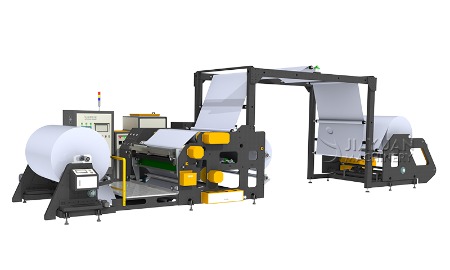
Adhesive coating machine
Sustainability is driving changes in
automotive adhesive coating. Low-VOC (volatile organic compound) adhesives, such as water-based and high-solids systems, are replacing solvent-based adhesives to reduce emissions. These adhesives require different coating equipment (corrosion-resistant materials) and drying conditions (longer drying times). Lightweighting, a key goal in automotive, leads to the use of thinner metal and composite substrates, which are more sensitive to heat and require adhesives that cure at lower temperatures. The development of structural adhesives with lower curing temperatures (80-100°C) reduces energy consumption and minimizes thermal distortion. The use of adhesives to replace welds and rivets reduces weight and improves crash performance. The coating process must be adapted to handle these new materials; for example, composites have low surface energy and require special primers or plasma treatment. The trend towards electric vehicles (EVs) introduces new requirements: adhesives for battery pack assembly must be thermally conductive and flame-retardant. The coating equipment must be able to apply these functional adhesives with high precision. The recycling of automotive components at end-of-life requires the adhesive to be compatible with the recycling process; for example, using adhesives that can be separated by heat or solvents. In conclusion, automotive adhesive coating is evolving towards lower environmental impact, better performance, and greater compatibility with lightweight and electric vehicles. Coating machine manufacturers are responding with new designs that offer higher precision, faster changeovers, and better energy efficiency, enabling automakers to meet the challenges of the future.