Cleaning the Coating Head: Troubleshooting Residue Issues, Preventing Cross-Contamination, and Extending Component Life
Stubborn residues, such as crosslinked or charred adhesives, can be difficult to remove with standard solvent wiping. For these cases, more aggressive methods are needed. For slot-dies, soaking the disassembled parts in a solvent that has high solvency power (e.g., MEK or NMP) for several hours can soften the residue. Ultrasonic cleaning with a heated solvent bath is highly effective for removing baked-on material; the cavitation action dislodges particles from intricate surfaces. For gravure cylinders, an ultrasonic cleaning system with a rotating brush can be used; however, care must be taken not to damage the cells. For roll coaters, a high-pressure water jet may be used for water-based adhesives, but for solvent-based, a solvent-soaked pad with mild abrasion may be required. In all cases, the cleaning agent must be compatible with the head material; for example, NMP can attack some rubbers, so it should be avoided on rubber-covered rolls. The cleaning time should be optimized; excessive soaking can soften the material or cause corrosion. After aggressive cleaning, the head must be thoroughly rinsed and dried to remove any residue of the cleaning agent. The effectiveness of cleaning is validated by visual inspection (using a magnifying glass or microscope), by a surface contact angle measurement (to check for contamination), or by a solvent rub test (wiping with a white cloth to check for residue). For high-precision applications, analytical methods like FTIR or XPS may be used to confirm that no organic residue remains. In summary, stubborn residue removal requires a combination of solvent soaking, ultrasonic agitation, and mechanical action, with careful selection of the cleaning method to avoid damaging the head.
Cross-contamination is a major concern when switching between different adhesive chemistries (e.g., from acrylic to silicone, or from solvent-based to water-based). Even trace amounts of a previous adhesive can cause severe defects, such as silicone transfer or curing inhibition. To prevent cross-contamination, a rigorous cleaning protocol must be followed: the entire fluid path—tank, pump, hoses, and coating head—must be flushed with a cleaning solution that is compatible with both the old and new adhesives. For slot-die, the die must be completely disassembled and each component cleaned individually. A "clean-in-place" (CIP) system with a recirculating solvent can be used for the pump and hoses. The use of dedicated components (e.g., a separate die for silicone) is the most effective way to prevent cross-contamination, but it is costly. If a single head is used for multiple products, a cleaning validation procedure must be established: after cleaning, a trial run with the new adhesive is made, and a sample is tested for any evidence of contamination (e.g., reduced adhesion or altered release). If contamination is detected, the cleaning process is repeated. The cleaning validation should be documented. In summary, preventing cross-contamination requires a thorough cleaning regimen, dedicated equipment where possible, and a robust validation procedure to ensure that the head is truly clean before the next production run.
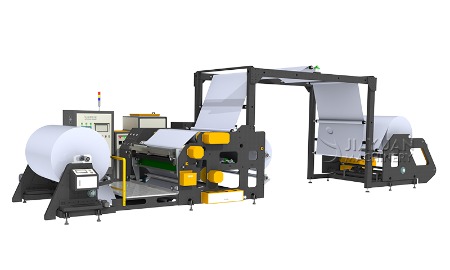
Adhesive coating machine
Extending the life of the coating head through proper cleaning is economically beneficial. Regular cleaning prevents the buildup of abrasive particles that can wear down the die lip, gravure cells, or roll surfaces. The use of soft brushes and wipes minimizes scratching. The cleaning agents should be chosen to not attack the base material; for chrome-plated surfaces, avoid acidic or caustic cleaners. For rubber rolls, use only solvents that are compatible; check the rubber's chemical resistance chart. After cleaning, the head should be inspected for wear; early detection of wear allows for re-grinding or re-chroming before the head is damaged beyond repair. The head should be stored in a clean, dry environment when not in use; apply a thin coat of corrosion inhibitor for steel parts. The cleaning frequency should be optimized: too frequent cleaning increases wear and consumes labor; too infrequent leads to buildup that is harder to remove. The optimal frequency is determined by experience and by monitoring the defect rate. In summary, proper cleaning not only maintains quality but also extends the service life of the coating head, reducing replacement costs and downtime.
Advanced cleaning technologies include laser cleaning, supercritical CO2 cleaning, and plasma cleaning. Laser cleaning uses a focused beam to ablate the residue without damaging the substrate; it is effective for removing thin layers of organic material from sensitive surfaces. Supercritical CO2 cleaning uses CO2 in a supercritical state as a solvent; it is non-toxic and leaves no residue, but the equipment is expensive. Plasma cleaning uses oxygen or argon plasma to oxidize or etch the residue; it is used for cleaning gravure cylinders and slot-die lips. These advanced methods are not yet common in routine production but are used for high-value components and for difficult residues. They require specialized equipment and trained personnel. In conclusion, cleaning the coating head is a multifaceted task that requires knowledge of the adhesive chemistry, the head material, and the available cleaning technologies. By implementing best practices, validating the cleaning effectiveness, and using advanced methods when needed, coating manufacturers can ensure that their coating heads are always in optimal condition, enabling consistent, high-quality production with minimal defects and maximum component life.