Coating Accuracy: Advanced Control Strategies, Run-to-Run Optimization, and Machine Learning Applications
Traditional feedback control, while robust, has limitations: it reacts to errors after they have already occurred, it cannot handle multiple correlated variables, and it does not learn from past runs. Advanced control strategies address these shortcomings. Model predictive control (MPC) uses a dynamic model of the coating process to predict the future behavior of the coat weight based on current and past inputs and manipulated variables. It then computes a sequence of optimal control moves over a future horizon (e.g., 10 seconds) to minimize the predicted error while respecting constraints (e.g., pump speed limits, die gap limits). At each time step, the first control move is applied, and the calculation is repeated. This "receding horizon" approach allows MPC to anticipate the effect of speed changes or disturbances and compensate proactively, reducing overshoot and settling time. In slot-die coating, MPC can coordinate the pump speed and the die gap to maintain coat weight during a speed ramp, keeping the thickness deviation below ±0.3% even during transients. Implementing MPC requires a reasonably accurate process model, which can be derived from step-response tests or from first-principles physics. The model must include the time delays and the dynamics of the pump, the die, and the gauge. Most modern control platforms offer MPC as an optional package; its implementation can reduce coat weight variation by 30-50% compared to PID.
Run-to-run (R2R) optimization is a batch-oriented control method that adjusts the process settings for each new run based on the results of the previous runs. This is particularly useful when the production is segmented into batches of the same product, and there is a natural break between batches (e.g., roll changes). In R2R, the control system collects data from the previous run—average coat weight, standard deviation, and defect counts—and uses a statistical model to update the setpoints for the next run. For example, if the previous run showed a bias of +0.3 gsm, the R2R controller will reduce the pump flow setpoint by a proportional amount for the next run. This compensates for long-term drifts, such as gradual change in fluid solids content or slow wear of the die lip. R2R is often combined with feedback control: the feedback loop handles short-term disturbances, while R2R adjusts the baseline for each run. The R2R algorithm can be a simple exponential weighted moving average (EWMA) or a more sophisticated Kalman filter. In battery electrode coating, R2R optimization has been shown to reduce the coat weight Cpk from 1.2 to 1.8, significantly reducing scrap. The key requirement for R2R is accurate measurement of the product quality at the end of each run, which may involve offline lab tests. Therefore, integration of the lab data into the control system is essential.
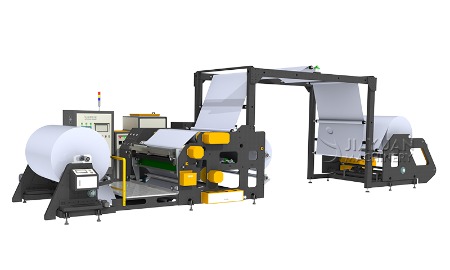
Adhesive coating machine
Machine learning (ML) is emerging as a powerful tool for
coating accuracy enhancement. ML algorithms, such as neural networks and random forests, can learn complex, non-linear relationships between multiple input variables (e.g., fluid viscosity, temperature, line speed, pump speed, die gap) and the output coat weight. These models can be trained using historical data from thousands of runs, capturing interactions that are not evident in simple linear models. Once trained, the ML model can be used as a "soft sensor" to predict the coat weight before the gauge measurement is available, allowing the control system to react faster. Alternatively, the ML model can be used in a model predictive control framework, replacing the first-principles model with a data-driven model. Some plants have implemented an ML-based "auto-tuning" system that continuously adjusts the PID gains based on the current process condition, achieving optimal performance across a wide operating range. Another application is anomaly detection: the ML model monitors the difference between the predicted and measured coat weight; if this difference exceeds a threshold, it indicates a fault (e.g., filter clogging, pump seal failure) and triggers an alert. This predictive diagnostic can prevent off-spec production. The success of ML depends on the availability of high-quality, labeled data and the expertise to build and maintain the models. Many coating machine vendors now offer cloud-based platforms that aggregate data from multiple lines and use ML to provide recommendations for accuracy improvement.
Case studies highlight the benefits of advanced control. In a battery electrode line, implementing MPC reduced the coat weight standard deviation from 1.2% to 0.6% at the same speed, allowing the target coat weight to be lowered by 2% while still meeting the specification, saving $200,000 per year in material cost. In an optical film line, R2R optimization with EWMA corrected a gradual drift caused by the aging of the UV lamp, maintaining the thickness within ±0.3 µm over a 24-hour run, compared to ±1.0 µm with manual adjustments. In a PSA tape line, an ML-based soft sensor predicted the coat weight 500 ms faster than the beta gauge, reducing the control lag and enabling the line to run 15% faster without increasing defects. These examples demonstrate that advanced control is not just an academic exercise; it delivers tangible economic returns. However, the implementation requires a significant investment in sensors, computing hardware, and personnel training. It also requires a culture of data-driven decision-making. The transition from PID to MPC or ML should be done stepwise: first, implement feedforward and PID; then, add R2R; finally, implement MPC or ML. Each step provides incremental improvement. The choice of strategy depends on the product's value and the complexity of the process.
Practical considerations for implementing advanced control include: ensuring that all sensors are reliable and calibrated; having a robust communication network for data transfer; collecting and storing historical data in a structured format; and validating the model's predictions with actual test runs. Also, the control system must have "fail-safe" modes: if the MPC or ML module fails, the system should revert to PID to maintain production. The operators must be trained to understand the new control logic and to interpret the additional information provided by the system. Regular audits of the model's performance are necessary; if the process changes (e.g., new fluid formulation), the model must be re-calibrated. In summary, advanced control strategies offer a clear path to superior coating accuracy, enabling manufacturers to meet ever-tighter specifications while reducing waste and increasing productivity. As the coating industry embraces Industry 4.0, these techniques will become standard, transforming coating accuracy from a challenge into a competitive advantage. The future lies in self-optimizing lines that use real-time data and machine learning to continuously improve their own performance, achieving accuracy levels that were previously unattainable.