Coating Curing: Advanced Monitoring, Process Control, and Energy-Efficient Technologies
Real-time monitoring of the cure degree is essential for high-quality, consistent production. Traditional off-line tests (e.g., solvent rub, hardness) are time-consuming and sample-destructive. Advanced online monitoring techniques include: (1) Near-infrared (NIR) spectroscopy: measures the concentration of reactive functional groups (e.g., epoxy, acrylate, isocyanate) by their absorption bands. The NIR sensor is mounted after the curing zone; the signal is correlated to the cure degree. The system can provide continuous feedback to the control system. (2) Dielectric analysis (DEA): measures the ionic conductivity and dipole relaxation of the coating; the dielectric loss factor changes as the polymer crosslinks. DEA sensors are placed in contact with the web; they are sensitive and can detect the cure degree in milliseconds. (3) Thermal imaging: measures the web temperature profile; a drop in temperature at the end of the oven may indicate incomplete curing (endothermic reaction). (4) Raman spectroscopy: similar to NIR, but provides more detailed molecular information. These advanced sensors enable closed-loop control of the curing process: the control system adjusts the oven temperature or UV lamp power in real-time to maintain the target cure degree, compensating for variations in coating weight, line speed, or ambient conditions. The integration of these sensors is a key part of Industry 4.0 in coating lines. In summary, advanced monitoring transforms curing from a "black box" to a well-controlled, predictable process.
Process control strategies for curing go beyond simple PID. Model predictive control (MPC) uses a dynamic model of the curing reaction to predict the cure degree based on the temperature or dose history. The MPC calculates the optimal setpoints for the oven zones or UV lamps to achieve the target cure degree at the end of the curing zone, considering the current line speed and coating weight. This allows the system to respond to speed changes preemptively, reducing the transient off-spec material. Run-to-run (R2R) optimization adjusts the baseline settings for each new batch based on the cure data from previous batches. For example, if the previous batch showed a slight under-cure, the R2R controller increases the temperature setpoint for the next batch. The combination of MPC and R2R provides robust, adaptive control that maintains consistent cure quality even with batch-to-batch variations in the coating formulation. In summary, advanced process control enhances the reliability and efficiency of the curing process.
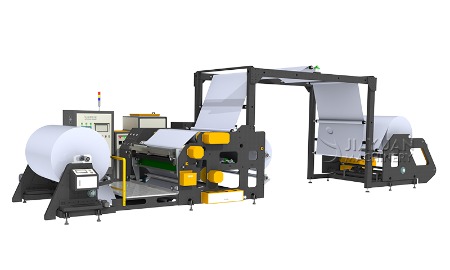
Adhesive coating machine
Emerging curing technologies offer energy and productivity benefits. LED UV curing has become a viable alternative to mercury lamps, with lower energy consumption, longer lifetime (20,000 hours vs. 1,000 hours), and no ozone generation. LED UV lamps emit a narrow wavelength band, which requires photoinitiators that match that band; however, they provide instant on/off, reducing idle energy. Electron beam (EB) curing uses high-energy electrons to generate free radicals without photoinitiators, allowing curing of thick, pigmented coatings. EB systems are compact and energy-efficient but require significant shielding and have high capital cost. Induction heating uses electromagnetic fields to heat the coating directly, providing rapid, uniform heating for metal substrates. NIR (near-infrared) curing uses wavelengths that penetrate the coating and heat it from within, offering fast drying and curing. These technologies are increasingly adopted in specialty applications where speed, energy savings, or low-temperature operation are critical. In summary, advanced curing technologies are expanding the capabilities and efficiency of coating lines.
Energy-efficient curing design: The curing process can consume 30-50% of the total line energy. Energy-saving measures include: (1) Heat recovery: using a heat exchanger to preheat the fresh air with the exhaust air, reducing fuel consumption by 20-40%. (2) Improved insulation: reducing heat loss from the oven walls. (3) Variable-speed fans: reducing airflow when the line is at low speed. (4) LED UV: using LED lamps which consume about half the energy of mercury lamps for the same output. (5) Optimized profile: using the minimum temperature and time required for cure, avoiding over-cure. (6) Zone control: using separate zones to heat only the area where curing is occurring. The buyer should conduct an energy audit and implement the most cost-effective measures. The payback period for many energy-saving measures is 1-3 years. In conclusion, energy-efficient curing is not only good for the environment but also improves the line's profitability.
Practical implementation tips: (1) Work closely with the coating supplier to understand the curing requirements and the margins. (2) Install inline cure monitoring sensors to provide real-time feedback. (3) Use a control system with predictive algorithms to adjust the curing parameters proactively. (4) Regularly calibrate the sensors and the curing equipment. (5) Monitor the energy consumption and set targets for reduction. (6) Train operators on the curing process and the control system. (7) Document the curing profiles and the corresponding quality results to build a knowledge base. In summary, advanced curing technologies and control strategies enable coating lines to achieve higher speeds, better quality, and lower energy consumption, providing a competitive advantage in the market. The future of curing lies in smart, adaptive systems that continuously optimize themselves based on real-time data and predictive models, pushing the boundaries of what is possible in coating production.