Coating Curing: Fundamental Kinetics, Thermal and UV Curing Systems, and Process Optimization for Thermoset Coatings
Curing is distinct from drying: while drying removes volatile solvents, curing involves chemical reactions that build molecular weight and form a three-dimensional polymer network. The degree of cure—the fraction of reactive groups that have reacted—determines the coating's final properties: hardness, adhesion, solvent resistance, flexibility, and durability. Insufficient curing results in a soft, tacky, or weak film that fails in service; over-curing can cause brittleness, discoloration, or substrate degradation. The curing kinetics are typically described by the Arrhenius equation for thermal systems, where the reaction rate depends exponentially on temperature. For UV systems, the kinetics depend on the photon flux, the photoinitiator concentration, and the reactivity of the monomers/oligomers. The time-temperature (or time-dose) relationship is the key to achieving the target cure degree. For thermal curing, the coating must be held at a specified temperature for a sufficient residence time; for UV, a specified dose (intensity × time) is required. The curing system must be designed to deliver the required energy while maintaining substrate temperature within safe limits. In summary, understanding the curing chemistry and kinetics is the foundation for designing an effective curing process.
Thermal curing is the most widely used method, employing convection ovens, infrared (IR) heaters, or a combination. Convection ovens heat the air, which transfers heat to the coating by convection. They are versatile and provide uniform heating but are relatively slow. Multi-zone ovens allow a staged temperature profile: a warm-up zone, a hold zone at the curing temperature, and a cooling zone. The warm-up zone prevents thermal shock and allows solvent to evaporate gradually; the hold zone provides the time-temperature integral for crosslinking; the cooling zone stabilizes the coated web before winding. The residence time is determined by the oven length and the line speed. IR curing uses radiant heat to directly heat the coating, which is faster and more energy-efficient, but it can cause non-uniform heating if the IR lamps are not properly positioned. IR is often used as a pre-heater before the convection oven. The temperature profile is critical: a typical profile for epoxy curing might be 80°C for 2 minutes, 150°C for 3 minutes, then cooling. The profile is optimized using differential scanning calorimetry (DSC) to measure the heat of reaction and to determine the degree of cure. In summary, thermal curing systems require careful temperature profiling to achieve complete crosslinking without damaging the substrate or the coating.
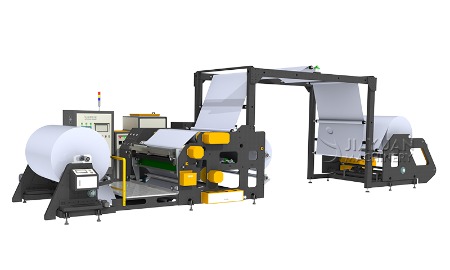
Adhesive coating machine
UV curing uses ultraviolet light to initiate photochemical reactions, typically free-radical or cationic polymerization. The coating contains photoinitiators that absorb UV light and generate reactive species (free radicals or cations) that trigger the polymerization of monomers and oligomers. UV curing is extremely fast—typically 0.1 to 5 seconds—making it ideal for high-speed lines and heat-sensitive substrates. The UV dose (energy per area) is the product of the intensity (W/cm²) and the exposure time. The intensity is determined by the lamp power and the focusing optics; the exposure time is the width of the UV lamp zone divided by the line speed. The UV spectrum must match the photoinitiator's absorption; mercury lamps emit broadband UV, while LED lamps emit narrow-band UV (e.g., 365 nm, 395 nm). LED UV offers longer lamp life, lower heat emission, and instant on/off capability, but it is more expensive and may require specific photoinitiators. The UV curing system includes the lamp housing, a reflector, a cooling system, and safety shielding. Oxygen inhibition is a common challenge in radical UV curing, as oxygen can scavenge free radicals, leading to under-curing at the surface. This is mitigated by using a higher photoinitiator concentration, conducting the cure under inert gas (nitrogen), or using a higher lamp intensity. In summary, UV curing offers unmatched speed and low-temperature operation, but it requires careful formulation and lamp selection.
Curing system optimization aims to achieve the required cure degree at the maximum line speed with minimum energy consumption. For thermal curing, the optimization involves adjusting the oven temperature profile and the airflow. A stepwise approach is used: (1) Determine the minimum cure temperature and time from the coating supplier's data. (2) Measure the actual web temperature using a temperature data logger; adjust the oven settings to achieve the target temperature profile. (3) Verify the cure degree by off-line tests (e.g., MEK double-rub, hardness, adhesion) and by online residual solvent or temperature monitoring. (4) Incrementally increase the line speed and adjust the oven temperature to maintain the same time-temperature integral. (5) Monitor the defect rate; if defects appear, reduce the speed or adjust the profile. For UV curing, the optimization involves adjusting the lamp power and the number of lamps to deliver the required dose. The dose is measured by a radiometer; the lamp power is adjusted to achieve the target dose at the current speed. The optimization should also consider energy efficiency: using heat recovery in thermal ovens, or using LED UV lamps which consume less power and have longer life. The energy cost is a significant part of the operating cost, so the optimal curing system is one that delivers the required cure at the lowest energy cost. In summary, optimization is a continuous process that balances speed, quality, and energy.
Troubleshooting curing defects: (1) Under-cure: the coating is tacky, or the solvent resistance is poor. Increase the temperature, residence time, or UV dose; check the oven temperature sensors or the UV lamp condition. (2) Over-cure: the coating is brittle or discolored. Reduce the temperature or residence time; for UV, reduce the lamp power or speed. (3) Blistering: trapped solvent expands during curing. Reduce the initial temperature ramp or increase the drying time before curing. (4) Cracking: excessive shrinkage or stress. Reduce the curing temperature or use a more flexible binder. (5) UV cure gradient: the top is cured but the bottom is not. Use a longer wavelength UV or increase the photoinitiator concentration. A systematic approach using root cause analysis is effective. In conclusion,
coating curing is a complex but well-understood process that requires a deep knowledge of the polymer chemistry, the curing equipment, and the interplay with the coating line. By selecting the appropriate curing technology, optimizing the profile, and troubleshooting defects, the coating line can achieve consistent, high-quality, and durable coated products that meet the most demanding specifications.