Coating Defects: Classification, Root Causes, and Systematic Troubleshooting
Coating defects are the bane of coating operations; they cause waste, rework, and customer complaints. Defects can be categorized by their visual appearance: linear (streaks, scratches), point (pinholes, craters), area (orange peel, mottle), and edge (edge bead, ooze). They can also be classified by their location: machine-direction (MD) or transverse (TD), and by their frequency: continuous or intermittent. The first step in troubleshooting is to characterize the defect: take a sample, examine it under magnification, note the pattern, and determine when and where it occurs. For example, a continuous streak in the MD is almost always caused by a scratch on the die lip or a particle lodged in the slot. An intermittent streak may be due to a piece of dried coating breaking off and reattaching. Pinholes are often due to bubbles in the fluid or air entrainment. Edge bead is a TD defect near the edges. Orange peel is a surface roughness that appears as a fine texture. Blisters are raised bubbles on the surface. Mottling is a cloudy, uneven appearance. Once the defect is characterized, the root cause can be traced using a fault tree or fishbone diagram that considers the fluid, the machine, the method, and the environment (the 4Ms).
The most common defects and their typical causes: "Streaks" are longitudinal lines caused by die lip damage, shim wrinkles, or contamination. Fix: inspect and clean the lip, replace the shim, or improve filtration. "Pinholes" are small holes caused by bubbles, air entrainment, or substrate contamination. Fix: degas the fluid, increase vacuum, or clean the substrate. "Edge bead" is a thick edge due to surface tension; fix: use tapered shims, edge vacuum, or air knives. "Orange peel" is a rough surface due to poor leveling; fix: increase temperature, reduce viscosity, or add leveling agents. "Blistering" is a bubble caused by trapped solvent; fix: reduce drying rate or increase oven temperature gradually. "Mottling" is a cloudy appearance due to non-uniform solids or poor wetting; fix: improve mixing, or treat the substrate. "Sagging" is a downward flow of the coating; fix: reduce coat weight or increase viscosity. "Craters" are circular depressions due to surface tension gradients; fix: reduce surface tension or add anti-crater agents. "Chatter" is a periodic thickness variation due to vibration; fix: balance rolls, dampen vibration, or change speed. This list is not exhaustive, but it covers the most frequent issues.
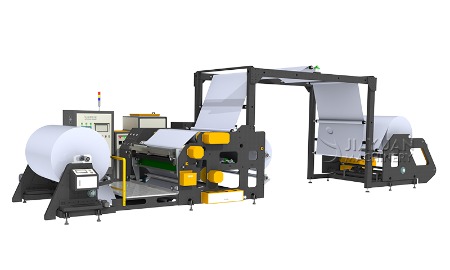
Adhesive coating machine
A systematic troubleshooting method is essential for efficient problem-solving. The method consists of: (1) Define the defect—describe it precisely; (2) Measure it—use a microscope, profilometer, or gauge to quantify; (3) Analyze the pattern—is it periodic, random, continuous, or at the edges? (4) Check the process data—review temperature, speed, pressure, tension, and viscosity logs; (5) Inspect the coating head—check the die lip, shim, doctor blade, or roll surfaces; (6) Inspect the fluid—check for gels, particles, or viscosity change; (7) Check the substrate—look for contamination, defects, or poor surface energy; (8) Check the drying/curing—verify temperature, airflow, and residence time; (9) Perform a small test—change one parameter at a time to see if the defect disappears; (10) Implement the corrective action and verify. This structured approach reduces the time spent on trial-and-error. It is also helpful to maintain a defect log that correlates each defect with the operating conditions; over time, this log becomes a valuable resource for rapid diagnosis. Training operators to use this method empowers them to solve many issues without engineering intervention.
Prevention is better than cure. Preventing defects involves proactive measures: (1) Maintain the coating head—regular cleaning and inspection; (2) Filter the fluid effectively—use appropriate mesh size and change filters regularly; (3) Degas the fluid to remove bubbles; (4) Control the temperature and viscosity within narrow ranges; (5) Pre-treat the substrate (corona, priming) to improve wetting; (6) Keep the environment clean (dust-free, stable temperature); (7) Use online inspection systems (cameras, gauges) to detect defects early; (8) Implement a quality management system (ISO 9001) that includes defect prevention. By following these practices, the defect rate can be reduced to less than 1% of production, which is the industry benchmark for high-quality coating. In summary,
coating defects are inevitable but manageable. With a systematic understanding of their causes and a rigorous troubleshooting approach, they can be minimized, leading to higher yields and customer satisfaction. The key is to combine operator vigilance, process control, and maintenance discipline.