Coating Die: Advanced Features, Active Profile Control, and Troubleshooting
Active profile control is the most significant advancement in slot-die technology. It allows the die lip gap to be adjusted locally across the width, correcting thickness variations in real-time. The most common implementation is thermal actuators: an array of cartridge heaters is embedded in the die body near the lip. Each heater controls a small zone (e.g., 20-50 mm wide). By heating or cooling the zone, the thermal expansion changes the lip gap locally: heating expands the metal, reducing the gap and thus lowering the coating thickness; cooling contracts the metal, increasing the gap and raising the thickness. The control system receives the thickness profile from a scanning gauge and calculates the required heater power for each zone to flatten the profile. The response time of thermal actuators is several seconds to minutes, so they are used for slow drifts (thermal changes, die wear). Piezoelectric actuators offer faster response (milliseconds) and are used for high-frequency corrections. Active profile control can reduce thickness variation by up to 70%, achieving uniformity better than ±0.5%. It also reduces edge bead by adjusting the gap at the edges. The system is calibrated during commissioning and should be re-calibrated periodically. In summary, active profile control is a powerful tool that enables the production of ultra-uniform coatings with minimal waste.
Edge bead reduction is another advanced feature. Edge bead—the thickening at the web edges—is caused by surface tension and pressure gradients. Several methods are used: (1) Tapered shims: the shim is cut with a gradual taper at the edges, reducing the slot gap and thus the coat weight locally. (2) Edge vacuum: a vacuum slot is placed at the edges to suck excess fluid. (3) Air knives: a jet of air blows off the excess fluid. (4) Edge deckles: movable blocks that physically block the flow at the edges. (5) Active profile control at the edges: the thermal actuators at the ends of the die are used to adjust the gap. The edge bead width and thickness can be measured by a profilometer; the parameters are adjusted to minimize it. The goal is to reduce the trim waste; in some advanced lines, edge bead is reduced to less than 2 mm. The buyer should work with the die supplier to optimize the edge bead reduction system for their specific fluid and process. In summary, edge bead reduction systems directly improve material utilization and reduce costs.
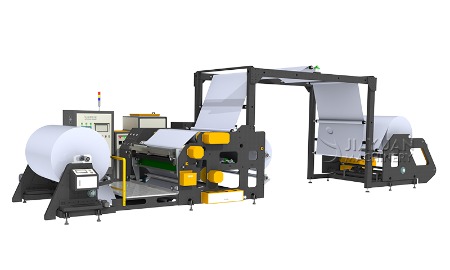
Adhesive coating machine
Die wear is inevitable, especially with abrasive fluids. The wear reduces the lip sharpness and changes the gap, causing non-uniform coating. Wear can be detected by inspecting the die lip under a microscope or by measuring the gap. To extend die life, wear-resistant coatings such as DLC, TiN, or ceramic coatings are applied to the die lip. These coatings can increase the life by 3-5 times. The die body may also be hardened by heat treatment. The buyer should consider the expected wear rate and choose the appropriate material and coating. When the die is worn beyond the allowable limit, it can be re-machined and re-coated. This is a significant cost, so proactive maintenance is essential. In summary, wear management is a key part of die ownership.
Troubleshooting die-related defects: (1) Streaks: continuous longitudinal lines. Check the die lip for nicks or scratches; clean or polish the lip. Also, check the shim for wrinkles or damage. (2) Edge bead: thick edges. Adjust the shim taper, the edge vacuum, or the active profile at the edges. (3) Center thick: thick in the middle. This may be due to die deflection; increase the die's rigidity or use a die with a crowned profile. (4) Side-to-side variation: the coating is thicker on one side. Check the die's alignment to the backup roll; adjust the die's angle. (5) Pulsation: periodic thickness variation in the machine direction. Check the pump and the pulse dampener. (6) Gel particles: random thick spots. Check the filtration and the fluid's quality. A systematic approach, using the gauge's profile and the operator's observations, is effective. The buyer should maintain a die log that records all adjustments, cleaning, and wear measurements. In conclusion, advanced die features and a disciplined troubleshooting approach enable the coating line to maintain high quality and productivity, even with challenging fluids and tight specifications.