Coating Die: Design, Materials, and Precision Engineering for Uniform Coating
The coating die, whether a slot-die, a gravure cylinder, or a roll coater's metering element, is the tool that transforms the bulk flow of coating fluid into a controlled, uniform film on the substrate. For slot-die coating, the die consists of two precision-machined blocks that form a narrow slot (typically 0.1-1.0 mm wide) through which the fluid is extruded. The die body contains an internal manifold that distributes the fluid from the inlet to the full width of the slot. The manifold geometry is critical for achieving uniform flow distribution across the web. The most common manifold designs are the "coat-hanger" (or fish-tail) and the "T-slot." The coat-hanger manifold uses a gradually expanding channel that reduces the pressure drop from the center to the edges, ensuring a constant flow rate per unit width. The T-slot manifold is simpler but may require a tapered cross-section to compensate for pressure losses. The manifold is often designed using Computational Fluid Dynamics (CFD) simulations to optimize the shape and size for a specific fluid viscosity and flow range. The shim—a thin metal foil placed between the two die halves—determines the slot gap and, in some designs, the coating width. The shim can have straight edges or tapered edges to reduce edge bead. The die lip—the exit edge of the slot—must be sharp and have a high-quality surface finish (Ra < 0.1 µm) to ensure clean flow separation and to prevent droplets from forming. In summary, the die's internal geometry and surface finish are the primary determinants of coating uniformity.
The materials used for coating dies must withstand the mechanical, chemical, and thermal stresses of the process. The most common material is precipitation-hardened stainless steel (e.g., 17-4 PH or 440C), which offers good corrosion resistance, hardness (45-55 HRC), and machinability. For high-wear applications, such as abrasive slurries, the die lip may be coated with tungsten carbide or diamond-like carbon (DLC) to extend its life. For gravure cylinders, the base material is steel, copper-plated for engraving, and then chrome-plated for hardness and wear resistance. Ceramic gravure cylinders (chromium oxide) are used for highly abrasive coatings. For hot-melt adhesives, the die must have good thermal conductivity and be heated by cartridge heaters or oil circulation; tool steel (e.g., A2) with high hardness is often used. The die body must have sufficient rigidity to withstand the internal pressure (up to 100 bar) without deflecting, which would cause non-uniform gap. The die's thermal expansion must be accounted for; the die and the backup roll are usually made of materials with similar coefficients of thermal expansion to maintain the gap as temperature changes. In summary, the choice of material affects the die's durability, coating quality, and maintenance frequency.
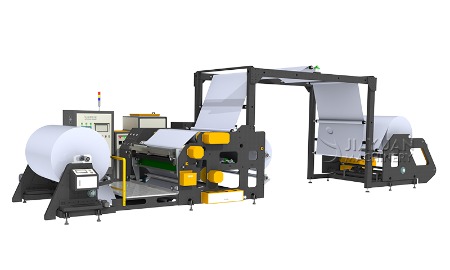
Adhesive coating machine
Precision machining of the
coating die is essential. The two die halves must be machined to a flatness of better than 0.005 mm over the entire width. The slot gap must be uniform within ±2 µm. The shim must be flat within 0.001 mm and free of burrs. The die lip is ground and polished to a mirror finish. The assembly of the die involves clamping the two halves with bolts that are torqued to a specific sequence and value to ensure even compression of the shim. If the bolts are over-torqued, the die may distort; if under-torqued, the shim may not seal, causing leaks. The die is then aligned with the backup roll using precision micrometers; the gap is set and measured with feeler gauges or laser sensors. The die's internal surfaces should be free of machining marks that could trap particles. The surface finish is measured with a profilometer. The die should be tested for flow uniformity by applying a colored fluid and observing the thickness profile. In summary, precision engineering and assembly are the foundations of a high-performance coating die.
Shim selection and design are critical for controlling the coat weight and edge bead. The shim thickness determines the nominal slot gap; for low-viscosity fluids, a thinner shim (0.1-0.2 mm) is used; for high-viscosity, a thicker shim (0.3-1.0 mm). The shim's width defines the coating width; the shim can be cut with a taper at the edges to reduce the gap gradually, thereby reducing edge bead. The taper length and angle are optimized based on the fluid's surface tension and the line speed. The shim material must be flat and resistant to deformation; stainless steel shims are common, but beryllium copper is used for its stability. The shim is a consumable; it should be replaced after a certain number of uses or when it becomes damaged. The shim's flatness should be checked before each installation. In some advanced dies, the shim is replaced by an adjustable deckle system that allows changing the coating width without replacing the shim. In summary, careful shim selection and design contribute to a flat coating profile and reduced trim waste.
Maintenance of the coating die includes regular cleaning (as discussed in a previous article) and periodic inspection for wear. The die lip should be inspected for nicks and scratches; small defects can be polished out, but deep scratches require re-machining. The internal manifold should be inspected for deposits; ultrasonic cleaning may be necessary. The die bolts should be re-torqued periodically to ensure consistent compression. The die's alignment should be checked after any maintenance. The die's service life depends on the fluid's abrasiveness and the cleaning frequency; a well-maintained die can last for many years. The buyer should consider purchasing a spare die to reduce downtime during maintenance. In conclusion, the coating die is a precision instrument that requires meticulous care and attention. By understanding the design principles, material choices, and maintenance requirements, the coating engineer can achieve consistent, high-quality coating, maximizing the die's performance and longevity.