Coating Drying Process: Advanced Drying Technologies, Energy Efficiency, and Solvent Recovery
High-velocity impingement drying is a technology that uses air jets with velocities up to 50 m/s to impinge directly on the wet coating. The high velocity breaks the boundary layer, dramatically increasing the heat and mass transfer coefficients. This allows the oven to be shorter—reducing the footprint—or the line speed to be higher. The impingement nozzles are arranged in a staggered pattern to ensure uniform coverage across the web. The air temperature can be higher than in conventional ovens, but the high velocity also reduces the risk of skinning because the surface is constantly cooled by the evaporating solvent. However, the high air velocity can cause web flutter, so the web must be supported by air flotation bars or by a tension system. Impingement drying is particularly effective for thick coatings and for high-speed lines. The buyer should consider impingement ovens for new lines or for upgrading existing ones. In summary, impingement drying offers a significant improvement in drying rate and space efficiency.
Air flotation ovens are used for delicate webs, such as thin films, where contact with rollers could cause scratches or contamination. In these ovens, the web is supported by a cushion of air from nozzles that are angled to provide a stable, non-contact support. The air also serves as the drying medium. The flotation bars are designed to keep the web straight and to prevent wrinkling. The web tension is low, minimizing stress. Air flotation ovens are common in optical film and medical coating lines. The drying uniformity is excellent because the web is fully exposed to the airflow on both sides. The oven's length is similar to conventional ovens, but the non-contact feature is a key advantage. In summary, air flotation ovens are essential for sensitive substrates and high-quality applications.
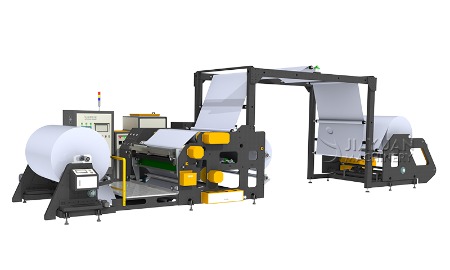
Adhesive coating machine
Combined IR and convection systems provide rapid heating and efficient drying. IR (infrared) heaters, either electric or gas-fired, are placed at the oven's entrance to pre-heat the web and the coating. The IR energy is absorbed directly by the coating, raising its temperature quickly without heating the surrounding air. This accelerates the initial evaporation, reducing the residence time needed in the convection section. After the IR zone, the web enters the convection section for the bulk drying. The combination can reduce the total oven length by 20-30%. The IR power and wavelength must be matched to the coating's absorption spectrum; for water-based coatings, mid-IR is effective. The IR heaters can be zoned to correct any cross-web temperature variations. In summary, combined systems offer a flexible and efficient drying solution, especially for speed-limited lines.
Energy efficiency is a major focus in drying. The drying process is energy-intensive; the cost of heating the air can be a significant portion of the total operating cost. Heat recovery systems capture the heat from the exhaust air and transfer it to the incoming fresh air. A plate heat exchanger or a thermal wheel is used; the recovery efficiency can be 50-70%. This reduces the fuel or electricity needed to heat the fresh air. Another method is to recirculate a portion of the exhaust air back into the oven; this reduces the amount of fresh air that must be heated. However, the recirculated air must have a low solvent concentration to maintain the drying driving force. The oven's control system should optimize the recirculation ratio based on the solvent load and the temperature. In summary, energy efficiency measures reduce operating costs and the environmental footprint.
Solvent recovery is mandatory for solvent-based coatings to comply with environmental regulations and to recover valuable solvent. The solvent-laden exhaust air is passed through a recovery system. The most common technology is activated carbon adsorption: the solvent vapors are adsorbed onto carbon beds, and then desorbed with steam or hot gas, condensed, and recycled. The recovery efficiency is typically 95-99%. The recovered solvent is often distilled to remove impurities and reused in the coating formulation, offsetting the cost of fresh solvent. The carbon beds must be regenerated periodically; the regeneration frequency depends on the solvent load. Another technology is thermal oxidation, where the VOCs are combusted at high temperature; the heat can be recovered. The choice between adsorption and oxidation depends on the solvent type, the concentration, and the local regulations. In summary, solvent recovery is both an environmental and an economic necessity, and it is an integral part of the drying system for solvent-based coatings. By implementing advanced drying technologies, heat recovery, and solvent recovery, the coating line can achieve high-speed, high-quality drying with minimal energy use and environmental impact, ensuring sustainable and profitable operation.