Coating Drying Process: Fundamentals, Equipment, and Optimization for Solvent and Water-Based Coatings
The drying process is a critical step in coating production that transforms the liquid coating into a solid, functional film. Drying involves the evaporation of volatile components—solvents (for solvent-based coatings) or water (for water-based coatings)—and, in some cases, the crosslinking of the polymer. The drying rate is governed by the heat and mass transfer coefficients: heat is transferred from the hot air to the coating, and the evaporated solvent is carried away by the air. The drying process typically occurs in three stages: (1) Constant-rate period: the surface of the coating is wet, and the evaporation rate is limited by the heat transfer; the rate is constant and high. (2) Falling-rate period: the surface begins to dry, and the evaporation rate is limited by the diffusion of solvent from the interior to the surface; the rate decreases. (3) Final period: the coating is nearly dry, and the residual solvent evaporates slowly. The drying curve (solvent content vs. time) is a key design parameter. The goal is to achieve complete drying—residual solvent below the specified limit—without causing defects such as skinning, blistering, or cracking. The drying equipment must provide the required heat and airflow while maintaining the substrate's temperature within its tolerance. In summary, understanding the drying fundamentals is essential for selecting and operating the drying system.
The most common drying equipment is the convection oven, where heated air is blown over the web. The oven consists of multiple zones, each with independent temperature and airflow control. The air is heated by gas burners or electric heaters, and it is circulated by high-velocity fans. The air impinges on the wet coating, breaking the boundary layer and enhancing heat and mass transfer. The air temperature is typically 40-150°C for solvent-based and water-based coatings; for hot-melt, no drying is needed. The residence time in the oven is determined by the line speed and the oven length; for high-speed lines, the oven can be 20-50 meters long. The airflow velocity is typically 5-20 m/s; higher velocity increases the drying rate but may cause web flutter. The oven is designed with a slight negative pressure to prevent solvent vapor from leaking into the production area. The solvent-laden air is exhausted to a solvent recovery system (for solvent-based) or to the atmosphere (for water-based, if compliant). Infrared (IR) ovens use radiant heat to directly heat the coating, which can be more efficient for thin coatings, but they are less uniform. Many modern ovens combine IR pre-heaters with convection zones to achieve rapid drying with good uniformity. In summary, the choice of drying equipment depends on the coating type, the required speed, and the energy efficiency.
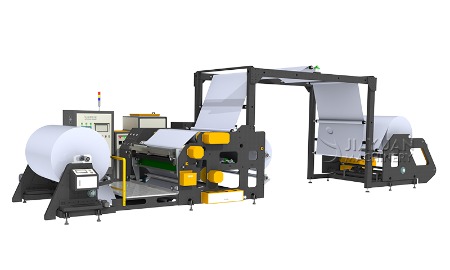
Adhesive coating machine
The drying profile—the temperature and airflow as a function of time—is critical for quality. For solvent-based coatings, a typical profile is: Zone 1 at low temperature (e.g., 50-70°C) to avoid skinning; Zone 2 at moderate temperature (80-100°C) for bulk evaporation; Zone 3 at high temperature (110-130°C) for final drying and crosslinking. For water-based coatings, the profile is similar but with lower temperatures (40-90°C) due to the higher latent heat of water and the sensitivity of water-based emulsions. The oven's temperature must be uniform across the width; a temperature variation of ±2°C is typically acceptable. The airflow should also be uniform; differential airflow causes differential drying, leading to mottling or curling. The oven's control system uses PID controllers to maintain the setpoints. The operator can adjust the profile based on the coating's behavior; for example, if blistering occurs, the initial temperature is reduced. The residual solvent is monitored by an NIR gauge after the oven; if it exceeds the limit, the speed is reduced or the temperature is increased. In summary, a well-designed drying profile ensures complete drying with minimal defects, maximizing line speed and quality.
Optimization of the drying process aims to maximize the line speed while maintaining quality. The speed is limited by the oven's drying capacity; to increase speed, the oven must be longer, the temperature higher, or the airflow higher. However, higher temperature may cause skinning or substrate damage; higher airflow may cause web flutter. The optimization is a trade-off: the buyer can use a design of experiments (DOE) varying temperature, airflow, and speed, and measuring the residual solvent and the defect rate. The results are used to find the maximum speed that still meets the quality criteria. The use of high-velocity impingement air, IR pre-heaters, and multiple zones can significantly increase the drying capacity. The energy consumption of the drying process is a major cost; heat recovery systems can capture the exhaust heat to preheat the incoming air, reducing fuel consumption by 20-30%. The oven's insulation should be maintained; any heat loss adds to the energy cost. In summary, optimization is a continuous effort to balance speed, quality, and energy efficiency.
Troubleshooting drying-related defects: (1) Blistering: bubbles under the coating. Reduce the initial temperature or increase the airflow to remove solvent vapor faster. (2) Skinning: a surface film that traps solvent. Reduce the temperature gradient and use a slower initial ramp. (3) Incomplete drying: residual solvent; increase the temperature or reduce the speed. (4) Wrinkling: web deformation due to uneven drying; improve the airflow uniformity and the tension control. (5) Curling: differential shrinkage; adjust the drying profile or use a substrate with a higher heat stability. The operator should monitor the oven's temperature uniformity and the residual solvent, and adjust the parameters accordingly. In conclusion, the drying process is a complex interplay of heat transfer, mass transfer, and fluid dynamics. By understanding the fundamentals, selecting the right equipment, optimizing the profile, and troubleshooting defects, the coating line can achieve efficient, high-quality drying, enabling the production of defect-free coated products at competitive speeds.