Coating Filter: Advanced Filtration Technologies, Validation, and Cleanroom Integration
In high-precision coating applications, standard cartridge filters may not be sufficient to achieve the required cleanliness. Advanced filtration technologies include: (1) Membrane filters: thin polymer films with a precise pore size (e.g., 0.1-1.0 µm). They provide absolute retention and are used for ultra-fine filtration of low-viscosity fluids. They are often used in optical coating and semiconductor applications. (2) Depth filters: thick, porous media that capture particles throughout the depth of the filter. They have higher dirt-holding capacity but may release fibers. They are used for medium-viscosity fluids. (3) Absolute-rated cartridges: tested to retain a specified percentage of particles of a given size; they are more reliable than nominal-rated filters. (4) Nanofiber filters: use nanofiber layers to achieve high efficiency with low pressure drop; they are gaining popularity. The choice of advanced filter depends on the required cleanliness level, the fluid's compatibility, and the budget. For example, a 0.2 µm membrane filter is used for sterile filtration in medical coating. The filter housing must be designed to minimize dead zones where particles can accumulate. The buyer should work with the filter supplier to select the optimal filter for their specific application, often based on a pilot test.
Validation of filtration performance is required for regulated applications. The validation includes: (1) Particle retention test: using a challenge of known-sized particles to verify that the filter removes them to the specified level. (2) Bubble point test: a non-destructive test that determines the integrity of membrane filters by measuring the pressure required to force air through the wetted filter pores. (3) Flow rate and pressure drop measurement: to ensure the filter operates within the specified range. (4) Extractables test: to ensure the filter does not release any contaminants into the fluid. (5) Bacterial retention test (for sterile applications). The validation should be performed by a qualified laboratory, and the results should be documented. The buyer should also establish a routine integrity test protocol for the filters, such as a bubble point test before each production run, to ensure that the filter is not damaged or bypassing. In summary, validation provides confidence that the filtration system consistently delivers the required cleanliness, which is essential for product quality and regulatory compliance.
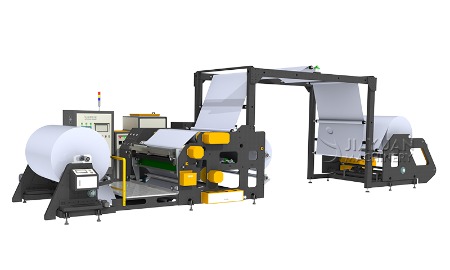
Adhesive coating machine
Integration of filtration with cleanroom operation is critical for high-purity coatings. The coating fluid must be handled in a cleanroom environment (Class 100 to Class 10,000) to prevent airborne particles from entering the fluid. The filter housing and the fluid lines should be sealed and kept under positive pressure to prevent ingress of contaminated air. The filter should be installed in a cleanroom-compatible housing with smooth surfaces and easy sanitization. The filters should be sterilized (for medical applications) using gamma radiation or steam, and they should be changed under cleanroom conditions. The fluid's particle count should be monitored by a particle counter placed downstream of the filter; the particle count should be below the specified limit. If the particle count rises, the filter may be failing, and it should be replaced. The operator should also monitor the pressure drop and the bubble point. In summary, cleanroom integration ensures that the coating fluid remains ultra-clean from the tank to the coating head, enabling the production of high-quality, defect-free coatings for critical applications.
Cost considerations for advanced filtration: high-performance filters are more expensive, but they reduce the defect rate and the associated scrap cost. The buyer should perform a cost analysis: (1) Calculate the cost of defects (scrap, rework, customer returns) without advanced filtration. (2) Estimate the reduction in defects with advanced filtration. (3) Subtract the cost of the advanced filters and the validation. If the net savings are positive, the investment is justified. The buyer should also consider the filter's service life; a longer-lasting filter may offset the higher initial cost. In many cases, the cost of advanced filtration is minimal compared to the cost of quality failures. In summary, advanced filtration is an investment in quality and brand reputation; it is essential for manufacturers of high-value coated products.
Practical implementation: (1) Start by assessing the current particle load using a particle counter. (2) Select a filter with a micron rating that is one step finer than the current one and evaluate the results. (3) Validate the filter's performance with the specific fluid and process conditions. (4) Integrate the filter into the cleanroom workflow, with procedures for sterile handling. (5) Establish a monitoring program for pressure drop, particle count, and bubble point. (6) Train operators on the new filter's handling and validation procedures. (7) Document all activities and results. By following these steps, the coating line can achieve the ultra-clean conditions required for the most demanding applications. In conclusion, advanced filtration technologies, when properly validated and integrated with cleanroom practices, enable the production of flawless coatings, opening doors to high-margin markets and establishing the manufacturer as a leader in quality and reliability.