Coating Head: Advanced Geometry, Materials, and Active Control Technologies
The geometry of a coating head has evolved from simple slits to sophisticated designs optimized through computational fluid dynamics. In slot-die heads, the manifold is the internal cavity that distributes fluid from the inlet to the full width of the slot. The most common manifolds are the "coat-hanger" (or fish-tail) and the "T-slot" designs. The coat-hanger manifold uses a gradually expanding channel that reduces pressure drop across the width, ensuring a uniform flow rate at every point. The T-slot manifold uses a straight transverse channel connected to a central feed; it is simpler but may suffer from higher pressure drop at the edges unless the channel cross-section is carefully tapered. To improve uniformity, some advanced heads feature a "cascaded" manifold with multiple inlet ports and internal baffles that actively shape the flow profile. The slot gap itself can be engineered with a slight taper—narrower at the edges to compensate for the edge bead—or with a "land" length that affects the shear rate and thus the fluid's viscosity. For gravure heads, the cell geometry has diversified from traditional quadrangular pyramids to hexagonal and helical patterns, each offering different release and transfer characteristics. Hexagonal cells provide more uniform emptying, reducing pattern visibility. For roll heads, the roll surface texture and grooving patterns are optimized to enhance fluid pickup and transfer; some rolls have a "micro-grooved" surface that reduces splashing at high speeds.
Material selection for coating heads is driven by the need for wear resistance, corrosion resistance, and thermal stability. For slot-dies, the die body is typically made of precipitation-hardened stainless steel (e.g., 17-4 PH) or tool steel (e.g., A2) that can be hardened to 55-60 HRC. The die lip, which experiences the highest abrasion, may be coated with diamond-like carbon (DLC) or titanium nitride (TiN) to extend service life. For highly abrasive slurries (e.g., carbon black in battery coatings), tungsten carbide or ceramic (alumina or silicon carbide) inserts are used at the lip. For gravure cylinders, the base steel is copper-plated for engraving, then chrome-plated for wear resistance; alternatively, ceramic cylinders (chromium oxide) are used for abrasives. The doctor blade is usually steel but can be ceramic-tipped for long life. For roll coaters, the rolls can be chrome-plated steel, rubber-covered (NBR, EPDM, PU), or ceramic-coated. Rubber covers must be resistant to the solvent; otherwise, they swell and lose dimensional accuracy. All materials must be compatible with the coating fluid—no pitting, stress corrosion cracking, or galvanic corrosion. Regular material testing, such as hardness and corrosion tests, should be part of the maintenance program. The surface finish of the
coating head components is critical: for slot-dies, the lip must have an Ra < 0.1 µm to prevent fluid adhesion and defect initiation; for gravure, the cylinder surface must be smooth outside the cells to allow proper doctoring; for roll coaters, the roll surface roughness determines the fluid film thickness and release characteristics.
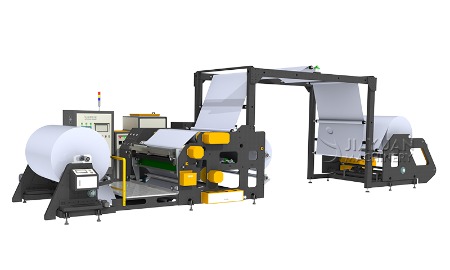
Adhesive coating machine
Active control technologies are revolutionizing coating head performance. Traditional heads are passive—once set, they maintain a fixed geometry. Active heads incorporate actuators that can adjust the die lip gap locally across the width. Thermal actuators consist of heater cartridges placed near the lip; by controlling the temperature of each zone, the thermal expansion of the metal changes the lip gap. This allows dynamic correction of thickness profiles: if an online gauge detects a thick region, the actuator heats that zone to expand the lip, reducing the gap and thus lowering the coat weight. Piezoelectric actuators offer faster response (milliseconds) and finer resolution than thermal ones, but they are more expensive and have limited stroke. Some advanced slot-dies have "active shims" where the shim thickness can be varied by piezoelectric elements, changing the slot gap locally. In gravure coating, "engraving on the fly" is being developed where the cylinder cell depth can be modulated by a laser during operation, enabling pattern variation. In roll coaters, "load-zone control" uses arrays of hydraulic cylinders to apply non-uniform nip pressure, compensating for roll deflection and edge bead. These active controls require sophisticated software that uses real-time thickness data and a mathematical model of the head's response to compute the optimal actuator settings. The closed-loop system can then maintain the coat weight profile within ±0.5% of target, even with changing fluid properties or web tension. The implementation of active control reduces waste, improves first-pass yield, and allows operation closer to the process boundaries, maximizing speed.
Maintenance of coating heads is a specialized craft. For slot-dies, the die must be disassembled regularly—typically after each batch or every shift. The internal manifold is flushed with solvent, and the shim is inspected for flatness on a granite surface plate. Any nicks on the die lip are carefully polished with a fine abrasive stone, using a lip polishing fixture to maintain the correct angle. The bolts that hold the two die halves together must be torqued to a specific sequence and value to ensure uniform clamping; otherwise, the slot gap will be non-uniform. Alignment of the die to the web is checked using a dial indicator or a laser; the die should be parallel to the backup roll within 0.01 mm across the width. For gravure heads, the doctor blade must be inspected for wear; a worn blade is replaced, and the blade holder pressure is checked. The cylinder is cleaned with a soft cloth and solvent; any cell damage is identified by visual inspection or by using a cell volume tester. The cylinder should be stored upright and wrapped. For roll coaters, the rolls are checked for parallelism and concentricity; any runout beyond 0.02 mm indicates the need for grinding. The nip pressure is calibrated using a nip impression paper that shows the pressure profile. All maintenance activities should be documented, and the data used to plan re-grinding or re-engraving. Training of maintenance personnel on the specific head's assembly and alignment procedures is crucial; a poorly reassembled head will never produce good coating. Investment in proper tooling, such as torque wrenches, dial gauges, and polishing kits, pays off in consistent quality. In conclusion, the coating head is a high-precision tool that, with proper geometric design, advanced materials, and active control, can achieve remarkable coating performance. However, its full potential is realized only when it is operated and maintained with the utmost care. The synergy between design, material science, control engineering, and maintenance practice defines the state of the art in modern coating technology.