Coating Head Designs and Their Impact on Coating Quality
The coating head, often referred to as the applicator or coating die, is the heart of any coating line. Its design determines the coating's uniformity, thickness, and freedom from defects. The coating head must convert the bulk flow of a coating fluid into a thin, continuous, and uniform layer on a moving substrate. This involves complex fluid dynamics, including pressure gradients, shear stresses, and surface tension interactions. The three dominant coating head types—slot-die, gravure, and roll coaters—each employ a different mechanism to achieve this. Slot-die heads consist of two precision-machined blocks with a narrow slot between them; fluid is pumped into an internal manifold and extruded through the slot onto the web. The flow is pre-metered, meaning the coating weight is set by the pump rate and line speed, independent of fluid properties (within a broad range). This makes slot-dies inherently accurate and stable. The slot geometry (gap, land length, and manifold design) is tailored to the fluid's viscosity and flow rate to ensure uniform distribution across the width. The slot-die's operating window—the range of speeds and flow rates that produce a stable liquid bridge or "bead"—is wide, but it requires vacuum assistance at higher speeds or for low-viscosity fluids to prevent air entrainment. The die can be heated or cooled to control fluid temperature. The main challenges with slot-die heads are the high manufacturing precision required, the susceptibility to edge bead, and the need for thorough cleaning to remove dried residue.
Gravure coating heads use an engraved cylinder that rotates through a coating pan and picks up fluid in its cells. The fluid is metered by a doctor blade that wipes the cylinder surface, leaving only the fluid in the cells. The coated fluid is then transferred to the web as it passes between the gravure cylinder and an impression roll. The coat weight is determined by the cell volume (depth, shape, and line count) and the transfer efficiency. Gravure heads are excellent for low coat weights (1-15 gsm) and high speeds. The transfer process is not pre-metered; the actual transfer depends on the fluid's viscosity, surface tension, and the nip conditions. Gravure heads produce very uniform coatings in the machine direction but can exhibit a "geometric" pattern from the cell structure, which may be visible in clear coatings. The doctor blade is critical; its pressure and angle affect both the coat weight and the cylinder's wear. Gravure heads are robust and relatively simple but require periodic cylinder re-engraving and are sensitive to abrasive fillers. Roll coating heads, in contrast, use a series of rotating rolls to transfer fluid from a pan to the substrate. The metering is controlled by gaps between rolls or by a doctor blade. Roll heads are versatile and economical, suitable for a wide viscosity range and coat weights from 5 to 200 gsm. The coating uniformity of roll heads depends on the parallelism and surface condition of the rolls; any irregularities cause thickness variations. The transfer is not pre-metered; the fluid film on the applicator roll is determined by the metering gap, and then partly transferred to the web. This leads to a "pick-up ratio" that can vary with speed and fluid properties. Roll heads are used in many conventional applications, but their accuracy is lower than slot-dies.
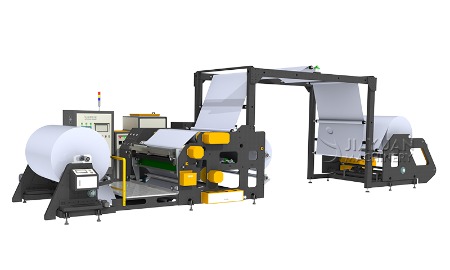
Adhesive coating machine
The bead dynamics in a slot-die head are critical for defect-free operation. The bead is the liquid bridge between the die lip and the web. It must remain stable under all operating conditions. Instability can lead to bead break (starved areas), air entrainment (pinholes), or dripping (excess fluid). The stability is governed by the capillary number, the Reynolds number, and the Weber number. The vacuum box, placed downstream of the die, exerts a negative pressure that stabilizes the bead by counteracting the hydrodynamic pressure from the web. The vacuum level must be tuned; too low causes air entrainment, too high pulls the web upwards. The die-to-web gap is typically 0.1-2 mm; a smaller gap improves bead stability but increases the risk of die contact. The die lip geometry—sharp or radiused—affects the contact line and the fluid's wetting. For high-viscosity fluids, a larger gap and higher pump pressure are needed. The bead's stability also depends on the fluid's surface tension; adding surfactants can broaden the coating window. Advanced slot-die heads have movable lips that allow real-time gap adjustment to compensate for thermal expansion or web thickness variations. Numerical simulation (CFD) is widely used to design the manifold and predict the velocity profile, ensuring a flat flow across the width. This design effort reduces the need for post-coating correction.
Coating defects are often directly attributable to the
coating head. Streaks in slot-die coating are almost always due to a damaged die lip or foreign particle trapped in the slot; they appear as continuous longitudinal lines. Edge bead is caused by surface tension effects at the lateral edges, leading to thickened coating; this can be mitigated by shim edge tapers, edge vacuum, or by reducing the die gap at the edges. Pinholes arise from bubbles in the fluid or air entrainment; proper degassing and vacuum control solve this. In gravure coating, "doctor blade streaks" are linear defects from blade nicks; they are eliminated by blade replacement. "Skipping" (uncoated spots) occurs when the cells are not fully filled or the transfer is incomplete; increasing the impression roll pressure or slowing down can help. In roll coating, "ribbing" is a periodic transverse pattern caused by mechanical vibration; this requires roll balancing or speed ratio adjustment. "Orange peel" is a rough surface due to poor flow; it indicates that the fluid's viscosity is too high or the leveling time too short. Understanding the head-specific defect mechanisms enables operators to quickly diagnose and correct problems. Furthermore, the coating head's material selection is crucial: it must resist corrosion from the fluid and maintain its dimensions under thermal stress. Stainless steel (316L) is common, but for high-wear fluids, ceramic or tungsten carbide coatings are applied to the lip. Regular inspection of the head with a microscope or profilometer is necessary to detect early wear. The shim, for slot-die, must be precisely flat; even a 2-micron wrinkle can cause a 5% thickness change. Therefore, the coating head is a precision instrument that demands meticulous maintenance and constant vigilance.
Choosing the right coating head involves a trade-off between precision, cost, speed, and flexibility. Slot-die heads offer the highest precision and are recommended for applications requiring <±2% uniformity and coat weights from 1 to 200 gsm. They are the best choice for high-value products like optical films, battery electrodes, and medical coatings. However, their capital cost is higher, and they require skilled operators for setup and cleaning. Gravure heads are ideal for very thin layers (1-10 gsm) at high speeds, with good repeatability, and are cost-effective for large volumes of release coatings and labels. They are less suitable for thick coatings or high-viscosity fluids. Roll heads are the most economical and versatile, covering a broad range of coat weights and viscosities; they are the workhorse for many general-purpose applications like tapes, adhesives, and paints, where a ±5% uniformity is acceptable. In some lines, multiple coating heads are installed in series to allow different coating methods for different passes, or to apply multi-layer coatings. The selection should be based on a thorough analysis of the fluid's rheology, the substrate's sensitivity, the required quality, and the production volume. Pilot trials on different head types are invaluable to collect empirical data on coating windows, defects, and operational ease. Ultimately, the coating head is not a standalone component; it interacts with the entire coating line, and its performance is amplified by the upstream fluid delivery and downstream drying. Thus, a holistic approach to coating head selection and operation ensures the best possible product quality and process efficiency.