Coating Line Integration: Design, Synchronization, and Efficiency Optimization
A coating line is far more than the coating head; it is an integrated assembly of mechanical, thermal, electrical, and control subsystems. The design of a coating line starts with the substrate type and width, the coating fluid, and the desired output. The unwinder must accommodate the roll weight and diameter; it typically has a dual-shaft turret with automatic splicing to allow continuous operation. The web path includes tension control zones with dancer rolls and load cells to isolate tension variations. The coater section includes the chosen coating head (slot die, gravure, roll, etc.) with its auxiliary equipment (pump, filter, degasser). The drying or curing section is often the longest part of the line; its length is determined by the maximum speed and the required evaporation rate. Following that, cooling rolls reduce the web temperature before any subsequent operation. Then, a laminating station may be added for transfer coating or protective film application. In-line inspection using cameras and thickness gauges provides quality feedback. The rewinder, also a turret type, winds the finished roll with controlled tension. All these modules must be mechanically aligned and electrically interfaced through a common control network.
Synchronization of drives is crucial for tension control and coating uniformity. Each driven roll in the line must have its speed precisely coordinated; otherwise, the web will stretch or slacken, causing wrinkles, breaks, or coat weight variations. Typically, a master speed reference is set, and each drive follows with a slight speed offset to maintain a specific tension. Tension is measured by load cells or dancer potentiometers and fed back to the drive controllers. The control system uses a cascaded PID architecture: the web speed is the primary loop, and tension is the secondary loop. For high-speed lines (>300 m/min), feed-forward control based on roll inertia is added to compensate for speed changes. The synchronization accuracy required is typically ±0.1% of speed. Any slip in the nip or oven rollers must be minimized; driven rollers with high-friction coatings are used. The control system also manages the ramp-up and ramp-down profiles to avoid web breakage during starts and stops. The splicing operations require the line to reduce speed temporarily, which affects the coating; the control system must automatically adjust pump flow and oven temperatures to compensate for speed changes.
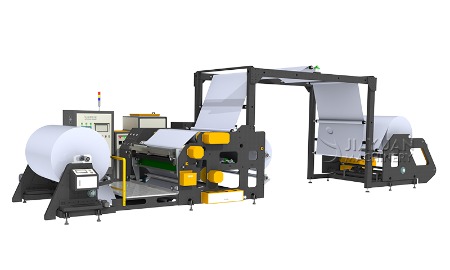
Adhesive coating machine
Efficiency optimization in a
coating line involves reducing waste, energy consumption, and downtime. Waste occurs during startup (off-spec coating), splicing, and edge trims. To minimize startup waste, many lines use a "set-up" mode where the coating is diverted to a separate trough until the parameters stabilize, then switched to the web. Splicing waste is reduced by using a festoon accumulator that allows the line to continue running at full speed during a splice, with only a short marker at the splice location for later removal. Edge trim waste can be reduced by narrower coating width and recycling trim material. Energy efficiency is improved by using heat recovery systems in the oven—exchanging heat from exhaust to incoming air, reducing fuel consumption. Also, variable-frequency drives on fans and pumps save electricity. The line's overall equipment effectiveness (OEE) is tracked; typical targets are >85% availability, >95% performance, and >98% quality. Downtime is minimized by predictive maintenance using vibration and temperature sensors on critical components (bearings, rolls, heaters). Quick-change die and clean-in-place systems reduce product changeover time.
Control system architecture is becoming increasingly sophisticated. Modern coating lines use a distributed control system (DCS) or PLC with a human-machine interface (HMI) that provides graphical views of the entire line. The HMI displays real-time data: speeds, tensions, temperatures, coat weight profiles, and defect maps. Operators can call up recipes for different products, which set all parameters automatically. Advanced systems include a "digital twin" that simulates the line behavior, allowing off-line testing of new recipes and optimization of parameters without interrupting production. Also, connectivity to the plant's MES (Manufacturing Execution System) enables tracking of production data, quality reports, and material usage. With Industry 4.0, the coating line can be monitored remotely, and alerts sent to engineers' smartphones in case of alarms. This reduces response time and allows proactive adjustments.
Line integration also involves material handling—the rolls of substrate and finished product are often heavy (up to 2 tons) and require lifts or conveyors. The layout must consider space for roll storage, maintenance access, and safety zones. Emergency stops, pull-cords, and light curtains are mandatory. The oven area must have fire suppression systems and exhaust hoods. The coating head area requires ventilation and solvent monitoring. All these safety and environmental systems are interlocked with the process control. When a new coating line is commissioned, a systematic "run-in" period with incremental speed increases is conducted to verify all subsystems. Training of operators and maintenance staff is essential; they must understand the interplay between modules. Regular audits of the line's performance against benchmark metrics help identify improvement areas. A well-designed and well-operated coating line can achieve high throughput, low scrap, and consistent product quality, making it a competitive asset in the converting industry. This holistic view—from unwinder to rewinder—is the key to successful coating operations.