Coating Line Troubleshooting: Systematic Approach to Quality and Downtime Issues
Troubleshooting a coating line requires a systematic, data-driven approach because the line is a complex chain of interdependent processes. When a quality defect appears—such as a sudden change in coat weight, streaks, or poor adhesion—the first step is to verify the measurement (thickness gauge, visual inspection) and determine if the defect is continuous or intermittent, and if it spans the full width or only a portion. Continuous defects usually indicate a steady-state parameter drift (e.g., viscosity change, pump speed shift). Intermittent defects often relate to splices, roll bearing issues, or pressure fluctuations. The troubleshooting process should start at the coating head and move upstream and downstream: check the pump flow rate, filter condition, die gap or blade setting, fluid temperature, and viscosity. If those are stable, examine the web tension and the substrate quality. If the defect persists, the problem may be in the oven or cooling section—check temperature profiles, airflow, and condensation. A structured checklist covering all modules can guide operators through these checks.
Common quality issues and their likely causes: "Coat weight drift" often results from pump speed variation (check encoder), fluid viscosity change (measure with a viscometer), or temperature fluctuation (verify oven and tank heaters). "Streaks" are usually from die lip damage, dirty gravure cells, or doctor blade nicks; inspect and clean. "Pinholes" indicate bubbles in the fluid; check degassing unit and filter. "Orange peel" points to poor leveling; increase temperature or add leveling agent. "Edge bead" is due to surface tension; adjust edge masking or gap taper. For each defect, a fault tree analysis can be built showing all possible root causes, prioritized by frequency. Data from the control system (trends of pressure, speed, thickness) should be reviewed; any correlation between the defect and a parameter change is a strong clue. Historical logs often reveal that the same issue occurred under similar conditions before, providing a shortcut to the solution.
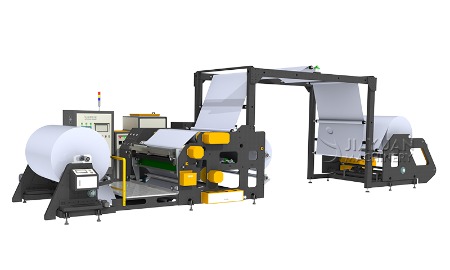
Adhesive coating machine
Downtime issues, such as web breaks or machine stoppages, are even more costly. Web breaks often occur at the oven entry, the coating nip, or the rewinder. The most common cause is a tension spike—a sudden increase or decrease in tension due to roll slippage, motor overshoot, or a splice not being properly joined. Tension logs should be examined; if a spike coincides with the break, the root cause is tension control. Check the dancer roll position and the load cell calibration. Another cause is a foreign object (a particle or a splinter) that gets caught between the roll and the web, tearing the web. Installing debris collectors and regular cleaning reduces this. Oven idler rolls may become stuck due to bearing failure, causing drag and breakage; regular greasing and temperature monitoring of bearings prevent this. For electrical failures, check motor drives, fuses, and connections. Emergency stop activations should be investigated to distinguish between actual safety events and nuisance trips (e.g., misaligned light curtains). A downtime log with codes (e.g., mechanical, electrical, process) helps categorize and prioritize improvement actions.
Root cause analysis is best performed using the "5 Whys" technique: for each problem, ask "why" five times to drill down to the fundamental cause. For example, if coat weight is high: why? Pump speed too high. Why? Encoder signal drifted. Why? Loose coupling. Why? Vibration loosened the set screw. Why? Screw not properly torqued during last maintenance. Then the corrective action is to tighten and apply thread-locking compound. This method prevents superficial fixes that don't address the underlying issue. The analysis should involve operators, maintenance engineers, and process engineers. Their combined knowledge yields a more complete picture. After corrective action, the line should be monitored to confirm the problem is resolved; if not, the analysis is revisited. Documenting the entire troubleshooting process—symptoms, tests, findings, and solution—creates a knowledge base for future reference.
Preventive measures are the ultimate goal. By analyzing historical defect data, one can identify patterns: e.g., a particular coating formulation always causes filter clogging after 6 hours, so schedule filter changes at 5 hours. Or, a specific bearing always fails after 2000 hours; replace it at 1800 hours. Implementing such predictive maintenance reduces unplanned downtime. Also, training operators to recognize early warning signs—like a slight increase in motor current or a change in web appearance—enables early intervention. Regular cross-functional meetings to review line performance and discuss recent issues foster a culture of continuous improvement. Furthermore, investing in condition monitoring (vibration analysis, thermal imaging) provides quantitative data for predicting failures. Ultimately, troubleshooting is not just about fixing problems; it is about building a robust process that minimizes the occurrence of problems. With a systematic approach,
coating line operators can achieve high availability and consistent quality, ensuring the line runs smoothly and profitably. This proactive stance is what distinguishes top-performing coating lines from average ones.