Coating Line for Sale: Key Considerations When Buying a Used or New Coating Line
When considering a
coating line for sale, the buyer must first define the production requirements: the substrate type (film, paper, foil, nonwoven), width (e.g., 1.6 m, 2.5 m), coating method (slot-die, gravure, roll, comma, etc.), adhesive type (solvent-based, water-based, hot-melt), coat weight range, and line speed. These specifications determine the technical suitability. The line's mechanical condition is the next priority: inspect the rolls for wear, the frame for rigidity, the drive system for accuracy, and the ovens for integrity. For used lines, a detailed inspection by a qualified engineer is essential; it should include: checking the roll surfaces for scratches and flat spots; measuring the roll runout and parallelism; inspecting the bearings for play; checking the die lip for wear; testing the oven's temperature uniformity; verifying the tension control system; and reviewing the maintenance logs. The seller should provide a list of spare parts included, any recent repairs, and the reason for selling. The control system's age and compatibility are important: an older PLC may be difficult to integrate with modern systems. The availability of technical documentation (schematics, manuals) is also crucial. For new lines, the buyer should evaluate the supplier's reputation, delivery time, and the terms of warranty and service. The total cost of ownership includes not only the purchase price but also installation, training, commissioning, and ongoing maintenance. A used line may have a lower upfront cost but may require more maintenance and have lower efficiency. A new line offers the latest technology and warranties but has a higher capital cost. The decision should be based on a financial analysis (payback period, ROI) and the company's risk tolerance.
The coating method must match the adhesive and substrate. For high-precision, low-coat-weight applications (e.g., optical films), a slot-die is preferred; for high-speed, commodity coatings (e.g., packaging), gravure or roll may be sufficient. The line's auxiliary equipment—unwinder, rewinder, corona treater, solvent recovery, oven, and chill rolls—must be compatible with the process. For solvent-based adhesives, the oven and solvent recovery system must be inspected for compliance with environmental and safety regulations; the LEL monitoring system must be functional. For water-based, the oven must be corrosion-resistant and have adequate dehumidification. For hot-melt, the melter and heated hoses must be in good condition. The line's width and speed must meet the production targets; a line that is too narrow limits product variety; one that is too wide may be inefficient. The maximum line speed should be verified by running a trial; if not possible, the motor power and drive ratings give an indication. The line's layout should fit the available floor space; the height, length, and width must be measured. Safety features—emergency stops, light curtains, fire suppression—must be operational. In summary, a thorough technical evaluation is required before any purchase. It is advisable to involve a third-party consultant to provide an unbiased assessment, especially for used lines.
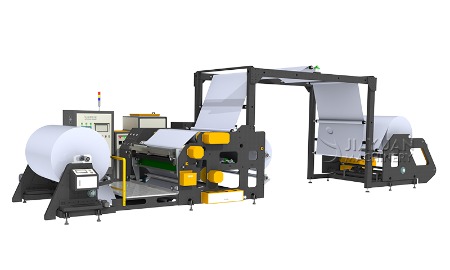
Adhesive coating machine
Commissioning is a critical phase after installation. For a new line, the supplier typically provides commissioning services. For a used line, the buyer must plan the commissioning carefully: leveling the frame, aligning the rolls, connecting the utilities, calibrating the sensors, and performing dry runs. The commissioning should follow a step-by-step plan: (1) Mechanical installation and alignment; (2) Electrical connection and verification; (3) Software upload and configuration; (4) Dry run with no coating to check web tracking and tension; (5) Wet run with a test fluid to check coating uniformity and coat weight; (6) Production run with the actual adhesive to validate quality. During commissioning, all process parameters are optimized. The operator training should be part of the commissioning; the operators must be trained on the specific control system, maintenance procedures, and troubleshooting. The commissioning report documents the final settings, the quality test results, and any issues encountered. A successful commissioning ensures that the line is ready for production. The buyer should also negotiate a warranty period for new lines; for used lines, a "sale as-is" is common, but the buyer can request a warranty on critical components (e.g., oven, drives) for a limited time. In summary, commissioning is a structured process that transforms a machine into a productive asset.
After-sales support is a major factor, especially for used lines. The buyer should ask about the availability of spare parts—some older models have obsolete parts that are hard to find. The supplier should provide a list of compatible spare parts and sources. The availability of technical support (phone, remote, on-site) is important; the supplier's response time should be defined. The buyer can also consider a service contract for the first year. The documentation (electrical schematics, mechanical drawings, software backups, operation manuals) must be transferred. The buyer should also verify the machine's compliance with local safety and environmental regulations; if the line does not meet the current standards, the buyer may need to upgrade it, which adds cost. The cost of shipping, customs, and installation should be included in the budget. In conclusion, purchasing a coating line is a complex decision that requires technical, financial, and operational evaluation. By following a structured approach—defining requirements, inspecting the machine, planning commissioning, and securing support—the buyer can acquire a line that meets production needs and provides a good return on investment.