Coating Machine Installation: Site Preparation, Mechanical Assembly, and Precision Alignment
The installation of a coating machine is a complex, multi-stage process that requires meticulous planning and execution. The first phase is site preparation. The installation site must have a level, reinforced concrete floor capable of supporting the machine's weight—typically 10-50 tons for a production line. The floor's flatness must be within ±2 mm over the machine's length to prevent frame distortion. The site must also provide adequate clearance for operation and maintenance, with at least 1.5 meters around the machine. Utilities must be brought to the site: electrical power (voltage and phase compatible with the machine's drives), compressed air (clean, dry, at the required pressure and flow rate), cooling water (for chill rolls and heat exchangers), and exhaust ventilation (for solvent vapors and heat). The buyer should also prepare a temporary storage area for crated components and a clean assembly zone. A project manager should coordinate the arrival of the installation team, the lifting equipment (cranes, forklifts), and the necessary tools. A detailed installation schedule, including milestones and contingency time, should be established. The site preparation phase typically takes 2-4 weeks and must be completed before the machine arrives.
The mechanical assembly begins with the positioning of the main frame. The frame sections are lifted onto the foundation and bolted together. The frame must be leveled using precision spirit levels or laser levels; the leveling feet are adjusted until the frame is within ±0.5 mm/m. Once leveled, the frame is grouted to the floor to ensure permanent stability. Next, the major components are installed: the unwinder, the coating head (slot-die, gravure, or roll), the drying oven, the cooling section, the laminating station (if present), and the rewinder. Each component is bolted to the frame and aligned with its neighbors. The web path—the sequence of rolls through which the substrate travels—is established. All idler rolls, driven rolls, and nip rolls are installed. The rolls must be aligned parallel to each other and perpendicular to the web direction. This is achieved using laser alignment tools; the parallelism must be within 0.05 mm over the roll's length. The roll gaps (nip pressures) are set according to the manufacturer's specifications. The coating head is mounted on a precision carriage that allows adjustment of the die-to-web gap and the angle. The head is aligned with the backup roll using dial gauges. The drive motors are coupled to the rolls via belts, gears, or direct drives. The electrical and pneumatic connections are made, and the control panel is wired to the machine's sensors and actuators. The entire assembly process is documented with photographs and measurements to ensure traceability.
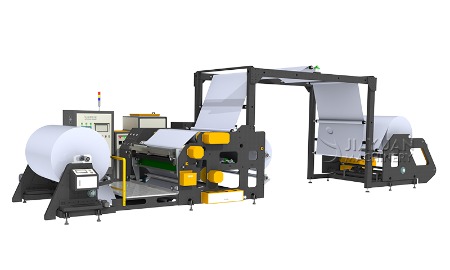
Adhesive coating machine
The critical alignment step is the die-to-web gap setting for slot-die or the roll gap for roll coaters. For slot-die, the die lip must be parallel to the backup roll within ±0.01 mm across the width. This is achieved by adjusting the die's mounting brackets and using feeler gauges or laser sensors. The gap is set to the specified value (typically 0.1-1.0 mm) at multiple points; if the gap varies, the die bolts are adjusted. For gravure, the cylinder must be parallel to the impression roll; the doctor blade is aligned to the cylinder. For roll coaters, the metering and applicator rolls are aligned, and the nip pressure is calibrated using pressure-sensitive film to verify uniform pressure distribution. After mechanical assembly, the machine undergoes a "dry run" without substrate or coating fluid to check all mechanical movements: the rolls rotate smoothly, the web path is free of obstructions, the tension control system responds, and the oven fans and heaters operate correctly. Any vibration, noise, or binding is corrected. The dry run also tests the safety interlocks: emergency stops, light curtains, and pull-cords. The machine is then ready for utility connection and the wet commissioning phase.
Utility connection involves hooking up the electrical power, compressed air, cooling water, and exhaust. The electrical connection must be performed by a licensed electrician, following the machine's wiring diagrams. The voltage, phase, and frequency must match the drives' requirements; a phase sequence check is performed. The compressed air supply must be filtered and dried to prevent contamination of the pneumatic actuators. The cooling water circuit is flushed to remove debris, and the flow rate and temperature are verified. The exhaust system is tested for proper airflow; the air velocity at the oven's exhaust hood is measured to ensure it meets the solvent vapor removal requirements. The control system is powered up, and the software is loaded. The PLC is checked for proper communication with the HMI, drives, and sensors. The calibration of all sensors—thickness gauges, temperature sensors, pressure sensors, and tension load cells—is verified. The machine's safety systems are tested again under power. After all utilities are confirmed, the machine is ready for the wet commissioning, which involves running the substrate and coating fluid to optimize the process parameters. The installation team should provide comprehensive training to the operator and maintenance staff during the commissioning phase. In summary, proper installation is a blend of precision mechanics, meticulous alignment, and systematic testing. Following a structured installation plan ensures that the coating machine achieves its designed performance, minimizes startup issues, and provides a solid foundation for long-term reliable operation.