Coating Machine Price: Factors, Cost Breakdown, and Budgeting for Coating Lines
Coating machine pricing is a complex subject because each machine is often customized to specific requirements. A basic bench-top lab coater may cost $20,000-50,000, while a full-scale production line for battery electrode coating can exceed $5 million. The wide range is due to the many factors that influence cost. The primary price drivers are: (1) Coating method: slot-die coaters are generally more expensive than roll coaters due to the precision machining and complex manifold design; gravure coaters are in the middle; comma coaters are expensive for high-viscosity applications. (2) Substrate width: wider lines (e.g., >2 m) require larger rolls, heavier frames, and more powerful drives, significantly increasing cost. A 1.5 m wide line may cost $1-2 million, while a 3 m wide line can cost $2.5-4 million. (3) Line speed: higher speeds (e.g., >300 m/min) require more powerful motors, faster control systems, and more robust mechanical designs, adding to the cost. (4) Auxiliary equipment: the cost of the oven, unwinder, rewinder, corona treater, and laminator can be 30-50% of the total line cost. A long multi-zone oven with solvent recovery adds significantly to the price. (5) Materials of construction: stainless steel (for corrosive or medical applications) is more expensive than carbon steel; explosion-proof components add cost. (6) Control system: advanced control systems with active profile control, MES integration, and remote diagnostics add $50,000-150,000. (7) Installation and commissioning: typically 5-15% of the machine cost, depending on the complexity and the location. (8) Supplier's brand and location: European and Japanese suppliers tend to be more expensive than Asian suppliers, but they may offer higher precision and reliability.
A typical cost breakdown for a mid-range production coating line (e.g., 1.6 m wide, slot-die, solvent-based, 200 m/min) might be: Coating head (slot-die + pump + filter): 15%; Drying oven (multi-zone, with solvent recovery): 25%; Unwinder and rewinder (turret, with tension control): 15%; Control system (PLC, HMI, sensors, gauges): 15%; Frame and mechanical components (rolls, drives, frames): 20%; Assembly, testing, and packaging: 5%; Installation and commissioning: 5%. This breakdown is approximate and varies by supplier. The buyer should request a detailed quote that itemizes these components. This transparency allows the buyer to identify cost drivers and to consider alternatives (e.g., a shorter oven, a simpler control system) to reduce the price. The buyer should also consider the total cost of ownership (TCO), which includes the purchase price, energy consumption, maintenance, and waste. A more expensive machine with higher efficiency and lower waste may have a lower TCO over its lifetime. Therefore, price should not be the sole decision criterion; the buyer should evaluate the TCO and the return on investment (ROI). In summary, understanding the cost breakdown helps the buyer make informed decisions and negotiate effectively.
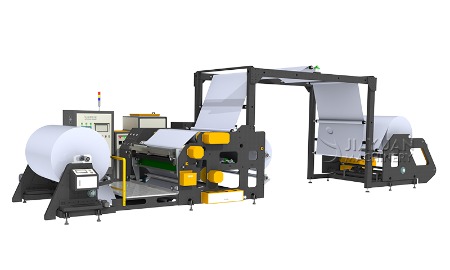
Adhesive coating machine
Budgeting for a coating machine requires a comprehensive approach. The buyer should first define the project scope and obtain multiple quotes (at least 3) from different suppliers. The quotes should be compared on a like-for-like basis, with clear specifications. The budget should include: (1) The machine cost (negotiated); (2) Shipping and insurance (5-10% of machine cost); (3) Customs and import duties (varies by country, 0-15%); (4) Site preparation (floor reinforcement, utilities, ventilation) - may be $20,000-100,000; (5) Installation and commissioning (5-15% of machine cost); (6) Operator and maintenance training (included or separate); (7) First set of spare parts (5-10% of machine cost); (8) Contingency (10-20% of total) for unforeseen costs. The total budget is typically 120-150% of the machine's base price. The buyer should also budget for the cost of the coating fluid and substrate for the trial runs during commissioning. The budget should be reviewed and approved by senior management. The buyer may consider financing options, such as equipment loans or leases, to spread the cost over time. In summary, a realistic budget that includes all related costs ensures that the project does not face financial shortfalls.
Cost optimization strategies can reduce the purchase price without compromising quality. (1) Standardize components: use off-the-shelf rolls, drives, and sensors instead of custom-made ones, where possible. (2) Choose a simpler coating method if it meets the requirements; e.g., a roll coater may be sufficient instead of a slot-die for less demanding applications. (3) Reduce the oven length by using a more efficient drying system (e.g., IR + convection). (4) Optimize the line speed: a slower line may be cheaper and may still meet the production target if the line runs longer. (5) Consider a used or refurbished machine (see previous article). (6) Negotiate volume discounts if buying multiple lines. (7) Ask the supplier to offer a "basic" package with optional upgrades that can be added later. (8) Compare prices from suppliers in different regions; but consider the cost of shipping and support. The buyer should also consider the long-term value: a higher-quality machine may have lower maintenance costs and better resale value. In conclusion, the price of a coating machine is influenced by many factors, and a thorough understanding of these factors enables the buyer to create a realistic budget and to negotiate the best value. The focus should be on the total cost of ownership and the return on investment, rather than just the initial purchase price.