Coating Pump System: Selection, Types, and Performance Optimization
The coating pump system is responsible for delivering the coating fluid from the supply tank to the coating head at a precisely controlled flow rate. The flow rate, combined with the line speed, determines the wet coat weight. Therefore, pump performance is critical for coating uniformity and consistency. The ideal pump for coating applications should provide a pulse-free, linear flow that is independent of backpressure (within a range), be easy to clean, and be compatible with the fluid's chemistry. The four main pump types used in coating are: (1) Gear pumps: positive displacement pumps with two meshing gears (external or internal). They provide a smooth, continuous flow with low pulsation, making them the most common choice for slot-die and gravure coating. They are available in stainless steel for corrosion resistance and can handle viscosities from 1 to 100,000 cP. The flow rate is proportional to the pump speed (rpm), which is controlled by a servo motor. Gear pumps require precise clearances; wear from abrasive fluids can reduce accuracy. (2) Diaphragm pumps: use a flexible membrane that moves back and forth to displace fluid. They are suitable for shear-sensitive fluids and fluids with suspended solids. However, they have higher pulsation and are less accurate than gear pumps. They are often used for water-based emulsions. (3) Peristaltic pumps: use a rotating roller to compress a flexible tube, pushing the fluid forward. They have no seals or valves, making them ideal for sterile or corrosive fluids. They are low-shear and can handle viscous fluids, but they have significant pulsation and the tubes wear out frequently. (4) Piston pumps: use a reciprocating piston to displace fluid. They can handle very high viscosities and provide high pressure, but they have high pulsation and are difficult to clean. They are used for hot-melt and other high-viscosity applications. The choice of pump type is driven by the fluid's viscosity, shear sensitivity, required flow rate (and thus coat weight and line speed), and the required accuracy.
Flow rate and pulsation are two critical parameters. The required flow rate is calculated from the target coat weight, line speed, and coating width: Flow rate (L/min) = (Coat weight (gsm) × Speed (m/min) × Width (m)) / (Solids fraction × Density (g/cm³) × 1000). For a typical PSA tape coating (20 gsm, 200 m/min, 1.5 m width, 40% solids, density 1.0), the flow rate is (20×200×1.5)/(0.4×1.0×1000) = 15 L/min. The pump must be sized to deliver this flow at the required pressure (which depends on the die gap and fluid viscosity). Pulsation is the variation in flow rate over each pump cycle. Gear pumps have low pulsation (typically 1-3% of the mean flow); diaphragm and peristaltic pumps have higher pulsation (5-15%). Pulsation causes periodic thickness variations in the coating. To reduce pulsation, a pulse dampener (a bladder or accumulator) is installed downstream of the pump. The dampener absorbs the pressure peaks and provides a smooth flow. The dampener must be sized correctly; a too-small dampener will not smooth the flow, while a too-large one may cause slow response. The pump and dampener combination should be optimized for the specific fluid and operating conditions. In summary, accurate flow measurement and pulsation control are essential for achieving consistent coat weight.
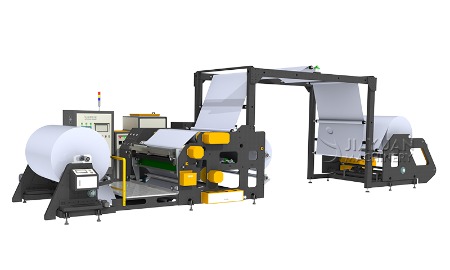
Adhesive coating machine
Pump installation and maintenance are critical for reliability. The pump should be mounted on a vibration-damping base to reduce mechanical noise and wear. The suction line should have a flooded suction (the tank is above the pump) or a positive head to prevent cavitation. The discharge line should be as short and straight as possible to minimize pressure drop. A filter (100-200 mesh) is installed on the suction side to prevent particles from entering the pump. A pressure gauge and a flow meter are installed on the discharge side for monitoring. The pump should be calibrated periodically: run the pump at a known speed and measure the actual flow rate by weighing the output over a measured time. The calibration curve (speed vs. flow) should be updated, especially if the fluid viscosity changes. For gear pumps, the internal clearances increase with wear, reducing the volumetric efficiency; regular inspection of the gears and housing is necessary. For diaphragm pumps, the diaphragms and valves should be replaced according to the schedule. For peristaltic pumps, the tube should be inspected for wear and replaced before it ruptures. The pump's seals and bearings should be lubricated according to the manufacturer's instructions. A log of pump performance (pressure, flow, motor current) helps to detect issues early. In summary, proper installation and regular maintenance ensure that the pump system delivers consistent, reliable flow, minimizing coating defects and downtime.
Advanced pump control systems are available for high-precision coating. A servo motor with a high-resolution encoder provides precise speed control. The pump speed is set by the line speed feedforward signal: the pump speed is proportional to the line speed, maintaining a constant coat weight regardless of speed changes. A feedback loop from the thickness gauge corrects any residual error. Some systems use a "cascade" control: an inner loop controls pump speed (using the encoder), and an outer loop controls coat weight (using the gauge). The inner loop is faster and rejects disturbances such as power fluctuations. For multi-layer coating, multiple pumps are coordinated to maintain the layer thickness ratios. The control system can also adjust the pump speed to compensate for fluid temperature changes (which affect viscosity) by using a temperature sensor. In summary, advanced control enhances the accuracy and stability of the
coating pump system, enabling high-quality production even with challenging fluids.
Troubleshooting common pump issues: (1) Flow rate drop: check for a clogged filter, cavitation (suction line blocked or fluid too viscous), or pump wear; (2) Pulsation increase: check the dampener's pressure and bladder condition; (3) Motor overcurrent: check for binding or increased viscosity; (4) Leakage: check seals and gaskets; (5) Noise: check for air in the fluid or mechanical wear. A systematic approach using the pump's pressure and flow data, combined with visual inspection, is effective. The buyer should train operators on pump troubleshooting and on the importance of maintaining the pump log. In conclusion, the coating pump system is a critical component that demands careful selection, precise control, and diligent maintenance. By choosing the right pump type, optimizing the flow and pulsation, implementing advanced control, and following a maintenance schedule, the coating line can achieve uniform coat weight, high production speeds, and low defect rates, contributing to overall operational excellence.