Coating Rolls: Design, Surface Engineering, and Performance in Roll Coating
Coating rolls are cylindrical components that rotate to carry and transfer coating fluids onto a moving web. They are found in various configurations: applicator rolls, metering rolls, backup rolls, and transfer rolls. The design of a coating roll must balance mechanical strength, dimensional precision, surface quality, and resistance to wear and corrosion. The core of the roll is typically made of steel, either solid forged or fabricated from tubing, depending on the roll diameter and required stiffness. For wide rolls (over 2 meters), a hollow design with internal ribs is used to reduce weight while maintaining rigidity. The roll is mounted on bearings at both ends, and the journal—the bearing surface—must be precision-ground to ensure concentric running. The roll's dynamic balance is critical; any imbalance causes vibrations that lead to barring defects. Rolls are balanced to ISO 1940 grade G1.0 for speeds above 300 m/min. The roll's outer surface is the functional part; it must have a precisely controlled profile (cylindrical, crowned, or tapered) and surface finish. The profile determines the nip pressure distribution; a crowned roll compensates for deflection under load, maintaining uniform nip across the width. The surface finish—measured as Ra (average roughness)—affects fluid pick-up, release, and transfer. A smoother roll (Ra < 0.2 µm) yields a thinner, more uniform film but may have poor wetting; a rougher roll (Ra 0.5-1.0 µm) picks up more fluid and is used for higher coat weights. The choice of surface finish is specific to the fluid and application.
Surface engineering of coating rolls involves applying a coating or covering that provides the required hardness, wear resistance, and release properties. The most common surfacing is hard chrome plating, typically 10-50 µm thick with a hardness of 65-70 HRC. Chrome-plated rolls are used for metering and applicator rolls in solvent-based and water-based systems; they are resistant to corrosion and abrasion, and they can be polished to a high gloss. However, chrome can be attacked by acidic fluids or chlorides; in such cases, electroless nickel plating or ceramic coatings (e.g., chromium oxide, aluminum oxide) are used. Ceramic coatings are applied by plasma spraying or HVOF (high-velocity oxygen fuel) and have hardness up to 1200 HV, making them ideal for abrasive slurries like battery electrode materials. Rubber coverings are used for backup rolls, nip rolls, and some applicator rolls where conformability is needed. The rubber material (NBR, EPDM, silicone, polyurethane) is chosen for solvent resistance, temperature resistance, and hardness (Shore A 30-95). Soft rubber (Shore A 30-50) provides high conformability for uneven substrates but wears faster; hard rubber (Shore A 80-95) gives better metering precision but less conformity. The rubber covering is bonded to the steel core through a process of vulcanization or adhesive bonding. The covered roll must then be ground to a precise diameter and profile. The thickness of the rubber cover is typically 5-15 mm; when the cover wears or is damaged, it can be re-ground or re-covered. The surface of a rubber roll should be smooth and free of pores to prevent fluid absorption. For high-speed applications, the rubber compound must have low hysteresis to avoid heat build-up.
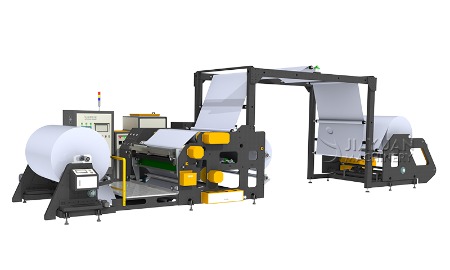
Adhesive coating machine
The performance of
coating rolls is critically dependent on their dimensional accuracy. The roll diameter must be constant within ±0.005 mm across the width to ensure uniform nip pressure. The runout (radial deviation) must be less than 0.01 mm to prevent cyclic thickness variations. These tolerances are achieved by precision grinding after hardening. The roll's crowning—an increase in diameter at the center—is calculated based on the roll's deflection under the nip load. For a 2-meter wide roll under 50 N/mm nip pressure, the deflection can be 0.1-0.2 mm; a crown of similar magnitude is ground to compensate. The crown profile can be parabolic or linear, depending on the loading pattern. Some rolls have a "Z" profile or multiple crowns to accommodate varying nip loads. The roll's surface hardness, for metal rolls, should be above 55 HRC to resist scoring; for rubber rolls, hardness determines the deformation under pressure. The hardness should be measured and recorded regularly; a drop of 5 Shore A points indicates aging or chemical attack and may require re-covering. The roll's surface roughness is measured with a profilometer; it should be maintained within the specified range. If the roughness increases due to wear, the roll must be re-ground. All these parameters are part of a roll quality passport, which is essential for traceability and replacement planning.
Coating roll defects and their mitigation are important operational topics. "Roll marks" are periodic defects caused by surface damage on the roll—a scratch or a pit that transfers a pattern to the coating. These are prevented by careful handling and by filtering the fluid to remove abrasive particles. If a scratch appears, the roll can be polished locally or re-ground. "Pick-off" occurs when the coating adheres to the roll rather than transferring to the web; this is due to poor release, often from a contaminated or worn surface. Cleaning with an appropriate solvent and, if necessary, applying a release agent can help. For rubber rolls, "swelling" due to solvent absorption changes the diameter and hardness, causing coating weight drift; using a solvent-resistant rubber compound (e.g., EPDM) or reducing the solvent content mitigates this. "Bearing failure" causes runout and vibration; regular lubrication and monitoring of bearing temperature prevent this. The roll's journal must be protected from coating fluid ingress by seals; if seals leak, the fluid can corrode the bearing. Overall, coating rolls require systematic care: regular cleaning, periodic dimensional checks, and adherence to the manufacturer's maintenance schedule. The cost of a high-quality coating roll is significant, but it is justified by the improved coating quality and extended service life. In modern coating lines, rolls are often equipped with sensors (temperature, vibration) that enable predictive maintenance, ensuring that the rolls perform reliably over long production runs.