Coating Rolls: Nip Dynamics, Transfer Efficiency, and Precision Roll Grinding
The nip is the region where two rolls (e.g., the applicator roll and the backup roll) come into contact with the substrate between them. In roll coating, the nip dynamics govern how much fluid is squeezed from the fluid film on the applicator roll onto the substrate. The nip pressure profile across the width is determined by the roll diameters, the nip load (force per unit length), the roll's elastic modulus, and the substrate thickness. For a given load, the contact width (nip width) can be calculated using Hertzian contact theory for two cylinders. The pressure is highest at the center and drops to zero at the edges. The fluid in the nip experiences a combination of pressure-driven flow and shear flow. The transfer efficiency—the fraction of fluid transferred from the applicator roll to the web—depends on the ratio of the nip flow to the feed flow. At low nip pressures, the transfer efficiency is low because the web does not make full contact; at high pressures, the efficiency saturates or may even drop due to "squeeze-out" where fluid is forced sideways. The optimal nip pressure is typically found empirically for each fluid and speed. The dwell time—the time the web spends in the nip—is inversely proportional to speed; a longer dwell time allows more complete transfer. For high speeds, a wider nip (lower pressure) may be needed to maintain contact time, but this reduces pressure. The nip pressure is controlled by pneumatic or hydraulic actuators; load cells measure the actual force and provide feedback. The roll's surface hardness (for rubber-covered rolls) affects the nip width; softer rolls give a wider nip but may cause non-uniform pressure if the roll is not perfectly crowned. Modern nip control systems use multiple actuators along the roll to adjust the pressure locally, enabling profile correction of the coating thickness.
Transfer efficiency is a critical metric in roll coating because it affects the material usage and coat weight consistency. For a reverse roll coater, the transfer efficiency can be as high as 80-90%; for a direct roll coater, it is typically 60-80%. Factors that reduce transfer efficiency include: low nip pressure (poor contact), poor wetting of the substrate (high surface tension), high viscosity that impedes flow, and high substrate speed that reduces dwell time. To improve transfer efficiency, operators can increase nip pressure, pre-treat the substrate (corona, flame), heat the fluid to lower viscosity, or reduce speed (if production allows). The transfer efficiency can be measured by weighing the fluid on the applicator roll before and after the nip, or by comparing the calculated coat weight from the metering gap to the actual measured coat weight. A drop in transfer efficiency over time often indicates roll wear (diameter change) or a change in the fluid's rheology. Therefore, regular monitoring of transfer efficiency is a good practice. In some coaters, a "doctor roll" is placed against the applicator roll after the nip to scrape off any remaining fluid and return it to the pan, allowing measurement of the untransferred fraction. This provides a direct measure of efficiency and enables automatic adjustment of the metering gap to compensate.
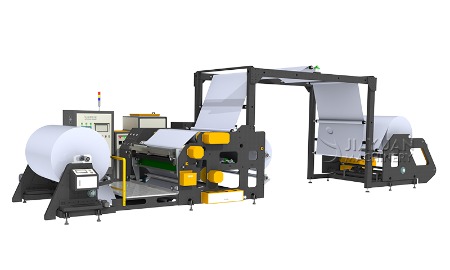
Adhesive coating machine
Precision roll grinding is the process that creates the final geometry and surface finish of the
coating rolls. Grinding is performed after the roll is hardened and before it is chrome-plated or covered. The grinding machine must be capable of holding tolerances of ±0.002 mm in diameter and ±0.005 mm in roundness. The grinding wheel is dressed to the desired profile (straight, crowned, or tapered). The crowning is typically generated by a computer-controlled grinding cycle where the wheel moves along the roll axis with a varying depth of cut. The crowning curve is calculated from the expected deflection under load; this requires detailed knowledge of the roll's stiffness and the nip load. After grinding, the roll is polished to the required surface roughness using super-finishing stones or belts. For chrome-plated rolls, the grinding is followed by chrome plating, which adds about 10-20 µm thickness, and then the chrome is polished to the final finish. For rubber-covered rolls, the rubber is bonded to the core, cured in an autoclave, and then ground on a lathe using a cylindrical grinder with a diamond-tipped wheel. The rubber grinding process generates heat that can degrade the rubber, so a coolant is used. The final diameter and profile are measured with a coordinate measuring machine (CMM) or a laser profilometer. The roll is also dynamically balanced to G1.0 or better. All these steps are documented in a roll log, which includes the as-ground dimensions, the crown profile, the surface roughness, and the balancing grade. When a roll is re-ground after use, the log is updated with the new measurements, and the crowning may be adjusted if the roll's stiffness has changed (e.g., due to material fatigue). Precision roll grinding is a specialist service; many coating plants send their rolls to external grinding shops with dedicated equipment. The cost and time of re-grinding are significant, so operators often have spare rolls to minimize downtime.
Nip and roll maintenance are complementary. The nip pressure should be calibrated regularly using a pressure-sensitive film (e.g., Fuji Prescale) that shows the pressure distribution; any non-uniformity indicates misalignment or uneven roll wear. The roll's surface temperature should be monitored; excessive heating due to friction can affect the fluid viscosity and cause thermal expansion, which changes the gap. For rubber rolls, the surface hardness should be checked with a durometer; a decrease in hardness of more than 5 points indicates aging or chemical attack, and the roll should be re-covered. The roll bearings must be lubricated according to the schedule; vibration sensors can detect early bearing wear. The roll cleaning system—typically a rotating brush or a doctor blade—must be maintained to prevent dried fluid buildup on the roll surface. All these maintenance tasks are part of the standard operating procedure. In summary, coating rolls are precision-engineered components that require careful attention to design, grinding, and maintenance. Their performance directly influences the coating quality, and the nip dynamics determine the transfer efficiency and uniformity. By understanding the interplay of roll geometry, surface finish, nip mechanics, and material properties, coating engineers can optimize the roll coating process to achieve high-quality, consistent results with minimal waste. The investment in high-quality rolls and regular precision grinding pays dividends in product quality and production efficiency, making it a cornerstone of successful roll coating operations.