Coating Sample: Advanced Characterization, Failure Analysis, and Long-Term Stability Assessment
While standard tests (peel, tack, shear) provide the basic performance data, advanced characterization techniques reveal the coating's microstructure, chemistry, and thermal behavior, which are essential for understanding the root causes of failure and for developing robust products. Scanning electron microscopy (SEM) provides high-resolution images of the coating's surface and cross-section. It can reveal defects such as pinholes, cracks, and agglomerates, and it can measure the coating's thickness at the micron level. Energy-dispersive X-ray spectroscopy (EDX) attached to the SEM can identify the elemental composition of particles or contaminants. For example, SEM can show if an adhesion failure is due to a contamination layer on the substrate. Fourier-transform infrared spectroscopy (FTIR) identifies the chemical functional groups in the coating, such as acrylates, urethanes, or silicones. It can detect oxidation, degradation, or the presence of unreacted monomers. Differential scanning calorimetry (DSC) measures the glass transition temperature (Tg) and the degree of crosslinking. A low Tg may indicate incomplete curing; a high Tg may indicate over-curing. These advanced techniques provide a deeper understanding of the coating's properties and the effects of process variations. In summary, advanced characterization is a powerful tool for quality assurance and root cause analysis.
Failure analysis is a systematic process to determine why a coating has failed in service or during testing. The steps include: (1) Visual inspection of the failed sample; (2) Optical microscopy to examine the fracture surface; (3) SEM to see the microstructure; (4) FTIR to check for chemical changes; (5) Comparison with a known good sample. Common failure modes: adhesion failure (the coating separates from the substrate), cohesion failure (the coating splits internally), and delamination (between layers). Adhesion failure may be due to low surface energy of the substrate, contamination, or under-curing. Cohesion failure may be due to over-curing (brittleness) or insufficient coat weight. Delamination may be due to differential shrinkage or poor layer compatibility. The failure analysis identifies the root cause, which is then used to correct the process. For example, if the FTIR shows that the coating is under-cured, the curing temperature or time is increased. In summary, failure analysis turns a failure into a learning opportunity.
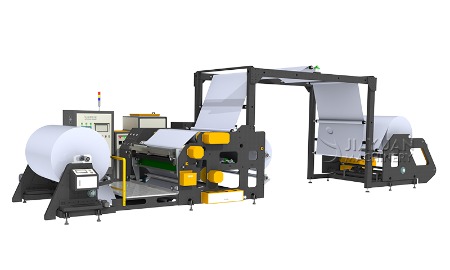
Adhesive coating machine
Long-term stability assessment is performed by accelerated aging tests. The samples are exposed to elevated temperature (e.g., 70°C), high humidity (e.g., 90% RH), and UV light for a specified time (e.g., 7 days, 14 days, 30 days). The properties (peel, tack, shear) are measured before and after aging; the retention percentage is calculated. A good coating should retain at least 80% of its initial properties. The aging tests also reveal any discoloration, cracking, or loss of adhesion. The results are used to predict the product's shelf life and to ensure that it meets the customer's durability requirements. For medical or automotive applications, the aging tests are often required by regulatory standards. In summary, accelerated aging is essential for validating the product's reliability over its intended service life.
Practical implementation: (1) Collect samples at the beginning, middle, and end of each run for a comprehensive assessment. (2) Use advanced characterization when standard tests fail to identify the cause. (3) Establish a library of SEM images and FTIR spectra for common defects to speed up analysis. (4) Perform aging tests on samples from the first production run and periodically thereafter. (5) Document all results and conclusions in a "failure analysis report." (6) Train engineers on the use of SEM, FTIR, and DSC. In conclusion, advanced characterization and failure analysis are essential for maintaining high quality and for continuous improvement in coating production. By using these techniques, manufacturers can not only detect and fix defects but also develop more robust products that meet the stringent requirements of modern applications.