Coating Sample: Preparation, Testing, and Quality Assessment for Process Validation
A coating sample is a physical piece of the coated web that is used to assess the quality and performance of the coating. Samples are taken at regular intervals during production (e.g., every roll or every hour) and during trials. The sample must be representative of the entire coating run; it should be cut from the web's center and edges to check the transverse uniformity. The sample size depends on the tests to be performed; typically, A4-sized sheets or 1-meter strips are used. The sample must be handled carefully—wearing gloves to avoid contamination, using clean scissors, and placing the sample on a clean surface. The sample is labeled with the product name, date, time, line speed, coat weight, and any other relevant parameters. The label should be attached to the non-coated side or to a separate tag. The sample should be stored in a controlled environment (temperature, humidity) to prevent aging before testing. In summary, proper sample preparation is the first step in accurate quality assessment.
The testing protocol for a coating sample depends on the product's specifications. Common tests include: (1) Thickness/Coat Weight: measured by a micrometer or a beta gauge; the average and the standard deviation are calculated. (2) Peel Adhesion: measured by a tensile tester, peeling the tape or label from a standard panel (e.g., steel) at a specified angle and speed; the force is recorded. (3) Tack: measured by a loop tack or rolling ball test. (4) Shear: measured by applying a static load to a sample and recording the time to failure. (5) Optical Properties: for films, haze, clarity, and transmittance are measured by a hazemeter. (6) Barrier Properties: oxygen or water vapor transmission rate (OTR/WVTR). (7) Aging: samples are exposed to heat, humidity, or UV for a set time, and then re-tested to check for degradation. The tests are performed according to ASTM or ISO standards. The test results are compared to the specification limits. In summary, the testing protocol is a comprehensive assessment of the coating's functional and aesthetic properties.
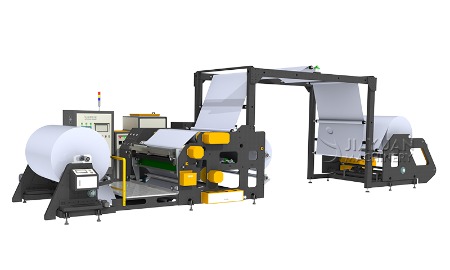
Adhesive coating machine
Interpretation of test results requires statistical analysis. The average and standard deviation of each test are calculated; the process capability (Cpk) is determined. If a test result is outside the specification, the cause is investigated: it may be due to a process drift, a material variation, or a measurement error. The operator should review the process parameters at the time the sample was taken. If the sample is from a trial, the results are used to adjust the process parameters for the next trial. The results are also used to create a "sample report" that is sent to the customer for approval. The report includes the test results, the measurement methods, and the conclusions. In summary, test results are the basis for quality decisions and customer communication.
Customer approval often requires a set of samples that represent the full range of the product's properties. The manufacturer may send samples for peel, tack, shear, and appearance. The customer may perform their own tests to verify the results. If the samples are approved, the manufacturer receives the "first article" approval, allowing full-scale production. If the samples are rejected, the manufacturer must make adjustments and submit new samples. The sample approval process is a critical milestone in product development. In summary,
coating samples are the tangible proof of quality and the key to securing customer confidence.
Practical tips for coating samples: (1) Use a consistent cutting method to avoid edge damage. (2) Label each sample clearly with a permanent marker. (3) Store samples in a clean, dry, dark place. (4) For aging tests, use a controlled oven or humidity chamber. (5) Use calibrated instruments and follow the standard test procedures. (6) Train operators on sample preparation and testing. (7) Keep a sample log that records the sample ID, the date, the parameters, and the test results. In conclusion, coating samples are an integral part of quality management. By following proper preparation, testing, and interpretation protocols, manufacturers can ensure that their coated products meet the required specifications and customer expectations. The sample data also provides a valuable historical record for process improvement and for resolving any future quality disputes.