Coating Speed Limits: Fluid Dynamics, Drying Capacity, and Mechanical Constraints
Coating speed is defined as the linear velocity of the substrate through the coating line, typically measured in meters per minute. Higher speed directly increases throughput and reduces unit cost, but it also exacerbates several technical challenges. The fundamental limit for any coating method is the "wetting speed" or "maximum coating speed" determined by the fluid's ability to spread and displace air on the substrate. At very high speeds, the fluid cannot fully wet the surface, leading to "air entrainment"—where microscopic air bubbles are trapped between the fluid and the substrate. The critical speed for air entrainment depends on the fluid's surface tension, viscosity, and the substrate's surface energy, as well as the geometry of the coating bead. For slot-die coating, the air entrainment speed is roughly proportional to the surface tension divided by viscosity, times a geometric factor. For low-viscosity fluids (water-based), the entrainment speed is relatively high (up to 500 m/min); for high-viscosity pastes, it can be very low (20-50 m/min) because the fluid cannot flow into the microscopic valleys of the substrate quickly. To increase the air entrainment limit, one can reduce the die-to-web gap, increase vacuum, or pre-treat the substrate to improve wettability. In gravure coating, air entrainment is less of an issue because the fluid is supplied from the cells, but the speed is limited by the fill and release dynamics of the cells; at extreme speeds, the cells may not empty completely, reducing coat weight.
Another fluid-dynamic limit is the "maximum flow rate" through the coating head, which is governed by the pressure drop in the slot or the gap. For slot-die, the pressure required to push a high-viscosity fluid through a narrow slot increases with speed because the required flow rate scales with speed. If the pump cannot deliver the necessary pressure or if the die's mechanical strength is insufficient, the speed is limited. This is particularly relevant for high-viscosity battery slurries; the die may need to be heated to reduce viscosity, or the slot gap increased, but that increases coat weight. Thus, there is an interplay between speed, coat weight, and viscosity. For roll coaters, the speed is limited by centrifugal forces that can throw fluid off the rotating rolls; this "splashing" limit is typically above 500 m/min for most designs, but for high-viscosity fluids, the fluid may not separate cleanly from the roll, causing streaking. For gravure, the speed is limited by the impression roll's ability to maintain contact with the cylinder without slipping; high speeds require higher nip pressure and can cause web stretching. The mechanical limits of the machine—bearings, rolls, and frames—also impose speed limits; as speed increases, so do vibration and wear. The machine's natural frequencies must be avoided; critical speeds are calculated and verified. Most modern coating lines are designed for speeds up to 300-600 m/min, but specialized lines for flexible packaging can exceed 1000 m/min.
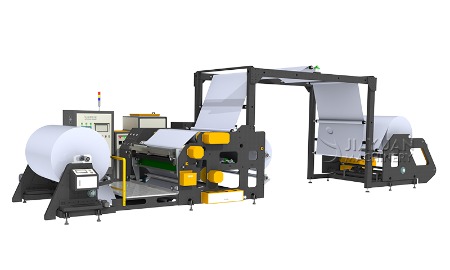
Adhesive coating machine
Drying capacity is often the bottleneck that limits
coating speed. After coating, the liquid layer must be dried (for solvent/water-based) or cooled (for hot-melt) to a stable state. The drying rate is determined by the oven's heat input, the solvent's latent heat, and the mass transfer coefficient. The required oven length for a given speed is: length = speed * residence time. For a typical solvent-based acrylic coating, the residence time may be 60 seconds; at 300 m/min, the oven length would be 300 meters, which is impractical. Therefore, high-speed lines use impingement air ovens with high velocity to enhance heat and mass transfer, reducing residence time to 10-20 seconds. However, the maximum drying flux is limited by the solvent's boiling point and the substrate's maximum temperature. If the oven temperature is too high, the substrate may shrink, wrinkle, or degrade. Also, the solvent vapor concentration must be kept below the LEL, which limits the air flow and thus the drying rate. For water-based coatings, the latent heat of water is high, so the speed is even more restricted; high-speed water-based lines often use a combination of IR pre-heaters and convection ovens to overcome this. The cooling section for hot-melts must remove the heat of solidification; the chill roll's capacity is finite, and at high speeds, the web may not cool sufficiently, leading to blocking. Therefore, the coating speed must be matched to the thermal processing capabilities. In many plants, the oven is the most expensive part of the line, and its design speed determines the overall line speed.
Web handling at high speeds presents challenges in tension control, web guiding, and splicing. Tension variations become more pronounced at high speeds because the web's inertia increases; a small speed mismatch can cause large tension spikes that may break the web. The tension control system must have fast response (sub-100 ms) and use feed-forward compensation. The dancer rolls must be light and have low friction to respond quickly. The web guide must correct any lateral movement within milliseconds; high-speed guiding systems use infrared sensors and fast actuators. Splicing at high speed is difficult; automatic splicing with a festoon accumulator allows the line to continue during a roll change, but the splice itself causes a transient in tension and coat weight. The splice must be reinforced with tape to prevent breakage. Also, at high speeds, the web's dynamic pressure against the coating head changes, affecting the bead stability; the vacuum level may need to be increased. The machine's vibration modes must be damped; sometimes, tuned mass dampers are added. In summary, high-speed coating pushes all subsystems to their limits. A systematic approach to speed enhancement involves: first, identify the limiting factor (e.g., drying, air entrainment, or web handling); then, implement targeted improvements (e.g., upgrade the oven, reduce gap, or improve tension control); finally, test incrementally. It is rarely possible to double the speed in one step; gradual increases with careful monitoring are more successful. The ultimate coating speed for a given product is a trade-off between productivity and quality; sometimes, reducing speed by 10% can reduce defects by 50%, yielding a better overall cost. Therefore, the optimal speed is determined by a cost model that includes yield, energy, and waste. Coating engineers use design of experiments to map the speed-quality curve and select the optimal operating point. This ensures that the coating line operates at the speed that maximizes profitability, not just the maximum possible speed.