Coating Speed Optimization: Balancing Throughput with Defect Prevention and Quality
Coating speed optimization is not about running as fast as possible; it is about finding the speed that maximizes profit per hour, which considers both throughput and the cost of defects, scrap, and energy. The relationship between speed and defect rate is often non-linear: at low speeds, defects may be due to poor leveling or excessive solvent retention; at moderate speeds, defects are minimal; at high speeds, defects such as air entrainment, ribbing, and edge bead increase sharply. This creates a "speed-defect curve" that is U-shaped or monotonic with a sharp upturn. The optimal speed is typically near the knee of the curve, where the marginal increase in defects equals the marginal value of additional throughput. To construct this curve, operators run the line at several speeds while keeping all other parameters (coat weight, temperature, vacuum) constant, and measure the defect density (e.g., number of defects per 1000 m). The coating weight must be maintained at the target; if it drifts with speed, adjustments are made. The curve can be plotted and the critical speed identified. Additionally, the coating window—the stability region—is speed-dependent; a wider window allows operation at higher speeds with less risk. The window can be extended by adjusting the die gap or vacuum as speed changes. Some lines use a dynamic setpoint schedule: the gap is automatically increased at high speeds to reduce shear and prevent breakup. This is part of the line's control logic. Therefore, speed optimization is an iterative process of testing, analyzing, and adjusting.
Statistical process control (SPC) is a powerful tool for monitoring coating quality at different speeds. Key quality attributes—coat weight, thickness variation, and defect counts—are measured and plotted on control charts (X-bar and R charts). The process capability index (Cpk) is calculated; a Cpk > 1.33 is generally considered capable. When speed is increased, the Cpk may drop due to increased variation; the operator must check if the drop is acceptable or if corrective actions (e.g., better tension control) are needed. SPC also helps detect early signs of instability, such as increasing variance, before defects become visually apparent. By maintaining control limits, speed can be increased gradually, and any out-of-control signal triggers a review. This data-driven approach avoids sudden quality excursions. Furthermore, the collected data can be used to build a predictive model of defect rate as a function of speed and other parameters (e.g., viscosity, substrate batch). This model, using regression or machine learning, can recommend the optimal speed for each new product based on historical performance. This is especially useful for lines that run many different products with varying characteristics.
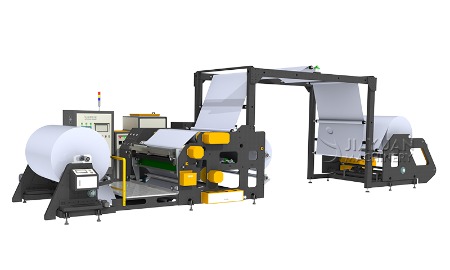
Adhesive coating machine
Incremental speed increase is a recommended practice. Instead of jumping from 100 m/min to 150 m/min, increase in 5-10 m/min increments, holding each speed for a sufficient time (e.g., one full roll) to collect stable quality data. This reduces the risk of catastrophic failure and allows the team to identify the specific speed at which a new defect appears. For example, at 120 m/min, no defects; at 130 m/min, occasional pinholes appear; then the cause can be investigated (e.g., vacuum adjustment) and the issue fixed, then continue increasing. This iterative "step-up and fix" approach often yields the highest sustainable speed. The increments are smaller at the higher end because the defects tend to escalate. The maximum speed achieved through this method is the "proven speed" for that product, which is used for production. The same procedure is repeated when the fluid formulation changes or when the line undergoes maintenance that could affect dynamics. The proven speed is documented in the product recipe.
Economic evaluation is the final step. The profit per hour at a given speed is: (throughput in m²/h) * (selling price per m² - variable cost per m²) - fixed cost per hour. Variable costs include material, energy, and waste. As speed increases, throughput increases linearly, but the waste percentage (defective product + trim) also increases. The net profit per hour may peak at a speed below the maximum, if the waste increase is rapid. For example, at 200 m/min, throughput is 10,000 m²/h with 5% waste; at 250 m/min, throughput is 12,500 m²/h but waste rises to 12%, so the effective good output is 11,000 m²/h—only 10% more output for a 25% speed increase. If the extra energy cost is also considered, the optimal speed might be 220 m/min. An economic model incorporating the speed-defect curve and cost data can be built in a spreadsheet. The model calculates the profit at each speed and finds the maximum. This model should be updated regularly with actual cost and waste data. The operating speed is then set to the economic optimum, not the technical maximum. This ensures the line is run at the most profitable level, which may be lower than the maximum but yields higher net income. Additionally, the model can be used to justify investments in new equipment (e.g., a better oven) that would shift the defect curve to the right, allowing higher speeds with lower waste. In summary,
coating speed optimization is a comprehensive engineering-economic activity that balances multiple factors. By using systematic defect mapping, SPC, incremental testing, and economic modeling, coating lines can achieve a sustainable speed that maximizes profitability while maintaining the required quality standards.