Coating Temperature Control: Effects on Viscosity, Wetting, and Coating Quality
Coating temperature refers to the temperature of the coating fluid at the point of application, as well as the temperature of the substrate and the ambient environment. Most coating fluids exhibit a strong temperature-viscosity relationship: for typical polymer solutions and emulsions, viscosity decreases by 2-5% per degree Celsius. This means a 10°C variation can change viscosity by 20-50%, directly altering coat weight, bead stability, and leveling behavior. For slot-die coating, a higher temperature reduces the pressure drop in the die, allowing higher speeds or narrower gaps. For gravure, lower viscosity improves cell filling and transfer efficiency. However, excessive temperature can cause solvent flash-off, premature crosslinking, or thermal degradation of polymers. Therefore, the
coating temperature must be maintained within a narrow window, typically ±1-2°C, using jacketed tanks, heated hoses, and temperature-controlled dies. Substrate temperature also matters: if the substrate is cold, the fluid may chill upon contact, increasing viscosity and reducing wetting, leading to de-wetting or pinholes. Conversely, a hot substrate can cause solvent to evaporate too quickly, forming a skin that traps solvent underneath. Hence, substrate pre-heaters or chill rolls are used to condition the web before coating.
Temperature control in the supply system begins at the mixing tank. Most tanks are jacketed with circulating water or oil, and equipped with a PID controller that maintains the setpoint. The fluid is circulated through a heat exchanger to ensure uniform temperature. The pump, hoses, and coating head must also be temperature-controlled; for hot-melt adhesives, the entire path from melter to die is heated to 120-200°C. For water-based systems, the tank is often cooled to prevent bacterial growth and evaporation. Temperature sensors (RTDs or thermocouples) are placed at multiple points: in the tank, at the pump outlet, at the die inlet, and on the die body. The control system uses these signals to adjust heating/cooling. In slot-die coating, the die itself is often heated or cooled to maintain the fluid temperature right up to the slot. If the die is not temperature-controlled, the fluid may cool as it passes through the die, increasing viscosity and causing a pressure rise, which can change the coat weight. Therefore, a well-designed coating line includes thermal conditioning of all wetted parts. Additionally, the ambient temperature in the coating room should be stable; drafts or fluctuations can affect the fluid temperature in open pans and the substrate's temperature.
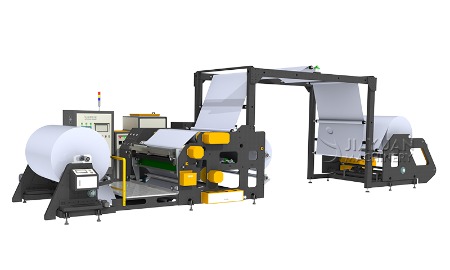
Adhesive coating machine
Temperature-related defects are common and often misdiagnosed. "Skinning" occurs when the surface of the coating dries too quickly due to high temperature or airflow, forming a film that traps solvent; this leads to blisters and pinholes. The solution is to lower the initial drying temperature or reduce the web temperature. "Gelation" or "clumping" happens when the fluid is overheated, causing polymer crosslinking or agglomeration; this appears as gel particles that cause streaks. The remedy is to reduce the tank temperature and ensure the fluid is not held at high temperature for too long. "Thermal degradation" is a permanent change in polymer chemistry due to excessive heat, resulting in discoloration, reduced adhesion, or brittleness. This is prevented by using temperature sensors with high-limit alarms and by avoiding hot spots in the die or hoses. "Cold start" defects occur when the system has not reached temperature before coating; the initial coating is too thick due to high viscosity. This is avoided by a warm-up routine that recirculates the fluid until the temperature stabilizes, and then diverting the first few meters of coating to waste. "Substrate shrinkage" can occur if the substrate is heated above its glass transition temperature, causing it to stretch or shrink; this changes the effective coating weight. Thus, the substrate temperature must also be monitored and controlled, especially for films like PET or polyimide, which are sensitive to heat. In summary, temperature is a powerful lever in coating control. By maintaining precise temperature regulation and understanding the thermal behavior of the fluid and substrate, coating lines can achieve stable viscosity, consistent coat weight, and defect-free films.