Coating Temperature Optimization: Balancing Rheology, Drying, and Energy Efficiency
The optimal coating temperature is the one that provides the required viscosity for stable coating while minimizing energy consumption and avoiding thermal degradation. The viscosity-temperature relationship can be modeled by the Arrhenius equation: η = A × exp(Ea / (R×T)), where η is viscosity, Ea is the activation energy, R is the gas constant, and T is absolute temperature. This model allows the prediction of viscosity at any temperature, given two reference points. The coating window—the range of speeds and flow rates that yield stable coating—is wider at lower viscosity (higher temperature). Therefore, increasing temperature can extend the coating window, allowing higher speeds or lower die pressures. However, higher temperature also increases the solvent evaporation rate, which can cause skinning and requires more solvent makeup. It also increases the energy needed to heat the fluid. There is an optimal temperature that maximizes the speed while keeping defects within acceptable limits. To find this optimum, a series of trials are run at different temperatures (e.g., 20, 30, 40, 50°C) while measuring coat weight, bead stability, defect counts, and drying efficiency. The data is plotted, and the temperature that gives the best balance is chosen. For example, in a slot-die coating of a 40% solids acrylic adhesive, increasing the temperature from 25 to 35°C reduced the die pressure by 30%, allowed a 15% speed increase, but increased solvent loss by 10%. The net effect on cost (material saving vs. energy and solvent cost) was positive, so the higher temperature was adopted.
Drying energy is a major cost in coating operations. The fluid must be heated to its application temperature, and the solvent must be evaporated in the oven. If the coating is applied at a higher temperature, it enters the oven already warm, which reduces the heat required from the oven. However, the solvent is already partly vaporized, which may increase the solvent load in the oven. The net energy balance depends on the specific heat of the fluid and the latent heat of the solvent. Typically, pre-heating the fluid reduces oven energy consumption slightly, but the effect is modest (e.g., 5-10%). A more significant energy saving comes from reducing the wet thickness (by using higher solids) rather than changing temperature. The temperature also affects the oven's drying profile: if the fluid is applied warm, the initial drying zone can be set lower to avoid skinning, while the bulk zone can be higher. This can improve the overall drying rate. An optimized temperature profile might be: tank at 35°C, die at 35°C, oven zone 1 at 60°C, zone 2 at 90°C, zone 3 at 110°C. This profile balances evaporation and leveling. The optimization should be done with the help of a drying model that calculates the solvent concentration in the film as a function of temperature and time. Such models are available in simulation software and can be used to predict the effect of temperature changes on drying performance.
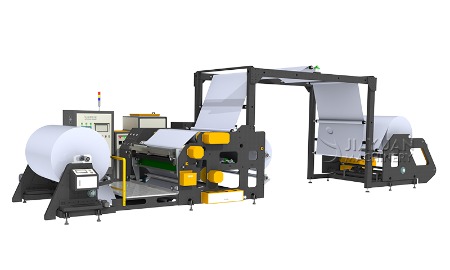
Adhesive coating machine
Energy efficiency also involves the heat loss to the environment. Heated tanks, hoses, and dies lose heat through insulation; poor insulation increases energy waste. The temperature setpoint should be as low as possible while still providing the required viscosity, to minimize heat loss. For water-based systems, a temperature of 20-30°C is typical; for solvent-based, 25-40°C; for hot-melt, the temperature is dictated by the melting point and is not adjustable. The use of variable-speed pumps and fans can reduce energy consumption during low-speed operation. The oven's exhaust heat can be recovered to preheat the incoming air or the coating fluid, using a heat exchanger. This can reduce energy costs by 20-30%. The optimization of temperature is therefore part of a broader energy management strategy. The cost of energy (electricity, gas) should be included in the economic model that determines the optimal temperature. For example, if energy prices are high, a lower temperature might be preferred even if it limits speed, because the net profit is higher. This dynamic optimization should be reviewed periodically as energy costs fluctuate.
Practical guidelines for temperature optimization: (1) Measure the fluid's viscosity at several temperatures and fit an Arrhenius curve; (2) Determine the viscosity window for the coating method (e.g., 100-1000 cP for slot-die); (3) Choose a temperature that places the viscosity in the middle of this window to allow margin; (4) Check the fluid's thermal stability by heating a sample for the maximum expected residence time and measuring properties; (5) Conduct a design of experiments with temperature, speed, and gap as variables to find the optimal combination; (6) Monitor the actual temperature at the die lip using a non-contact infrared sensor; (7) Adjust the setpoint based on product quality data (e.g., adhesion, gloss); (8) Implement a temperature ramp for startup to avoid thermal shock; (9) Document the temperature settings in the product recipe. By following these steps, coating lines can operate at the most efficient temperature, reducing waste and energy consumption while maintaining high quality. The optimization is not a one-time event; as the fluid formulation changes or the line ages, the optimal temperature may shift. Therefore, a regular review cycle (e.g., quarterly) is recommended. In conclusion,
coating temperature optimization is a classic engineering problem that balances rheological, thermal, and economic factors. With careful measurement, modeling, and control, it yields significant benefits in productivity, quality, and cost.