Coating Thickness: Impact on Product Performance, Drying Dynamics, and Defect Prevention
Coating thickness is a primary determinant of the coated product's functional performance. In adhesives, thicker coatings generally increase peel strength and tack but reduce shear holding power due to the increased creep of the thicker adhesive mass. The optimal thickness is a compromise: for a PSA tape, 20-30 gsm is typical for general-purpose applications, while high-performance tapes may use 40-50 gsm. For barrier coatings, thickness is directly proportional to the oxygen or water vapor transmission resistance; a minimum thickness is required to achieve the desired barrier, and any below-threshold area creates a defect. For optical films, thickness uniformity is critical because variations in thickness cause color shifts and Newton's rings; thickness tolerances are often below ±0.5 µm. For conductive coatings, thickness affects the sheet resistance; a 10% increase in thickness can reduce resistance by 10%, impacting the performance of flexible circuits. Therefore, product designers specify a target thickness with a narrow tolerance, and the coating process must deliver it consistently. The relationship between thickness and property is often non-linear, so even small deviations near the low end can cause drastic property drops. Thus, process capability (Cpk) is a key metric; a Cpk > 1.67 is often required for critical applications.
The drying dynamics are heavily influenced by coating thickness. A thicker wet film contains more solvent per unit area, requiring more heat and longer residence time to evaporate. The drying time increases roughly with the square of the thickness because the solvent must diffuse from the bottom of the film to the surface. For thick coatings (>100 µm), internal solvent can become trapped, leading to blistering or "solvent pop" defects. To avoid this, the drying oven must have a controlled temperature profile: a gentle first zone to allow surface evaporation without skinning, followed by higher temperatures to drive out the bulk solvent. The coating thickness also affects the shrinkage during drying; thicker films shrink more, creating internal stresses that can cause warping, cracking, or delamination. For high-solids coatings, the shrinkage is less, but for low-solids, the volume reduction is significant. The stress is proportional to the thickness; if the stress exceeds the substrate's strength or the coating's cohesive strength, cracking occurs. Therefore, the maximum thickness is often limited by the drying and stress constraints. In hot-melt coatings, the thickness affects the cooling rate; thicker films take longer to solidify, which can cause blocking or slow line speeds. Thus, the
coating thickness must be optimized for both performance and processability.
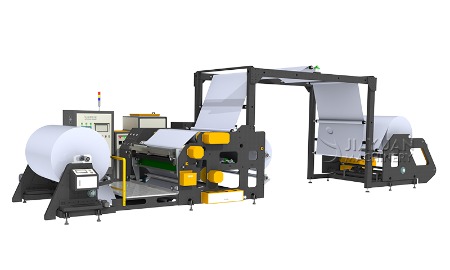
Adhesive coating machine
Thickness-related defects are among the most common coating issues. Edge bead—a thickened region at the web edges—is caused by surface tension and pressure gradients. It can be reduced by using tapered shims, edge vacuum, or air knives, but if the bead is too thick, it may not dry properly, causing a sticky edge or cracking. Orange peel is a surface roughness defect that is more pronounced in thicker coatings because the fluid has more time to flow and form hills and valleys; it is mitigated by reducing viscosity or adding leveling agents. Pinholes and bubbles are more likely in thick coatings because air bubbles have a longer path to escape; degassing the fluid and using a slower drying ramp can help. Cracking occurs when the coating shrinks and stresses exceed the cohesive strength; reducing thickness or using a more flexible binder solves this. Another defect is "mottling" (cloudy appearance), which is due to non-uniform thickness on a micro-scale; it is common in water-based coatings where the solids concentration varies. All these defects can be minimized by maintaining the target thickness within a narrow band and by optimizing the drying profile. A thickness variation of just 5% can make the difference between a perfect film and a defective one. Therefore, thickness control is not just about meeting a spec; it is about preventing a whole cascade of defects.
The economic impact of thickness variation is twofold. First, any coating applied above the target is wasted material, which directly increases the cost per square meter. For a high-value coating costing $20/kg, a 5 µm excess on a 100 gsm target (5% over) adds $1/m² in material cost. For a line producing 10 million m²/year, that is $10 million in lost profit. Second, if the thickness is below the minimum, the product fails performance tests and must be scrapped or reworked, adding waste and rework costs. Therefore, there is a narrow "thickness window" within which the product is both functional and cost-effective. The goal of thickness control is to center the process on the target and reduce the standard deviation so that the process capability is high. This allows the target to be set at the minimum acceptable thickness (to save material) while still keeping the product within spec. This is the essence of "thickness optimization." Advanced lines use model predictive control that not only corrects deviations but also adjusts the target based on real-time performance data, continuously pushing the process towards the economic optimum. For example, if the peel test shows that adhesion is still acceptable at 48 gsm, the target can be lowered from 50 to 48 gsm, saving 4% material. This requires a robust feedback loop that integrates thickness data with quality test results.
In summary, coating thickness is a multi-dimensional parameter that affects product quality, processing efficiency, and cost. A comprehensive understanding of the measurement techniques, control strategies, drying dynamics, and defect mechanisms is essential for coating engineers. By implementing advanced sensors, closed-loop control, and statistical optimization, coating lines can achieve consistent thickness at the lowest possible material usage, maximizing profitability while ensuring product reliability. The trend towards thinner coatings in electronics and packaging, driven by material savings and sustainability, places even greater emphasis on precision thickness control, making it a key differentiator in the competitive coating industry. Continuous training of operators in thickness-related troubleshooting and the use of data analytics will further enhance the capability of modern coating lines to meet these stringent demands.