Coating Trial: Purpose, Design, and Execution for Process Development and Optimization
Coating trials are an essential step in the development and optimization of any coating process. They serve multiple purposes: (1) Evaluating new adhesive or coating formulations for coatability and performance; (2) Testing new substrates or release liners; (3) Determining the optimal process parameters—coat weight, speed, temperature, gap, vacuum—for a given product; (4) Identifying potential defects and their causes; (5) Validating the equipment's capability and the process's robustness. A well-designed trial can significantly reduce the risk of costly failures in full-scale production. The trial is typically conducted on a pilot coater, which is a smaller-scale version of the production line, or on a production coater at reduced speed. The trial should be planned with clear objectives, a defined experimental matrix, and a data collection plan. The results are analyzed to define the "operating window"—the range of parameters that produce acceptable quality. In summary, a coating trial is an investment in knowledge that pays off in higher quality, lower waste, and faster time-to-market.
The design of the trial is critical. The most effective method is Design of Experiments (DoE), which systematically varies the key parameters to identify their effects and interactions. For example, a typical DoE for slot-die coating might vary: coat weight (target ±20%), line speed (e.g., 50, 100, 150 m/min), die-to-web gap (0.2, 0.4, 0.6 mm), and vacuum level (10, 20, 30 mbar). The response variables are coat weight uniformity, edge bead, defect count, and peel adhesion (for adhesives). The DoE design (e.g., full factorial or central composite) is chosen based on the number of factors and the desired resolution. The trials are randomized to avoid bias. The results are analyzed by regression to create a mathematical model that predicts the responses for any combination of parameters. The model is then used to find the optimal parameter set that meets all quality targets. In summary, DoE is a powerful tool that maximizes the information gained from a limited number of trials.
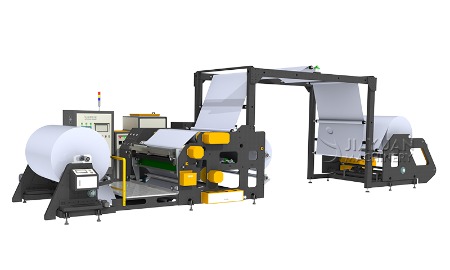
Adhesive coating machine
Execution of the trial requires careful preparation. The fluid must be prepared according to the formulation, with the correct solids content and viscosity. The substrate must be of the specified type and width. The coater must be set up with the correct die or cylinder, and the gap and temperature must be adjusted. The trial plan should include a "start-up" procedure to reach steady state, a series of test points (each with a set of parameters), and a "shut-down" procedure. At each test point, the line is allowed to stabilize for a sufficient time (e.g., 1-2 minutes), and then samples are collected for analysis. The samples are labeled with the test point number and the parameters. The coat weight is measured online and verified off-line. The defects are inspected visually and by a camera. The performance tests (peel, tack, shear) are conducted on the samples. All data is recorded in a trial log. In summary, the execution must be disciplined to ensure that the data is reliable and traceable.
Analysis of the trial results involves statistical and graphical methods. The DoE model is validated by checking the residuals and the R-squared value. The model is then used to generate contour plots or surface plots that show the effect of two parameters on a response, while holding others constant. For example, a contour plot of coat weight uniformity vs. gap and vacuum reveals the optimal region. The model can also be used for "desirability" analysis, where the user specifies the target ranges for each response, and the software finds the parameter set that maximizes the overall desirability. The results are also used to identify the "robust" region—the range of parameters where the quality is insensitive to small variations, which is important for stable production. The final output is a "recommended operating window" that defines the acceptable ranges for all parameters. This window is documented in the product recipe. In summary, the analysis transforms raw data into actionable knowledge.
Practical tips for
coating trials: (1) Start with a "screening" DoE to identify the most important parameters; (2) Use a pilot coater for initial trials to save material and time; (3) Conduct the trials on the same type of substrate and with the same fluid batch to minimize variability; (4) Always run "center point" replicates to check for repeatability; (5) Collect sufficient sample length (e.g., 10 meters) at each point for testing; (6) Use a systematic labeling system; (7) Document everything—parameters, observations, defects, test results; (8) Involve the operators in the trial; they often provide valuable insights. In conclusion, a well-planned and executed coating trial is the cornerstone of process development. By using DoE, careful execution, and thorough analysis, the manufacturer can define a robust process that delivers consistent quality, reduces waste, and accelerates product launches.