Coating Trial: Scale-Up from Pilot to Production, Troubleshooting, and Data-Driven Optimization
Scale-up from a pilot coater to a production line is a critical step that often reveals differences in performance. The pilot coater may have a smaller width (e.g., 300 mm vs. 1.5 m), a lower speed, and different roll sizes and oven characteristics. The scale-up challenges include: (1) Heat transfer: the production oven may have different airflow patterns, requiring a recalibration of the drying profile; (2) Web handling: the wider web may have different tension and edge guide dynamics; (3) Edge bead: the edge bead behavior may change with width; (4) Pump performance: the larger production pump may have different pulsation characteristics. To mitigate these, the trial should include a "scale-up" phase where the pilot data is used to predict the production settings, and then the predictions are validated on the production line at reduced speed. The DoE model from the pilot can be adjusted using production data. It is also advisable to run a "production confirmation" trial with the final recipe and settings to ensure that the quality is consistent. In summary, scale-up requires a systematic approach and often several iterations.
Troubleshooting using trial data is a powerful technique. If a defect appears in production, the trial data can be used to identify the root cause by comparing the production parameters with the trial data. For example, if the production line has a streak, the trial data may show that a similar streak occurred at a certain die gap or vacuum level; this suggests a gap or vacuum issue. The trial data also provides a baseline for the acceptable range of each parameter; if the production parameter is outside that range, it is a likely cause. The operator can also use the trial model to predict the effect of adjusting a parameter; for example, "if I increase the gap by 0.05 mm, the coat weight will change by X%." This predictive capability enables targeted adjustments. In summary, trial data is a valuable reference for troubleshooting.
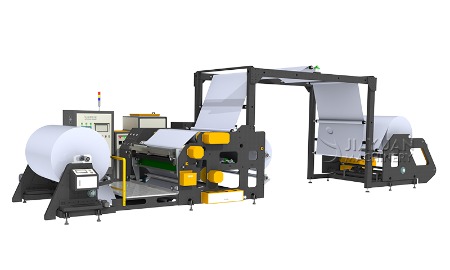
Adhesive coating machine
Data-driven optimization uses the trial data to continuously improve the process. The trial data, combined with production data, is used to create a "process model" that relates the parameters to the quality metrics. This model can be updated with new data, making it more accurate over time. The model can be used to find new, improved operating points that were not tested in the original trial. For example, the model may predict that a slightly higher temperature and a slightly lower gap could improve the uniformity without increasing defects. The model can also be used for "what-if" analysis; for example, "if I change the substrate, how should I adjust the parameters to maintain quality?" This capability is the basis for a "self-optimizing" line. In summary, data-driven optimization turns the trial data into a living asset that continues to generate value.
Digital knowledge management: The trial data, the DoE results, the recommended operating window, and the scale-up notes should be stored in a digital repository (e.g., a database or a cloud platform). This repository becomes a "knowledge base" for the company. When a new product is developed, the operator can search for similar products and use their operating windows as a starting point, significantly reducing the trial time. The repository also includes defect photos and their solutions, helping the operator to quickly diagnose issues. The knowledge base is continuously updated with new trials and production data. In summary, a digital knowledge base is a strategic asset that accelerates innovation and improves consistency. In conclusion,
coating trials are not just a one-time event; they are the foundation of a continuous improvement cycle. By effectively designing, executing, analyzing, and storing the trial data, manufacturers can achieve a deep understanding of their coating process, enabling rapid scale-up, effective troubleshooting, and ongoing optimization. This capability is a key differentiator in the competitive coating industry.