Coating Troubleshooting: Case Studies and Root Cause Analysis for Common Coating Defects
Case Study 1: Continuous Streak in Slot-Die Coating of Acrylic PSA. Defect: A continuous, fine streak appeared in the machine direction, located 150 mm from the left edge. Investigation: The die was removed and inspected; a small scratch (approx. 20 µm) was found on the die lip at the corresponding location. The scratch was caused by a metal particle that had become embedded in the shim and scratched the lip during assembly. Corrective Action: The die lip was polished with a fine abrasive stone to remove the scratch; the shim was replaced with a new one. The cleaning procedure was revised to include a more thorough inspection of the shim before assembly. Preventive Measure: Implement a "cleanliness check" for all shims using a magnifying glass; train operators on proper handling. Result: The streak disappeared, and no recurrence was observed in the following months.
Case Study 2: Intermittent Pinholes in Gravure Coating. Defect: Pinholes appeared randomly, mostly in the center of the web, occurring every 50-100 meters. Investigation: The fluid was checked for bubbles; a visual inspection of the supply line showed a small air leak at a fitting. Air was being drawn into the fluid, causing bubbles. The pump was also pulsating slightly, which exacerbated the issue. Corrective Action: The fitting was tightened and sealed with thread sealant; a pulse dampener was added to the pump outlet. The fluid was degassed using a vacuum degasser. Preventive Measure: Include air leak checks in the daily maintenance checklist; monitor pump pressure for pulsation. Result: Pinholes were eliminated; the line speed could be increased by 10% due to improved flow stability.
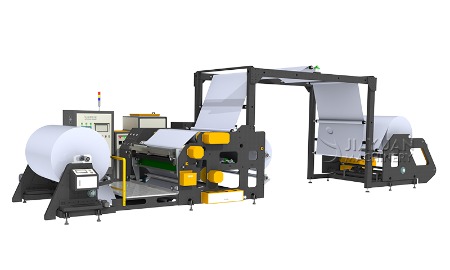
Adhesive coating machine
Case Study 3: Edge Bead in Slot-Die Coating of Hot-Melt Adhesive. Defect: The coating at both edges was 20% thicker than the center, causing slitting difficulties and waste. Investigation: The thickness profile showed a parabolic shape with edge bead. The shim had straight edges, and the die gap was uniform. The adhesive's surface tension was high, causing the fluid to pull inward at the edges, resulting in a thicker edge. Corrective Action: A shim with tapered edges (gradual reduction in width at the edges) was installed. The edge vacuum was increased to suck excess fluid at the edges. Preventive Measure: Use edge-tapered shims as standard for this adhesive; set the edge vacuum based on the adhesive's surface tension. Result: Edge bead reduced from 20% to 5%, reducing trim waste by 15%.
Case Study 4: Orange Peel in Roll Coating of Water-Based Adhesive. Defect: The coated film had a rough, wavy surface (orange peel) that reduced the product's gloss and adhesion. Investigation: The adhesive's viscosity was found to be too high (15,000 cP) at the application temperature (25°C). The viscosity was measured at a shear rate typical of roll coating; it was above the recommended range. The cause was a batch variation in the thickener addition. Corrective Action: The adhesive was diluted with water to reduce viscosity to 10,000 cP; the roll speed ratio was adjusted to increase shear and improve leveling. Preventive Measure: Implement a viscosity check for each batch before production; use a viscometer to verify the viscosity at the application shear rate. Result: Orange peel was eliminated; the gloss improved by 20%. In summary, these case studies demonstrate the importance of systematic investigation, the use of appropriate tools (magnifying glass, viscometer, profilometer), and the implementation of both corrective and preventive measures. The lessons learned are documented and shared across the team to prevent recurrence. A culture of continuous improvement and data-driven decision-making is essential for effective
coating troubleshooting.