Coating Width Management: Methods, Edge Effects, and Profile Control
Coating width is a critical parameter in web coating that directly affects material usage, product dimensional accuracy, and downstream converting processes such as slitting and winding. In many applications, the coating must cover the full working width of the substrate, but often with a slight margin to allow for edge bead removal or to ensure full coverage despite web wander. The target coating width is set by the die's slot width (in slot-die) or by the engraved cylinder's width (in gravure) or by the roll's face length (in roll coating). However, the actual effective coating width can be different from the mechanical width due to fluid spreading, edge bead, or substrate shrinkage. In slot-die coating, the effective width is determined by the shim length and the flow distribution at the edges. The shim can be cut to the exact width, but the fluid may swell or recede at the edges due to surface tension, producing a slightly narrower or wider coating. Typically, the shim is designed to be 1-2 mm wider than the intended coating width to compensate for edge recession. In gravure coating, the engraved pattern may extend to the cylinder edges, but the effective width is often trimmed by the doctor blade's edge. In roll coating, the coating width is governed by the roll's face length and the pan's width; the fluid tends to spread naturally to the roll edges unless contained by edge dams. Maintaining a consistent coating width is essential for reducing edge trim waste and ensuring that the final product meets the customer's width specification.
Edge effects are the most significant cause of coating width variation. The term "edge bead" refers to the thickened zone at the edges of the coating, which is typically 2-10 mm wide and can be 1.5-3 times the nominal thickness. Edge bead is caused by surface tension pulling fluid from the edge inward and by the pressure gradient at the die edge (in slot-die) or by the capillary action at the roll edge. This thickened portion is usually trimmed off after drying; therefore, the coating width must be slightly larger than the desired finished width to allow for this trim. The trimming width is waste, so minimizing edge bead is economically important. Techniques to reduce edge bead include: using shims with tapered ends in slot-dies (gradually reducing the slot gap near the edges); applying edge vacuum to suck away excess fluid; using edge air knives to blow off the excess; or adding "edge dams" in roll coating to contain the fluid. Some slot-dies feature "edge deckles"—movable blocks that physically block the flow at the edges, allowing the coating width to be adjusted without changing the shim. In addition to edge bead, "edge recession" (the coating slightly pulling back from the edge) can occur if the fluid has high surface tension and the substrate is not wetting well; this is corrected by increasing the substrate's surface energy or lowering the fluid's surface tension. Another edge effect is "edge smear" where fluid is transferred to the backup roll and then back to the web outside the intended width, causing contamination; this is prevented by using a slightly narrower
coating width than the web and ensuring proper nip alignment.
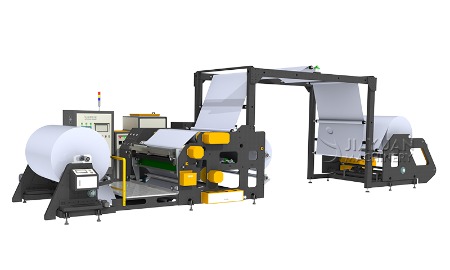
Adhesive coating machine
Profile control is the technology used to maintain a constant coating width and thickness across the transverse direction. In advanced coating lines, the coating width is not static; it can vary with changes in temperature, fluid viscosity, or pump flow rate. Active width control uses sensors—usually edge detection cameras that identify the wet coating edge—and actuators that adjust the shim position, the deckle position, or the edge air flow. For slot-dies with motorized edge deckles, the deckles can be moved inward or outward to adjust the width in real-time. The control system compares the measured width to the setpoint and makes corrections. In gravure, width is more difficult to adjust dynamically because the cylinder is fixed; however, the doctor blade can be shifted to change the effective width. In roll coaters, width control is rarely active; it is set by the pan width and the roll face. Profile control also extends to thickness distribution; for slot-dies, thermal actuators can adjust the lip gap locally, which not only corrects thickness non-uniformity but also indirectly affects the edge bead and thus the effective width. The integration of width and thickness profile control is a hallmark of modern slot-die coaters. The control algorithm uses a model of the die's response to thermal or mechanical inputs; it can correct both average thickness and the shape of the thickness profile, ensuring a flat profile with sharp, well-defined edges. This minimizes trim waste and maximizes usable width.
Coating width measurement is typically performed by optical edge sensors or line-scan cameras. For transparent coatings, a backlight is used to create contrast. The sensor provides a digital signal of the edge position, from which the width is calculated. The measurement accuracy is typically ±0.1 mm. In some lines, the substrate's width is also measured, and the difference (the "coating margin") is monitored. If the margin drops below a threshold, an alarm alerts the operator to adjust the die or the web guide. The coating width data is logged along with other process parameters, enabling correlation with product quality and assisting in troubleshooting. For example, if the coating width shrinks over time, it may indicate a change in fluid viscosity or a thermal drift; the data can trigger preventive action. In addition, the edge trim width (the difference between coating width and final slit width) is tracked; a high trim width indicates excessive waste and prompts an optimization review. By minimizing the trim width, material savings of 2-5% can be achieved, which is significant for high-volume production. Some plants use "trimless" coating where the coating width exactly matches the substrate width and no trimming is needed; this requires extremely precise width control and is only feasible for stable substrates and fluids.
Practical guidelines for coating width management include: always start with a shim or die setting that is 2-3 mm wider than the target, then adjust gradually; monitor the edge bead and adjust the edge taper or vacuum accordingly; keep the fluid temperature and viscosity stable to avoid width changes due to rheological variations; ensure the web is guided accurately to maintain the coating centered; calibrate edge sensors regularly; and document the width settings for each product recipe. When changing from one product to another, the width may need to be adjusted; using quick-change shims or deckles reduces changeover time. In roll coating, using edge dams with adjustable width can change the coating width without changing the rolls. Finally, the downstream slitting process should be aligned with the coating width; if the coating is not uniform across the width, the slitter knives may need to be repositioned. Effective coating width management, combined with edge bead reduction, leads to higher material utilization, lower scrap, and better customer satisfaction. It is a key performance indicator for coating line operators, and continuous improvement efforts often target width-related losses. With modern control technology, coating width can be maintained within ±1 mm, even at high speeds, making it a solved problem for well-designed lines.