Comma Coater: Precision Knife Coating for Thick and Uniform Layers
The comma coater is a variant of knife-over-roll coating where the metering element is a specially shaped roll with a curved, comma-like profile. This roll is positioned above a backing roll, and the coating fluid fills the gap between them. The substrate passes between the two rolls, and the comma roll scrapes the excess fluid, leaving a precise thickness on the web. The comma shape allows a more gradual pressure distribution than a straight blade, reducing wear and improving coating uniformity. The gap between the comma roll and the backing roll determines the wet coating thickness. This gap can be adjusted by moving the comma roll vertically or horizontally using precision micrometers or motorized actuators. Comma coaters are particularly suited for high-viscosity pastes and slurries, such as those used in lithium-ion battery electrodes, where coat weights of 50-200 gsm are common. They can handle solid contents up to 70% and viscosities exceeding 100,000 cP, making them one of the few coating methods for such thick fluids. The coating width can be up to 2 meters, and line speeds typically range from 5 to 100 m/min.
The key to successful comma coating is gap control. The wet thickness is approximately equal to the gap distance, but the fluid's elasticity and surface tension can cause swelling or retraction after leaving the gap. Therefore, a calibration curve must be established for each fluid by measuring dry coating weight at different gap settings. The gap is usually set using a feeler gauge or laser displacement sensor. The comma roll surface must be extremely smooth and hard—typically chrome-plated steel with a mirror finish (Ra < 0.2 µm). Any imperfection will show as a streak on the coated layer. The backing roll is often rubber-covered to provide a conformable nip, but for thick pastes, a steel backing roll with a high-friction surface is used to prevent slip. The fluid is fed into the gap either by a pump or by a dam that keeps a pool of fluid. The pool level must be maintained constant; a level sensor controls the pump flow. If the pool level drops, starvation occurs; if it rises, flooding and leakage result.
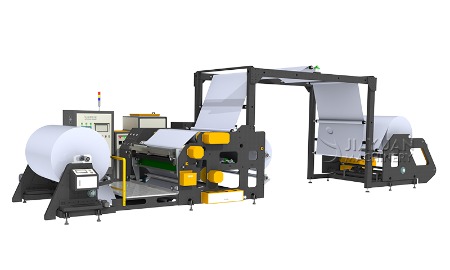
Adhesive coating machine
Coating uniformity in a
comma coater depends on the parallelism of the rolls, the stiffness of the machine frame, and the uniformity of the fluid properties. Any deflection of the rolls under load causes a thicker coating in the middle than at the edges. To counteract this, the comma roll is often crowned (slightly larger diameter in the center) or the backing roll is hydraulically loaded with a variable profile. Modern comma coaters use a "deflection compensation" system with multiple support rollers or an internal wedge mechanism to adjust the gap dynamically across the width. Online thickness gauges (beta or X-ray) provide feedback to a control system that adjusts the gap or the fluid feed locally. Additionally, the fluid temperature must be regulated because viscosity changes with temperature, affecting the coating weight. A heat exchanger or jacketed tank is typically included. The fluid should also be filtered and degassed to prevent agglomerates and bubbles, which cause streaks and pinholes.
Process optimization involves balancing speed, gap, and fluid rheology. Higher speeds require a slightly larger gap to maintain the same coat weight because of hydrodynamic lift. Conversely, for very thick coatings, the speed may be limited by the fluid's ability to wet the substrate fully. The comma roll's rotational speed is usually set to a ratio of the web speed—typically 30-70% of web speed to provide a shearing action that helps level the coating. If the comma roll is stationary (scraping mode), it can cause higher drag and wear. For abrasive fluids, the comma roll may be made of tungsten carbide or coated with diamond-like carbon. The life of the comma roll is a major cost factor; regrinding and re-chroming are standard maintenance tasks. The frequency depends on the fluid's abrasiveness; for electrode slurries with carbon black, the roll may need regrinding every 100 hours of operation. Regular inspection of the roll surface with a profilometer detects wear early.
Defects in comma coating include "streaks" (due to roll scratches or particle buildup), "orange peel" (from poor leveling), and "edge bead" (thick edges). Streaks are eliminated by cleaning the roll and ensuring proper filtration. Orange peel is reduced by lowering the viscosity or increasing the fluid's leveling time (e.g., adding a leveling agent). Edge bead can be minimized by using edge dams or by reducing the gap at the edges. Some comma coaters have a "tapered gap" adjustment where the edges are set slightly narrower than the center. Also, the substrate's tension and cleanliness are crucial; any wrinkles or dust cause coating defects. The drying oven after the comma coater must be matched to the thick coating; long ovens with multiple temperature zones are needed to avoid blistering. In summary, the comma coater is a robust, high-precision machine for thick coatings, especially in the battery and heavy-duty industrial sectors. Its simplicity and effectiveness make it a popular choice, but it demands meticulous mechanical alignment and regular maintenance to maintain its accuracy and longevity.