Comma Coater: Process Parameters, Blade Profile, and Edge Bead Control
The comma coater's blade profile is not a simple straight edge; it has a curved surface that creates a controllable pressure gradient in the fluid film. This profile is engineered to produce a uniform shear stress across the coating width, which minimizes the "barber pole" effect common in straight blade coaters. The blade is typically ground to a radius of 0.5 to 2 mm at the tip, and the angle of attack (between the blade and the backing roll) is set between 15 and 45 degrees. A smaller angle provides a gentler metering action, suitable for shear-sensitive fluids, while a larger angle gives a sharper cut, better for high-viscosity pastes. The blade is also adjustable in the cross direction to compensate for uneven fluid feed. Some advanced comma coaters have segmented blades that allow independent gap adjustment at each segment, enabling automatic profile control. The blade material is usually hardened tool steel or ceramic-coated steel to resist wear. The blade should be inspected daily for nicks or wear; a worn blade produces non-uniform coating and should be re-ground or replaced.
The gap setting is the primary control for coating weight. The relationship between gap and wet thickness is approximately linear for Newtonian fluids, but for non-Newtonian (shear-thinning) fluids, the relationship is more complex. The fluid's viscosity, shear rate, and elasticity all affect the final thickness. A practical method is to perform a "thickness calibration run" where the gap is set at several values, and the resulting dry coating weights are measured. These data points are fitted to a polynomial equation, which is then used in the control system to calculate the required gap for any target coat weight. This calibration should be repeated whenever the fluid formulation changes or when the blade is re-ground. The gap adjustment mechanism must be highly precise, with resolution of 1 µm. Motorized micrometer drives with encoder feedback are standard. The gap is set with the machine stopped, but thermal expansion during operation can change the gap by several microns; therefore, temperature sensors on the blade and backing roll are used to apply thermal compensation automatically. This is particularly important for hot-melt coatings.
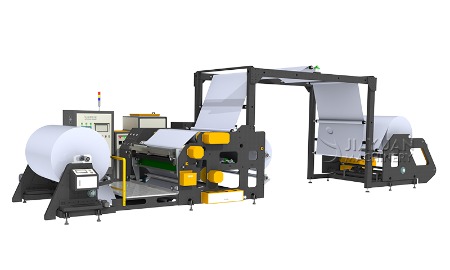
Adhesive coating machine
Edge bead is the thickening of coating at the substrate edges. In
comma coaters, it arises from surface tension pulling fluid from the center to the edges, and from the discontinuity of the gap at the edges. To control edge bead, several techniques are employed. One is to use edge dams—small barriers at the edges of the pool that confine the fluid. Another is to reduce the gap at the edges by tapering the comma roll ends (crowning with reverse taper). Some coaters use an air knife directed at the edges to blow excess fluid back into the pool. The most common industrial practice is to apply a slightly wider coating than needed and then slit the edges off after drying, but this wastes material. For high-value products, active edge bead control using a secondary blade or vacuum suction at the edges is preferred. The edge bead thickness can be measured by a laser profiler and the control system adjusts the edge gap actuators in real-time.
Fluid rheology plays a major role in comma coating. Shear-thinning fluids (e.g., battery slurries with CMC binder) exhibit lower viscosity at high shear rates near the blade, which helps leveling, but they thicken after exiting the gap, affecting the final coating structure. The fluid's yield stress (if any) determines the minimum gap achievable before the coating breaks. For non-Newtonian fluids, the coating weight is not simply gap times solids fraction; it requires a Herschel-Bulkley or power-law model to predict. Coating engineers often use rheometers to characterize the fluid and then use computational fluid dynamics (CFD) to simulate the flow in the gap. This helps in optimizing the blade angle and gap for the best uniformity. The fluid's surface tension also affects edge bead and wetting; adding surfactants can reduce edge bead but may affect adhesion. Therefore, formulation and machine settings must be co-optimized.
Maintenance of the comma blade involves regular dressing (light grinding) to restore the edge sharpness and profile. The dressing interval depends on throughput and abrasiveness; for ceramic slurries, it may be daily; for soft adhesives, weekly. The backing roll also needs periodic inspection for flatness; any indentation or buildup causes thickness variation. The fluid pool level must be controlled by a float valve or level sensor; variations of ±5 mm in pool height can change the hydrostatic pressure and affect the coating weight by 1-2%. Therefore, a PID controller is often used to maintain the level. The machine's frame rigidity is also critical; deflection under load must be within 0.01 mm/m to maintain profile. Some coaters use a bridge structure with pre-stressed beams to minimize deflection. Overall, the comma coater is a finely tunable machine. By mastering gap control, edge bead mitigation, and rheological understanding, operators can achieve exceptionally uniform thick coatings, making it a preferred choice for advanced energy storage and heavy coating applications.