Comprehensive Guide to Coating Machines for Adhesive Applications: From Laboratory to Production Scale
Coating machines for adhesive applications span a wide spectrum from benchtop laboratory units to high-volume industrial production lines. Laboratory coaters are used for formulating new adhesives, screening substrates, and optimizing drying/curing conditions. They typically operate at narrow widths (100-300 mm) and low speeds (0.1-5 m/min), with manual or semi-automatic controls. They allow researchers to test small batches (50-500 ml) and produce samples for adhesion testing or customer demonstration. Pilot coaters bridge the gap, with widths of 300-800 mm and speeds up to 50 m/min, incorporating production-level components like closed-loop tension, multi-zone ovens, and automated die adjustment. They are essential for scale-up studies, ensuring that the coating process parameters developed in lab are viable at larger scales. Production coaters are full-scale machines with web widths from 1 to 4 meters and speeds exceeding 200 m/min. They include heavy-duty frames, high-capacity pumps, large-diameter rolls, and extensive safety systems. The choice of scale depends on the development stage, available budget, and intended production volume.
A critical aspect of adhesive coating machine design is the compatibility with various adhesive classes: solvent-based, water-based, hot-melt, and radiation-curable. Each class imposes different requirements on materials of construction, heating/cooling, and environmental controls. Solvent-based adhesives require explosion-proof motors, spark-resistant components, and solvent recovery systems to handle VOC emissions. Water-based adhesives need longer drying ovens due to slower evaporation and corrosion-resistant materials like stainless steel. Hot-melt adhesives demand heated hoses, melters, and applicators with precise temperature regulation, as viscosity is highly temperature-dependent. Radiation-curable adhesives (UV/EB) need shielding and specialized curing lamps, but they allow very high-speed operation and solvent-free application. Therefore, when procuring a coating machine, one must clearly define the adhesive type(s) to be processed, as retrofitting for a different chemistry is often expensive and technically challenging.
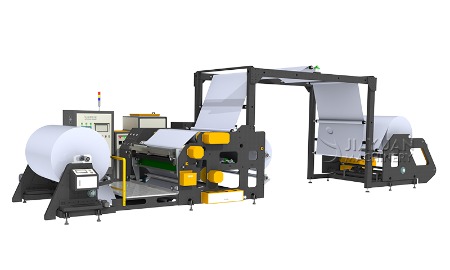
Adhesive coating machine
The substrate to be coated also heavily influences machine design. Thin films (e.g., polyester, polyimide) require low-tension handling and gentle nip pressure to avoid stretching or tearing. Foams and nonwovens are thicker and compressible, needing gap control rather than nip pressure to maintain coat weight. Paper and board are robust but absorbent; they may need primer layers before adhesive application. For each substrate, the unwinder, coater, and rewinder must be configured with appropriate core sizes, edge guides, and tension ranges. Some machines feature multiple unwinders and rewinders for continuous splicing, enabling uninterrupted production. Additionally, the coating method must be chosen to suit the substrate's surface energy and topography; for instance, high-surface-energy films like PET can accept slot-die coating, while low-energy materials like polyethylene require corona pretreatment. Machine builders often offer modular options for easy adaptation to different substrates.
Process integration is another key consideration. Coating machines for adhesive are often part of a larger converting line that includes lamination stations, slitters, and inspection systems. Lamination combines the coated adhesive with a second substrate (like a release liner) to form a finished tape or label. This requires precise alignment and nip pressure to avoid wrinkles or air bubbles. Slitting divides the wide master roll into narrower rolls of specified widths, demanding accurate shear or razor slitting with minimal dust. Inspection systems—using cameras or laser scanners—detect defects in real-time and can automatically mark or reject defective sections. All these modules must be synchronized, with common control architecture (PLC or DCS) to coordinate speeds and tensions. Downtime in any module affects the entire line, so reliability and quick-change features are paramount.
Operational training for adhesive coating machines is often underestimated but is vital for achieving optimal performance. Operators must understand fluid rheology, heat transfer, web mechanics, and basic electronics. They should be able to interpret thickness profiles, adjust parameters, and troubleshoot common issues without relying solely on engineers. Many machine suppliers provide on-site training and comprehensive manuals. Additionally, simulation software can help operators practice startup, shutdown, and emergency procedures. The learning curve is steep, but well-trained operators reduce scrap, increase safety, and extend equipment life. In today's digital age, remote support via augmented reality (AR) is emerging, where technicians can guide operators through repairs using smart glasses. Investing in training pays back quickly through improved efficiency and lower defect rates. Ultimately, a
coating machine for adhesive is not just a piece of hardware; it is a complete system that demands careful selection, integration, and human expertise to deliver high-quality adhesive products consistently.