Comprehensive Overview of Coating Equipment: Classification, Selection Criteria, and Industrial Applications
Coating equipment is the backbone of converting and manufacturing industries, enabling the deposition of functional, protective, or decorative layers onto flexible webs, rigid sheets, or three-dimensional parts. The equipment can be broadly classified into two categories: web coating machines (for continuous rolls of film, paper, foil, or textile) and piece coating machines (for discrete parts like automotive panels or electronic housings). Web coaters include roll coaters, gravure coaters, slot-die coaters, comma coaters, spray coaters, and curtain coaters. Each type employs a distinct mechanism to meter and apply the coating fluid. The choice of equipment is driven by the fluid's rheology, the required coating thickness and uniformity, the substrate's sensitivity, and the production volume. Additionally, ancillary equipment—such as unwinders, rewinders, tension control systems, ovens, and laminators—forms an integral part of the coating line. Understanding the capabilities and limitations of each equipment type is essential for process engineers to make informed investment and operational decisions.
Slot-die coating equipment has gained prominence in high-precision applications due to its pre-metered, closed-system operation that delivers exceptional thickness uniformity with minimal waste. The equipment comprises a precision-machined die body, a shim to define the slot gap, a manifold for fluid distribution, and a pump system that supplies the fluid. Slot-die coaters are versatile, handling viscosities from 1 cP to over 100,000 cP, and can apply layers from sub-micron to several hundred microns. They are widely used in battery electrode manufacturing, optical film production, and OLED display fabrication. Roll coating equipment, by contrast, is simpler and more economical, using a series of rolls to transfer fluid from a pan to the substrate. It is ideal for high-speed, low-to-moderate precision applications like adhesive tapes, paints, and primers. Gravure coating equipment employs an engraved cylinder to deposit very thin, uniform layers, making it the preferred choice for release liners, label stock, and packaging films where coat weights range from 1 to 10 gsm. Spray coating equipment uses atomization to apply coatings onto complex 3D surfaces, such as automotive interiors, medical devices, and electronic circuit boards. The selection of coating equipment must also consider the drying and curing systems, as these directly affect line speed and product quality. For solvent-based coatings, long convection ovens with solvent recovery are required; for water-based, high-humidity ovens with corrosion-resistant materials are necessary; for hot-melt, chill rolls replace ovens. Thus, the equipment package must be engineered as a cohesive system.
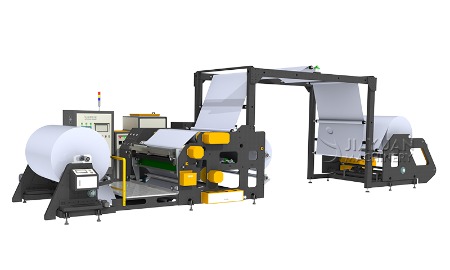
Adhesive coating machine
Key selection criteria for
coating equipment include the substrate's physical properties (thickness, width, tensile strength, surface energy), the coating fluid's rheological characteristics (viscosity, surface tension, solids content, shear sensitivity), and the product specifications (target coat weight, uniformity tolerance, defect limitations). Production speed and web width determine the required mechanical robustness and control system capabilities. For example, a high-speed line (300 m/min) with a 2-meter wide web demands stiff frames, powerful drives, and fast-response tension control. The equipment's cleanability and changeover time are crucial for plants running multiple products; quick-die-change systems and automated cleaning cycles reduce downtime. Additionally, environmental and safety regulations influence equipment design: solvent-based lines require explosion-proof components and solvent recovery units; water-based lines need corrosion-resistant materials; hot-melt lines need thermal insulation and fume extraction. The equipment's control architecture—whether PLC-based with HMI or more advanced with Industry 4.0 connectivity—affects ease of operation and data traceability. The total cost of ownership includes not only the capital cost but also energy consumption, maintenance frequency, spare parts availability, and technical support from the supplier. Running pilot trials on candidate equipment is highly recommended to validate performance and identify any hidden limitations. Ultimately, the right coating equipment balances technical capability, operational cost, and future scalability to meet both current and anticipated production demands.
Industrial applications of coating equipment span a vast array of sectors. In the packaging industry, coating equipment applies barrier layers (e.g., PVDC, EVOH) and heat-seal coatings on food packaging films. In the electronics sector, it deposits photoresists, dielectric layers, and conductive inks for flexible circuits and displays. The energy storage industry relies heavily on slot-die coating equipment for lithium-ion battery electrodes, where precise coat weight and uniformity directly impact battery capacity and safety. The medical field uses coating equipment for drug-eluting stents, transdermal patches, and hydrophilic coatings on catheters. The automotive industry applies anti-corrosion primers, sound-dampening coatings, and scratch-resistant clearcoats using spray or roll coaters. Each application requires specific equipment features: for instance, battery electrode coating needs thick paste handling, heavy-duty comma or slot-die coaters with active profile control; optical film coating demands cleanroom environments and ultra-precision slot dies with vibration isolation; and medical coating requires sanitary design and validated cleaning protocols. The trend towards sustainable materials—water-based, bio-based, and solvent-free adhesives—is pushing equipment manufacturers to design coaters with better drying efficiency, lower VOC emissions, and easier cleanup. Furthermore, the integration of inline metrology (thickness gauges, defect detectors) and closed-loop control is becoming standard, enabling real-time adjustment of coating parameters to maintain quality. The future of coating equipment lies in modularity, digitalization, and energy efficiency, allowing converters to respond rapidly to market changes while reducing environmental footprint. In summary, coating equipment is a diverse and dynamic field; proper selection, operation, and maintenance are essential for achieving high-quality, cost-effective production across countless applications.