Continuous Coating: Principles, Steady-State Operation, and Process Stability for Uninterrupted Production
Continuous coating is the process of applying a coating fluid onto a moving substrate in an uninterrupted manner, with the line operating at a constant speed and all process parameters held steady. This mode is used for high-volume production of products such as tapes, labels, packaging films, and battery electrodes. The key advantage is high productivity: a continuous line can run for days or weeks with minimal downtime, producing large quantities of coated material at a low unit cost. The steady-state operation allows the control system to maintain the coat weight, temperature, and tension within tight tolerances, ensuring consistent quality. The line is typically started up, the coating is applied, and after the initial transient (which is sent to waste), the line runs continuously until the run is complete. The main challenges are maintaining the stability of the fluid properties (viscosity, solids content) over time, preventing the accumulation of dried residue on the coating head, and managing the roll changes (splices) without stopping the line. In summary, continuous coating is the most efficient way to produce large volumes of coated products.
Steady-state operation requires that all critical parameters remain constant. The fluid viscosity must be stable; this is achieved by temperature control of the supply tank and the coating head, and by using a recirculation system that prevents evaporation and sedimentation. The fluid's solids content must be monitored and adjusted if necessary; an inline densitometer or refractometer can provide real-time feedback. The line speed must be precisely regulated; a high-performance drive system with a master speed reference ensures that the speed is constant. The web tension must be stable; the tension control system must compensate for the changing roll diameters during unwinding and rewinding. The oven temperature and airflow must be uniform; the control system should use zone temperature sensors and pressure transducers. The coating head's gap or pressure must be maintained; the shim or the die bolts should not shift. Any drift in these parameters will cause a drift in the coat weight or the coating quality. The operator should monitor the control charts and make minor adjustments as needed. In summary, steady-state operation is the result of a well-designed and well-maintained control system.
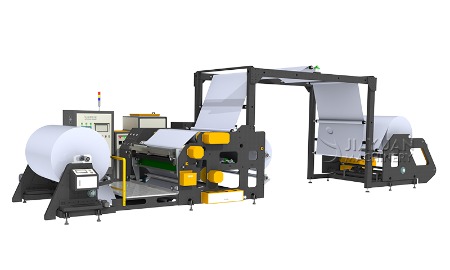
Adhesive coating machine
Process stability in
continuous coating is achieved through a combination of robust equipment design, effective control, and vigilant operator monitoring. The equipment should be designed with thermal stability (e.g., water-cooled jackets for the die) and mechanical rigidity to resist vibrations. The control system should use advanced algorithms, such as adaptive control, that adjust the PID gains based on the process dynamics. The operator should follow a standard operating procedure (SOP) for startup, steady-state, and shutdown. The operator should also perform regular checks: verify the fluid's viscosity with a hand-held viscometer, inspect the coating bead with a microscope, and measure the coat weight with a lab gauge. The data from the online gauges should be plotted on SPC charts; any trend that approaches the control limits should trigger an investigation. The maintenance team should perform scheduled cleaning of the coating head and the filters to prevent gradual buildup. In summary, process stability is a shared responsibility of the equipment, the control system, and the people.
The economic benefits of continuous coating are substantial. The startup waste is only a small fraction of the total output; once the line is stable, the scrap rate is low. The high utilization of the equipment (high uptime) reduces the depreciation cost per unit. The consistent quality leads to fewer customer complaints and returns. The continuous operation allows the manufacturer to build inventory efficiently and to meet large orders with short lead times. The energy consumption per unit is lower because the oven and the line are kept at operating temperature continuously, avoiding the thermal cycling losses of batch operation. The labor cost per unit is also lower because the line requires fewer operators per unit of output. In summary, continuous coating is the most cost-effective mode for high-volume, standardized products.
However, continuous coating has limitations. It is not suitable for short runs or for products that require frequent product changes, as the changeover time (cleaning the coating head, flushing the lines, changing the shim) can be significant. The line's long run length requires large substrate rolls; handling and storing large rolls can be challenging. The accumulation of dried residue on the coating head over a long run may eventually cause defects; the run length must be limited to prevent this. The buyer should balance the benefits of continuous coating with the flexibility needed for their product mix. In conclusion, continuous coating is the workhorse of the converting industry, offering unmatched productivity and quality when the production volume is high and the product is stable. By investing in robust equipment, advanced control, and skilled operators, manufacturers can achieve long, uninterrupted runs with consistent quality, maximizing profitability.